Monday, March 26, 2007
The Daily Hump: Burgle
 I was watching the highly underrated 1966 spy flick Funeral in Berlin last night. Harry Palmer, played by Michael Caine, and Israeli secret agent Samantha Steel enter her apartment to find that it's been ransacked*. Harry's exact words are "You've been burgled."
 Burgled is a back-formation of burglar; etymologically speaking a back-formation is created when you remove all the bits and pieces (affixes) of an earlier word to derive, falsely, an "orginal" form. Burglar was from Medieval Latin via Old French. The Latin verb burgare, meaning "to break open, commit burglary" comes from the Latin burgus meaning "fortress, castle" (which is a Germanic loan-word similar akin to borough, bourgeois, etc...). While burglar appeared in English (via Middle English) as early as the 1540s burgled didn't show up until the late 19th c.
*Ransacked is from the Old Norse rannsaka, meaning "to pillage" and literally comes from "to search the house". The second element saka, "to search", is related to the Old Norse soekja, which is the root of our word seek.
burglar [Online Etymology Dictionary]
ransack [Online Etymology Dictionary]
burgle [OED]
back-formation [Wikipedia]
Funeral in Berlin [IMDB]
Labels: Latin, Medieval Latin, Old French, Old Norse, The Daily Hump

Friday, March 09, 2007
The Daily Hump: Varnish
 When not huffing varnish I'm humping it. Varnish comes from an Old French word of the same meaning, vernis. In Medieval Latin vernix meant an "odorous resin" and this is likely from the late Greek verenike, which is from the Macedonian Greek Berenike (literally "bringer of victory"). Berenike was an ancient city in Libya (now known as Benghazi) named for Berenike II, queen of Egypt, who lived during the 3rd c. CE and was murdered by her son Ptolemy IV. The story goes that Berenike (the city) was one of the first to experiment with the wide usage of varnishes.
varnish [Online Etymology Dictionary]
Berenice [Online Etymology Dictionary]
Berenice II [Wikipedia]
Benghazi [Wikipedia]
Labels: Greek, Medieval Latin, Old French, The Daily Hump
Thursday, March 01, 2007
Hump This: Squirrel
 Hump This is a (quasi-)weekly Friday feature where you, the WordHumper reader, choose which lucky word gets humped back to the stoneage (or at least to Proto-Indo-Europa). Today's request comes from RM in California who writes:
 Dear Wordhumper,RM, thanks for the question--our word squirrel comes to us via the Anglo-Norman esquirel circa 1327. Is it a coincidence that the word appears a mere twenty years before the black death ravaged Europe and just one decade before the launch of the Hundred Years' War? I don't think so. That being said, the squirrel made it into Old French (escurel) via the Latin sciurus, which came from the Greek skiouros, literally meaning "shadow-tailed." The notion is squirrels have large bushy tails which allow them to easily shade themselves. Fascinating.
Like so many in my close knit family, I have an affinity for rodents and in particular, squirrels. Once, I saw a show on some cable channel I no longer get that said the word 'squirrel' comes from a greek word meaning something along the lines of, 'covers head with his tail for shade'. I could be totally wrong because this was awhile ago. So, where does the word 'squirrel' come from?
 If you have a word you'd like humped please email it along with your city or state to wordhumper@gmail.com. To paraphrase Q-Tip of A Tribe Called Quest, the ladies sweat my Wordhump style like the squirrels sweat the nuts.
squirrel [Online Etymology Dictionary]
Labels: Anglo-Norman, Greek, Hump This, Latin, Old French
Tuesday, February 27, 2007
The Daily Hump: Of Kilts, Tartans and Tartars*
 Kilt first makes an appearance in the English language as a type of tartaned skirt in the early 18th c. Our noun actually came from a now little-used verb form meaning "to tuck up." This word came to us via the Middle English kilten, meaning "to tuck up" (is "to tuck up" a Britishism for "to tuck in"? Anyone? Bueller?) Going back further kilt seems to be from a Scandinavian source as witnessed by the Old Norse kilting and kjalta meaning skirt or lap.
The word tartan likely comes to us via the Middle French tiretaine which referred to a "strong, coarse fabric." This can be traced back to Old French and then to the Medieval Latin tyrius meaning "cloth from Tyre." It's also possible the word was influenced by the Middle English tartaryn, also a type of cloth, which comes from Old French but is ultimately rooted in the word Tartar.
And speaking of Tartars, the tartar on your teeth is from the Greek tartaron which referred to the gunk settled to the side of casks. The Greek term is believed to be of Arabic origin unlike the proper noun Tartar which is said to be from Tata, a name the Mongols gave themselves, with some spicy influence from the Latin Tartarus, aka hell.
kilt [OED]
kilt [Online Etymology Dictionary]
tartar [OED]
Tartar [OED]
tartan [OED]
tartan [AHD]
Tartar [Online Etymology Dictionary]
*The Daily Hump is not really daily anymore--it'll now only be published on Tuesdays and Thursdays, so it really should be The Semiweekly Hump, but that name is dumb and plus I'd have to eat those rebranding costs, etc...thus, The Daily Hump it is. That being said, daily or not, there is still a new WordHumper post every weekday and thus you always have a good reason to come back now, y'hear?
Labels: Greek, Medieval Latin, Middle English, Middle French, Old French, Old Norse, The Daily Hump
Friday, February 23, 2007
The Daily Hump: Pate
You loyal WordHumper readers will likely remember that we've seen pantina before, in regards to the knee; patina is the root for the kneecap's scientific name patella.
pate (1) [Online Etymology Dictionary]
Labels: Latin, Medieval Latin, Old French, The Daily Hump
Friday, February 09, 2007
The Daily Hump: Venison
 Venison, too, comes from Latin, but does not follow the beef/pork pattern because venison's root had nothing to do with deer. Rather, venison is from the past participle of the Latin verb venari, meaning to hunt or pursue. When English first took the word from the Old French back at the end of the 13th c., venison actual referred to the flesh of any animal killed in a hunt. It's only in later centuries that the definition became restricted to deer meat.
The Latin venari is likely from the Proto-Indo-European base *wen-, which has been translated as "to strive after, wish, desire, be satisfied." This also happens to form the base for that goddess on a mountain top burning like a silver flame, on the summit of beauty and love; I believe Venus was her name.
Shocking Blue [Wikipedia]
venison [Online Etymology Dictionary]
Venus [Online Etymology Dictionary]
venison [AHD]
venison [OED]
Labels: Latin, Old French, PIE, The Daily Hump
Wednesday, February 07, 2007
The Daily Hump: Arctic
I've travelled beyond the Arctic Circle; it's an incredible place and I highly recommend it. Unfortunately, I didn't see any polar bears and that's a real etymological disappointment. See, Arctic comes from Latin arcticus, which comes from the Greek arktikos, meaning "of the bear." Bears? Yes. The Greeks were referring to the constellation Ursa Major which sits in the north. The Greek arktikos recalls the Proto-Indo-European root *rtko, which we also come upon in the Welsh word for bear, arth; this is a probable source for the name Arthur.
 Interestingly, in Middle English the word was not Arctic, but rather Artic. This is because in Medieval Latin that first c sound ceased to be pronounced so the Old French, the source of the Middle English, dropped the letter completely. The c was restored in 1601 after the word was refashioned to adhere to the original Latin spelling.
Not surprisingly Antarctic comes from anti + Arctic; that is, "the opposite of the Arctic." And no, despite my graphic there are no polar bears in the southern hemisphere...I was simply trying to draw a connection between the word Arctic and bears. Nevermind. My genius is wasted on you.
arctic [AHD]
Arctic [Online Etymology Dictionary]
Antarctic [Online Etymology Dictionary]
Arctic [OED]
Arthur [Behind the Name]
Ursa Major [Wikipedia]
Labels: Greek, Latin, Medieval Latin, Middle English, Old French, PIE, The Daily Hump, Welsh Gaelic
Wednesday, January 31, 2007
The Daily Hump: Caterpillar
 It's not so much I have a fear of caterpillars as much as they simply give me the willies. And I'm an animal person--I don't mind snakes, I like mice and rats, even most insects don't bother me. No, caterpillars (and millipedes and centipedes) hold a special place in my gut. I'm so acutely aware of caterpillars that I'm convinced I can smell their presence; I know this from the series of unscientific experiments I ran while mowing the lawn. I'd get a whiff of larva and shawnuff on a nearby plant would be a thick nasty green tomato caterpillar. Or above my head a colony of tent caterpillars would be weaving their hellish web of arboreal misery. And there, on the driveway, was a woolly bear caterpillar, least offensive of the lot simply because it had the misfortune of being run over by the car. My keen sense of smell protects me from these monsters.
 Caterpillar ultimately comes to us from the Old French chatepelose, which literally translates to "hairy cat." You may remember cat from a previous hump but the second element is from the Latin pilosus, meaning "hair." The Italian surname Pelosi comes from this same Latin root. Has the House of Representatives been taken over by a caterpillar masquerading as a San Francisco liberal? Given the facts it seems plausible.
 Judge caterpillars for yourself, but remember this;
 Our word caterpillar is first recorded in English in 1440 in the form catyrpel. Catyr, the first part of catyrpel, may indicate the existence of an English word *cater, meaning "tomcat," otherwise attested only in caterwaul. Cater would be cognate with Middle High German kater and Dutch kater. The latter part of catyrpel seems to have become associated with the word piller, "plunderer"...[from AHD: emphasis mine]See? Even our modern day spelling hints to the caterpillar's intrinsic malevolence. Madame Speaker (if that is your real name), I rest my case.
caterpillar [AHD]
caterpillar [Online Etymology Dictionary]
caterpillar [OED]
caterpillar [Wikipedia]
Italian surnames [Italy World Club]
Labels: Dutch, Latin, Middle High German, Old French, The Daily Hump
Tuesday, January 30, 2007
The Daily Hump: Sibyl Disobedience
My name is Humpty, pronounced with a Umpty.
Yo ladies, oh how I like to hump thee.
 A Sibyl (note the capital S) is a member of a group of women who the Greeks and Romans regarded as having powers of divination and prophecy. In common noun form the word has come to mean a witch or, as used in the quote below from Network, a fortune-teller. Our word sibyl comes to us from the Greek Sibulla by way of Latin (Sibylla), Old French and Middle English (sibile). The word's origin is not fully understood but it is thought to come from the Doric Siobolla and from Attic Theoboule, meaning "divine wish."
Diana: Did you know there are a number of psychics working as licensed brokers on Wall Street? Some of them counsel their clients by use of Tarot cards. They're all pretty successful, even in a bear market and selling short. I met one of them a couple of weeks ago and thought of doing a show around her -- The Wayward Witch of Wall Street, something like that...Her name, aptly enough, is Sibyl. Sybil the Soothsayer.sibyl [AHD]
sibyl [Online Etymology Dictionary]
Sibyl [OED]
Cybill Shepherd [IMDB]
Labels: Attic, Doric, Greek, Latin, Middle English, Old French, The Daily Hump
Thursday, December 14, 2006
The Daily Hump: Ramparts
Seriously, I love ramparts and I look forward to this humptastic challenge. But first, before we start, I went to check out the complete lyrics to "The Star-Spangled Banner" which is the only song I can think of that ever used the word ramparts. So, I go to Wikipedia and here's what I find:
 (I've taken a screenshot in case some killjoy has gone ahead and changed the entry. You've got to love Wiki technology.)
 Anyway, rampart is from the Old French verb remparer meaning "to fortify". English had a similar verb, now considered archaic, rampire, meaning "to strengthen". Thus, one could conceivably rampire the vampire with ramparts. Incidentally, vampire has nothing to do with rampire. Vampire is said to be from the Kazan Tartar word ubyr, "witch."
But I digress: remparer is from re + emparer, re obviously meaning "again" and emparer meaning "to fortify or take possession of". This verb, in turn, can be traced back through Old Provençal to the Vulgar Latin anteparare meaning "to make preparations beforehand" (ante + parare). The Latin parare is where we get our verb prepare, obvi.
rampart [OED]
rampire [OED]
rampart [Online Etymology Dictionary]
mutton recipes [About]
vampire [Online Etymology Dictionary]
Labels: Kazan Tartar, Latin, Old French, Old Provençal, The Daily Hump
Monday, December 11, 2006
The Daily Hump: Boulevard
The French most likely didn't invent the word boulevard on purpose. Just as there are hundreds of French words we English-speakers regularly mangle beyond comprehension, the French aren't always so great at enunciating foreign words either. Boulevard is a prime example; it's likely the result of the Old French's garbled attempt to adopt the Middle Dutch bolwerc (literally: plank + work), which successfully survived the transformation into English as bulwark. In Modern English a bulwark is the wall of a fortification, but the Old French bollevart likely referred to the flat promenade which ran along the top of a demolished city wall.
Tomorrow: Were ramparts really constructed from parts of rams?
Hint: No.
Boulevard [OED]
Bulwark [AHD]
Boulevard [Online Etymology Dictionary]
Labels: Middle Dutch, Old French, The Daily Hump
Friday, December 08, 2006
Hump This: Governor/Gubernatorial
I would like you to explore governor/gubernatorial. I see how the words are related.. sort of. B's and V's are related and vowels have drifted but why? What happened?
 In order to understand the differences in spelling let's start by looking at govern.
Govern enters the English language at the end of the 13th c. via Old French. The French, in turn, had gotten the word from the Latin gubernare, which originally had the meaning "to steer (a ship)". The Latin word comes from the Greek kybernan, also meaning "to steer or pilot", and which, incidentally happens to be the root of our word cybernetics. Now you understand why cyborgs run the government.
Gubernatorial is a chiefly American word that first appeared in 1734 in reference to "The [New Jersey] Governor in his gubernatorial Capacity". Apparently the colonial Americans assumed the Latin verb gubernare must have had an associated adjective construction, gubernatorius, despite lacking evidence of this form.
So, gubernatorial was contrived directly from the Latin versus governor which found its form via the normal transformations common to centuries of usage.
If you have a word you'd like humped please email it, along with your location, to wordhumper.
Gubernatorial [OED]
Govern [OED]
Gubernatorial [Online Etymology Dictionary]
Labels: Greek, Hump This, Latin, Old French
Tuesday, November 28, 2006
The Daily Hump: Mulberries
 Most children first encounter the concept of a mulberry bush at a very early age. It's the place where monkeys chase weasels while dogs laugh in amusement until suddenly, rather inexplicably, the weasel "pops". (The cryptic nursery rhyme, which date back to 17th c England, apparently confounds many people.) The "mulberry bush" is actually not a bush at all, but rather a tree native to the warmer climates of Asia, Africa and North America. It's also economically valuable as the leaves are the sole food source for silkworms.
The word mulberry can obviously be broken in to two components. Analyzing the second element first, -berry comes from the Germanic languages, thus we find berie in Old English. This, in turn, is believe to come from the Old Teutonic *basjôn-, *bazjôn-. As the OED notes
The ulterior history is uncertain: *bazjo- has been conjecturally referred to *bazo-z [meaning "bare"] (q.v.), as if a bare or uncovered fruit, also to the root represented by [Sanskrit] bhas-, [meaning] "to eat".To understand the first element, mul-, it's best if we look at the mulberrie's genus, Morus, which comes from the Latin word for the mulberry, morum. The plural of the Latin morum is mora, and in post-classical Latin (4th c.) this form became the feminine singular. By the 12th c. mora became more became moure and then the Old French mur. Finally, mur became mul and mulberry makes its first recognizable appearance in English in Wycliffe's Bible of 1382 ("cedres as longe mulberies").
If you're curious about that mur to mul transformation, R and L are very similar phonetically (both are alveolar consonants) and it's not surprising that one would transform into the other. To give you an idea of the letters' similarities
...in Korean, there is a phoneme /r/ that is a flapped r between vowels, and is an l-sound in other phonetic contexts. These sounds are very different to an English speaker, who is attuned to hearing them because the differences are meaningful in English. However, the native Korean speaker has learned from an early age to consider the two sounds the same. Thus, Korean speakers do not differentiate the two words "ram" and "lamb", despite the fact that both R and L sounds occur in the language.Phonemes [Wikipedia]
Labels: Korean, Latin, Old English, Old French, Proto-Germanic, Sanskrit, The Daily Hump
Wednesday, November 22, 2006
The Daily Hump: A Humorous Perversion
 Today's hump is neither humorous nor perverse. You've been had. This morning we're looking at gallivant, which the OED describes as a "humorous perversion" (ah!) of gallant (noting that gallivant is generally used in its present participle form gallivanting). Gallant isn't just a ugly old-folks car. Back in the early 19th c., around the same time gallivant first appeared in print (1823), gallant was being used to mean "to gad about idly". Interestingly the OED defines gallivant as "To gad about in a showy fashion, esp. with persons of the other sex." What's with gad?
Gad (in verb form) is of obscure origin. Although it's possible the word comes from the same root as the noun form (i.e. gadfly, where the sense of gad refers to a goad used for prodding cattle), the OED notes that its usage quotes don't support this thesis. Rather, they theorize that gad is "a back-formation" of gadling, which during the 16th c. meant a wayfarer or vagabond. The original sense of gadling, as it was used in Beowulf ("His gædelinges guðgewædu"), meant "companion" or "fellow" and it comes from the Old English root gæd meaning "fellowship". Incidentally, this is the same root which gives us our modern verb to gather.
The verb gallant is from the adjective form and is of French origin. The OED notes
The early senses of the adj. in Fr. are: ‘dashing, spirited, bold’ (obsolete in Fr., but the source of the prevailing sense in mod.Eng.); ‘gay in appearance, handsome, gaily attired’; and ‘fitted for the pleasures of society, attractive in manners, courteous, polished’. The last of these gave rise in mod.Fr. to the specialized senses ‘politely attentive to women’, and ‘amorous, amatory’, which were adopted into Eng. in the 17th c., and are usually distinguished by the accentuation ga'llant.The Old French root, galant, is from the past participle form of the Old French verb galer, meaning "to make merry". Via a Spanish lineage this is where Modern English gets its word gala.
WordHumper returns on Monday. Gobble gobble.
Labels: French, Old English, Old French, Spanish, The Daily Hump
Monday, November 20, 2006
The Daily Hump: Farce
Something as ridiculous as a theatrical farce; a proceeding that is ludicrously futile or insincere; a hollow pretence, a mockery.The word originally comes to us from the Latin farcīre, meaning "to stuff". In the 13th c. the latinized farsa, farsia was used in both English and French to refer to words and phrases used to "pad out" interludes or interpolations in liturgical texts. Shortly thereafter, the Old French farce evolved to mean "interludes of impromptu buffoonery" which were ad-libbed by actors in religious dramas. The transition to the modern sense is thus obvious.
And just in time for Thanksgiving, there still exists a verb form which retains the original Latin sense and means "to stuff", as for roasting. The noun farce can also means "stuffing". And you may have heard the word forcemeat, which is finely ground, spiced meat that is generally used as stuffing. The first element, force-, comes from the same Latin root as farce.
Labels: Latin, Old French, The Daily Hump
Thursday, November 16, 2006
The Daily Hump: Dandelion
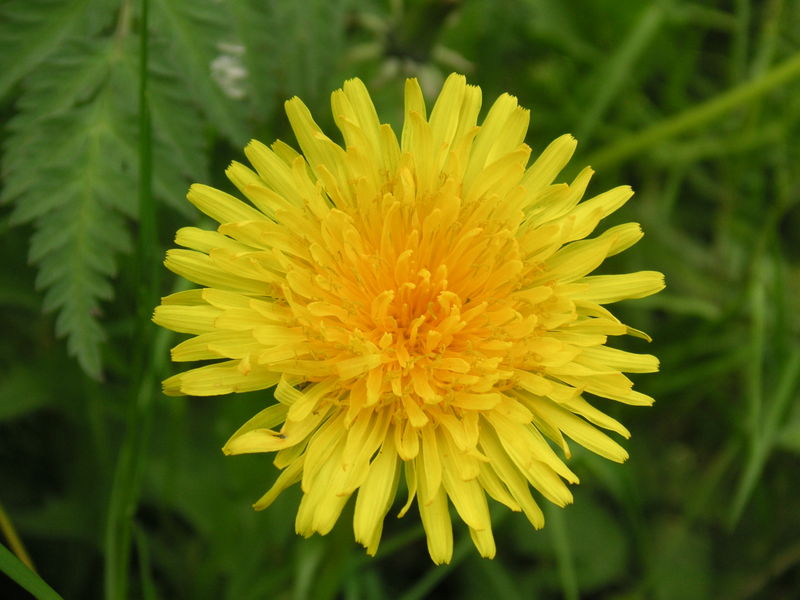 I owned an album when I was very young, "Dandelions Never Roar"; even to a 3-year-old the title's pun was plainly obvious. But it wasn't until 25 years later that I wondered whether this common flower really had a feline namesake or whether the similarities in name were purely coincidental.
I'm now able to report that this is not a coincidence. Speakers of Middle English called the dandelion dent-de-lioun. From here it's pretty easy to see the Old French (dent-de-lion) influence and translate the root; "tooth of lion". This description of course refers to the flower's sharply indented leaves. As the AHD reports,
The English spelling reflects the pronunciation of the Old French word at the time it was borrowed into English. The t in dentdelion probably disappeared early in Old French, having been absorbed into the related sound of the d. The earliest recorded instance of the word occurs in an herbal written in 1373, but we find an instance of dandelion used in a proper name (Willelmus Dawndelyon) in a document dated 1363.
 It's interesting to note that in Modern French the name for the flower has absolutely nothing to do with lions or teeth; the word is pissenlit, which amusingly translates to "urinate in bed". As Wikipedia states this likely refers to the flower's well-known diuretic properties. The dandelion's herbal properties are also what gives it its genus, Taraxacum. Botanical.com says that
 Taraxacum...is derived from the Greek taraxos (disorder), and akos (remedy), on account of the curative action of the plant. A possible alternative derivation of Taraxacum is suggested in The Treasury of Botany:In any event, next time you travel to Paris, drink too much wine and piss your sheets, just claim it was the dandelion.The generic name is possibly derived from the Greek taraxo ("I have excited" or "caused") and achos (pain), in allusion to the medicinal effects of the plant.
Labels: Middle English, Old French, The Daily Hump
Monday, November 13, 2006
The Daily Hump: Scrimshaw
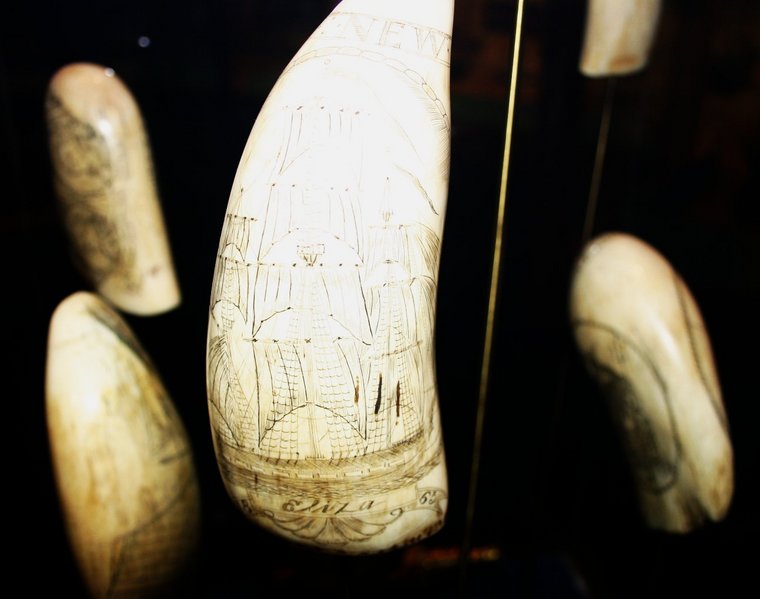 Scrimshaw is a type of art practiced by sailors to pass the time during long voyages at sea. It's the art of carving intricate designs onto whale bones, whale ivories, seashells, etc... using walrus tusks, whale teeth or anything else sailors can find. Michael Quinion reports
 The origin of the word is almost totally mysterious; it was first recorded about 1825, but its spelling in the first half of the nineteenth century was variable, with forms such as scrimshonting, scrimshonging, scrimshandy, scrimshanking and skrimshander all appearing at various times. There’s some suggestion that our modern spelling was influenced by the proper name Scrimshaw, but nobody seems to know quite why. Since a person who did this on board ship wasn’t working, it may be that the British English scrimshank, to shirk one’s duty, came from the same source.According to the Online Etymology Dictionary the English surname Scrimshaw is attested to as far back as 1154 and comes from the Old French escremisseor, "fencing-master" (that's fencing as in swords, not chain-links). In the OED we find the early 17th c. word scrimer, defined as "fencer", which is a variation of escrimer, or "swordsman". The modern sports term scrimmage come from this French root, as does skirmish.
Here's my theory: When one scrimshaws they're carving with a sharp point. Is it then possible that scrim- reflects the tool of the scrimshaw artisan--that sword-like tip of the walrus tooth that's used to create the intricate designs? -shaw is a bit more difficult to understand, but given that scrimshaw went through so many variations (see Michael Quinion's quote above) where only the scrim- portion remained constant then it appears that -shaw is not critical to the meaning of scrimshaw. Rather, it could be that the -shaw ending was ultimately employed simply because Scrimshaw is an English surname in relatively common usage; that is, scrimshaw came to mean carving with a sharp point (the scrim) via some sort of slang process (similar to the slang substitutions we see in Cockney rhyming slang, where the substituting word has no literal relationship to the original word it's replacing.). Just an idea...
Labels: Old French, The Daily Hump
Thursday, November 02, 2006
The Daily Hump: Bugibu who?
 When people think bugaboo they generally think baby strollers and carriages. Well, I'm here to change that.
As quoted from Weird Wide Words in Tuesday's post, bugaboo has a Welsh root, bwg, meaning "ghost". The -boo appendage is simply an interjection meant to add to the word's scare-factor. Although funny-sounding, there's nothing amusing about bugaboos; they're objects of anxiety (albeit exaggerated), or recurring or persistent problems. Bugaboo first appears in the English language around 1740. The Online Etymology Dictionary reports that bugaboo was
...connected by Chapman [got me] with Bugibu, demon in the Old French poem "Aliscans" from 1141, which is perhaps of Celtic origin (cf. Cornish bucca-boo, from bucca "bogle, goblin").Per the OED, the specific line from "Aliscans" reads:
Et puis d' infer iras o Bugibu, Aveuc ton Dieu Mahom[et] et Cahu.I was curious how Muhammad got mixed-up in this so I did some research. "Aliscans" is an example of chansons de geste, early French epic poetry, which generally tell stories about the Arab invasion of the south of France. Why would a French author sic a (potenially) Celtic demon on the Saracens? My guess is Bugibu hails from Brittany and his name is of Breton origin**--that'd still place him about 600 miles from Arles (Aliscans' location), but it's a helluva lot closer than Wales or Cornwall.
And then from Hell will come, o Bugibu, with your God Muhammad and Cain*.
[translation mine]
Given the name's demonic association, it seems odd that a company would call itself Bugaboo to market infant transportation devices. Then again, the company is Dutch so who knows what they're smoking.
*According to some Cahu was a pagan god, reinterpreted as the devil [See Old French Online]
**Or possibly Bugibu is a holdover of the Celtiberian language which was spoken in central Spain and is presumed extinct by the 4th c. AD.
Bugaboo [American Heritage Dictionary]
Old French Online [U of Texas]
La Geste de Garin de Monglane [Wikipedia]
Labels: Breton, Celtiberian, Cornish, Old French, The Daily Hump, Welsh Gaelic
Friday, October 20, 2006
The Daily Hump: Mushrooms and Toadstools
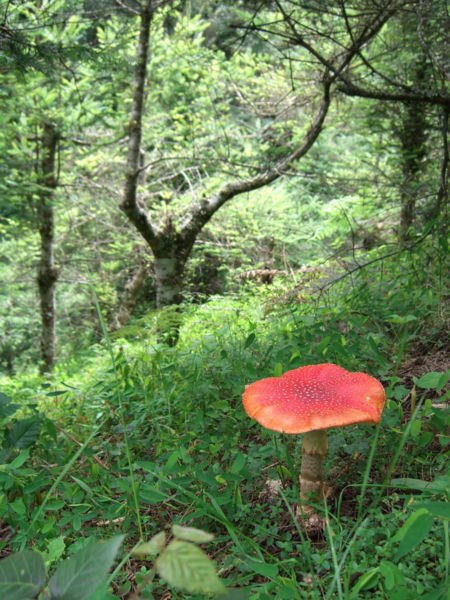 There's so much to say about mushrooms and toadstools from a historical and cultural perspective that I wouldn't know where to begin nor is WordHumper the forum to explore the intricacies of my favorite fungi. The best I can do is suggest you read Elio Schaecter's excellent In The Company of Mushrooms*. As for me, I'll be limiting this discourse to purely an etymological examination.
Mushroom comes to us from the Medieval Latin musariō, musariōn- via Old French, Anglo-Norman then finally Middle English. Per the Online Etymology Dictionary:
Barnhart says [mushroom is] "of uncertain origin." Klein calls it "a word of pre-Latin origin, used in the North of France;" OED says it usually is held to be a derivative of Fr. mousse "moss," and Weekley agrees, saying it is properly "applied to variety which grows in moss."Don't worry, I don't know who Banhart, Klein or Weekley are either.
Toadstool is one of my favorite words in the English language. The OED and many other dictionaries explain the word as "fanciful"; a compound of toad + stool that was first coined in Middle English. Toads were regarded as extremely poisonous and toadstools generally only refer to inedible or poisonous mushrooms. In my readings I also happened upon an alternate etmology which suggests that toadstool had nothing to do with toads but rather the German tod, death. As Wikipedia states:

The term [toadstool] dates from the fourteenth century and is a fanciful [there is that word again!] name combining toad, which were associated with poison, and stool, which is an archaic term for the head of a mushroom. Another explanation comes from the German translation of tod-stuhl, literally, "death-chair," referring to the shape of the fruiting body and also to the slow, agonizing death from mushroom poisoning for those who eat it.Regardless of which etymology is correct, toadstools are named for their toxicity. Given the association of toads with poison I investigated whether the English toad could be related to the German tod; alas, the OED claims that although toad can be traced as far back as to the Old English tādige it has no cognates in other languages and is thus considered of unknown origin.**
In conclusion, next time you're shrooming with the hippies, smelling a stinky phallus, hanging out with the hobbits, Smurfs, mycologists, or Brothers Mario, or just eating a slice of pizza stop and think about what a lousy and boring world we'd live in without the ubiquitous mushroom.***
*Completely unrelated, I also suggest you read Spy: The Funny Years.
 **It should be noted that Princess Toadstool is the best character available in Super Mario Bros 2 (photo: SMB1). Obviously, I'm not the only person who wondered why Mario would be romantically involved with someone whose last name is based upon a fungus responsible for "slow, agonizing death"; in late 1996 Nintendo changed her name to Peach. So gay.
***I'll be out of the country for a few days so the next hump will be on Wednesday.
Labels: Anglo-Norman, German, Medieval Latin, Middle English, Old English, Old French, The Daily Hump
Friday, September 29, 2006
TRJ: Cuckoo for Cuckold Puffs
Today's special in the history of WordHumper because we're inaugurating "Total Request Jive" or "TRJ" for short. This will be a weekly Friday feature where you the WordHumper reader decide which lucky word gets humped back to the stoneage (or at least to Proto-Indo-Europa). And today's word comes to us from CH in Brooklyn who IMs:
CH: i want you to hump "cuckold"
CH: i bet it's dirty
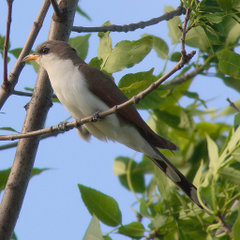 I accept your challenge, CH! Cuckold goes back to the Old French word for the cuckoo bird. Because it's Friday and I'm lazy and the research has already been done let's go right to the blockquote from American Heritage.
 The female of some Old World cuckoos lays its eggs in the nests of other birds, leaving them to be cared for by the resident nesters. This parasitic tendency has given the female bird a figurative reputation for unfaithfulness as well. Hence in Old French we find the word cucuault, composed of cocu, “cuckoo, cuckold,” and the pejorative suffix –ald and used to designate a husband whose wife has wandered afield like the female cuckoo. An earlier assumed form of the Old French word was borrowed into Middle English by way of Anglo-Norman. Middle English cokewold, the ancestor of Modern English cuckold, is first recorded in a work written around 1250.The OED adds that in German cuckold
...applied to the adulterer as well as the husband of the adulteress, and Littré cites an assertion of the same double use in French; in English, where cuckold has never been the name of the bird, we do not find it applied to the adulterer.You may have heard that cuckolds are sometimes "wearing the horns"--if you're into egregious acts of humiliation you'll be happy to learn that this refers to an apocryphal tradition that claims in some European villages when a wife gives birth to a child recognizably not his own a parade is held "...in which the hapless husband is forced to wear antlers on his head as a symbol of his wife’s infidelity". Ouch.
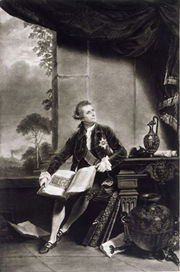 It should be noted that although cuckold does have a rather negative connotation not all men who suffered this fate were necessarily unhappy. In fact a wittol is a man who doesn't mind that his wife is servicing the neighborhood. This comes from the Middle English wetewold, which is composed of the verb weten (to know), and (coke)wold, which, as we saw above means cuckold. The most famous of wittols is likely Sir William Hamilton (left) whose wife Emma became the lover of Horatio Nelson.
On a side note, the Middle English weten is also responsible for our Modern English word wit. And in case you're wondering how cuckoo came to mean a foolish or crazy person, I'm sorry to say sources are vague at best. The OED simply notes that a person is called cuckoo in reference to the "bird's monotonous call."
wittol [American Heritage]
wit [American Heritage]
wittol [OED]
cuckold [OED]
cuckoo [OED]
cuckold [Wikipedia]
cuckoo [Wikipedia]
William Hamilton [Wikipedia]
Labels: Anglo-Norman, Middle English, Old French, TRJ
