Thursday, December 14, 2006
The Daily Hump: Ramparts
Are you happy? I'm finally humping ramparts!
Seriously, I love ramparts and I look forward to this humptastic challenge. But first, before we start, I went to check out the complete lyrics to "The Star-Spangled Banner" which is the only song I can think of that ever used the word ramparts. So, I go to Wikipedia and here's what I find:
 (I've taken a screenshot in case some killjoy has gone ahead and changed the entry. You've got to love Wiki technology.)
 Anyway, rampart is from the Old French verb remparer meaning "to fortify". English had a similar verb, now considered archaic, rampire, meaning "to strengthen". Thus, one could conceivably rampire the vampire with ramparts. Incidentally, vampire has nothing to do with rampire. Vampire is said to be from the Kazan Tartar word ubyr, "witch."
But I digress: remparer is from re + emparer, re obviously meaning "again" and emparer meaning "to fortify or take possession of". This verb, in turn, can be traced back through Old Provençal to the Vulgar Latin anteparare meaning "to make preparations beforehand" (ante + parare). The Latin parare is where we get our verb prepare, obvi.
rampart [OED]
rampire [OED]
rampart [Online Etymology Dictionary]
mutton recipes [About]
vampire [Online Etymology Dictionary]
Seriously, I love ramparts and I look forward to this humptastic challenge. But first, before we start, I went to check out the complete lyrics to "The Star-Spangled Banner" which is the only song I can think of that ever used the word ramparts. So, I go to Wikipedia and here's what I find:
 (I've taken a screenshot in case some killjoy has gone ahead and changed the entry. You've got to love Wiki technology.)
 Anyway, rampart is from the Old French verb remparer meaning "to fortify". English had a similar verb, now considered archaic, rampire, meaning "to strengthen". Thus, one could conceivably rampire the vampire with ramparts. Incidentally, vampire has nothing to do with rampire. Vampire is said to be from the Kazan Tartar word ubyr, "witch."
But I digress: remparer is from re + emparer, re obviously meaning "again" and emparer meaning "to fortify or take possession of". This verb, in turn, can be traced back through Old Provençal to the Vulgar Latin anteparare meaning "to make preparations beforehand" (ante + parare). The Latin parare is where we get our verb prepare, obvi.
rampart [OED]
rampire [OED]
rampart [Online Etymology Dictionary]
mutton recipes [About]
vampire [Online Etymology Dictionary]
Labels: Kazan Tartar, Latin, Old French, Old Provençal, The Daily Hump

Monday, September 18, 2006
The Daily Hump: Corsair
When did the US first fight in North Africa? Forget WWI, WWII or Ronald Reagan's 1986 raid on Libya--the Americans had fought in the region much earlier as memorialized in the opening line of the Marines' Hymn, "From the halls of Montezuma, to the shores of Tripoli." In fact, the Americans were on the shores of Tripoli *much* much earlier, in 1801, and it's all the fault of the corsairs (as is the US Navy).
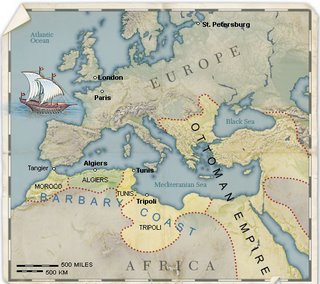 A corsair is simply a pirate, especially a pirate along North Africa's Barbary Coast. The Saracen and Turkish corsairs were actually officially sanctioned by their governments and were used as a means of disrupting Christiandom's Mediterranean trade. Corsair also came to mean the government sanctioned ships that these pirates used.
The corsairs, originally hired by the fledgling US government to protect its merchant ships, began to attack their charges. In retaliation the United States began construction of its navy and launched a series of wars against the Barbary pirates that lasted from 1801 to 1815.
The word corsair came to our language via Old Provençal and Old Italian, having its roots in the Medieval Latin cursārius which is a variation of cursus, meaning "plunder" or "a hostile excursion." In Latin cursus has a much more benign definition simply meaning "a run or voyage" (cursus is the past participle of currere, to run). Hence corsair is related closely to our English word course (as in "to run a course") and as corsairs were often involved in a chase, it's easy to see the etymological connection.
On a side note, the Italians created a false etymology for corsair, associating the word with the Corsicans with whom there was quite a bit of animosity.
corsair [OED]
corsair [Answers.com]
Barbary pirates [Wikipedia]
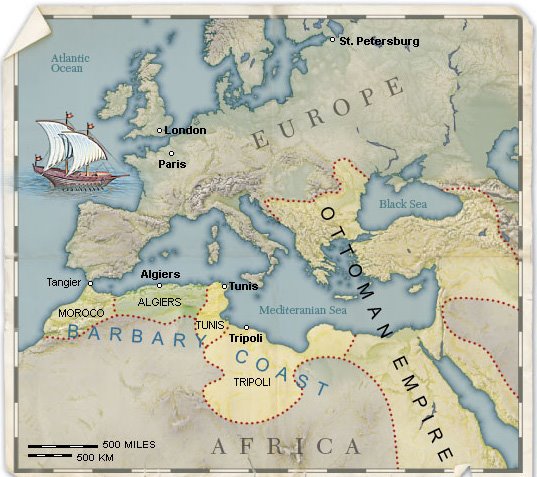 A corsair is simply a pirate, especially a pirate along North Africa's Barbary Coast. The Saracen and Turkish corsairs were actually officially sanctioned by their governments and were used as a means of disrupting Christiandom's Mediterranean trade. Corsair also came to mean the government sanctioned ships that these pirates used.
The corsairs, originally hired by the fledgling US government to protect its merchant ships, began to attack their charges. In retaliation the United States began construction of its navy and launched a series of wars against the Barbary pirates that lasted from 1801 to 1815.
The word corsair came to our language via Old Provençal and Old Italian, having its roots in the Medieval Latin cursārius which is a variation of cursus, meaning "plunder" or "a hostile excursion." In Latin cursus has a much more benign definition simply meaning "a run or voyage" (cursus is the past participle of currere, to run). Hence corsair is related closely to our English word course (as in "to run a course") and as corsairs were often involved in a chase, it's easy to see the etymological connection.
On a side note, the Italians created a false etymology for corsair, associating the word with the Corsicans with whom there was quite a bit of animosity.
corsair [OED]
corsair [Answers.com]
Barbary pirates [Wikipedia]
Labels: Italian, Medieval Latin, Old Italian, Old Provençal, The Daily Hump
