Wednesday, March 28, 2007
The Daily Hump: Words of a Feather
 The English word petition originally had a chiefly religious sense, meaning a supplication or prayer. The word comes from the Latin verb petere "to require, seek, go forward, to aim at" and ultimately we can trace its origin to the Proto-Indo-European base *pet-/*pte-, "to rush, to fly". From this base we've gotten words like pterodactyl, the Old English feðer (feather) and fearn (fern--for its feather-like fronds), and the Latin penna, meaning "feather, wing" which survives in modern ornithology to mean the contour feather of a bird (as opposed to a down feather or plume). From the Italian plural of penna we get penne, as in the pasta, whose diagonally cut ends likely reminded people of writing utensils, pens, whose name also comes from penna because pens were made from quills, the main shafts of feathers.
petition [Online Etymology Dictionary]
pen [Online Etymology Dictionary]
fern [Online Etymology Dictionary]
penne [AHD]
Labels: Italian, Latin, Old English, PIE, The Daily Hump

Thursday, March 01, 2007
The Daily Hump: If The Brogue Fits...
 Ah, the storied brogue, that singsong lullaby of the Irish, brogue being another name for the strong dialectal accent common to Irish and Scottish speakers of English. Before we begin, let's look at one of OED's alternate definitions for brogue:
 A rude kind of shoe, generally made of untanned hide, worn by the inhabitants of the wilder parts of Ireland and the Scotch Highlands.This is important because brogue in the dialectal sense probably originated from "speech of those who call a shoe a brogue." Or, if you believe Wikipedia,
The term has been said to have been coined by an Englishman who met an Irishman whose accent was so thick that he spoke "as though he had a shoe in his mouth".Of course, English has other examples of words that were influenced by footwear: ciabatta (from Italian) and sabotage (from French) being the two most obvious. However, shoes are not always the namesake; in the case of clodhopper (clod being from Old English via Proto-Germanic and Proto-Indo-European base *gel- "to make round") the word originally referred to a plowman (literally "one who goes around fields") but then later it became the heavy shoes worn by such an unsophisticated rustic. Likewise plimsolls are so named because the band around the shoe that holds the two parts together reminded people of the mark on the hull of a ship that shows how heavy it can be loaded (the Plimsoll line--Samuel Plimsoll was a 19th c. M.P. keen on shipping reforms).
brogue [Online Etymology Dictionary]
ciabatta [OED]
sabotage [OED]
clodhopper [OED]
clod [Online Etymology Dictionary]
brogue [Wikipedia]
clodhopper [AHD]
plimsoll [Online Etymology Dictionary]
Samuel Plimsoll [Wikipedia]
Labels: French, Irish Gaelic, Italian, Old English, PIE, Proto-Germanic, The Daily Hump
Wednesday, October 18, 2006
The Daily Hump: Choppin' Broccoli
 Broccoli has been a favorite vegetable of mine for years now. Whether steamed, raw or stir-fried it's one of the simple pleasures in life. My love stems from a number of factors including broccoli's taste, the auditory satisfaction I receive when crunching into a raw floret, and even broccoli's general aesthetic qualities--the deep green and bonzai-like complexity.
Despite its obvious Italian roots, the first mention of broccoli is in a mid-16th c. French text. It's possible Romans were cultivating the plant as far back as the 1st c. CE (a vegetable similar to broccoli is described by Pliny the Elder) but, at least in the New World, the vegetable was considered fairly exotic until commercial cultivation began in California in 1922.
In Italian the word broccoli is a plural form of broccolo, which is the flowering sprout of a turnip. The root brocco means shoot or stalk and is a direct descendant of the vulgar Latin *brocca meaning spike. In addition to broccoli, *brocca gives us such modern English words as broach (via the Latin broccus, projecting), brooch and brocade.
broccoli [OED]
broccoli [Wikipedia]
Labels: French, Italian, Latin, The Daily Hump
Tuesday, September 26, 2006
The Daily Hump: Charlatans
 Charlatans are frauds who often make elaborate claims of skill or knowledge in order to con their unassuming victims. The word has numerous synonyms and today we're going to examine a few.
 First, let's look at the word charlatan itself. It's a word that came to English in the early 17th century via the French, who borrowed it from the Italian ciarlatano, which is a hybrid of ciarlare, "to prattle" and cerrentano, an inhabitiant of Cerreto. According to the American Heritage Dictionary Cerreto was a city once famous for its quacks.*
 And speaking of quacks, in the above definition it's actually an abbreviation for quacksalver. Not to be confused with quicksilver (which is a future hump), quacksalver comes to us from 16th century Dutch where it was thought to mean "one who quacks about ointments." It has also been suggested that the quack- portion meant "to work in a bungling fashion", but that doesn't lend itself to as much humormous imagery.
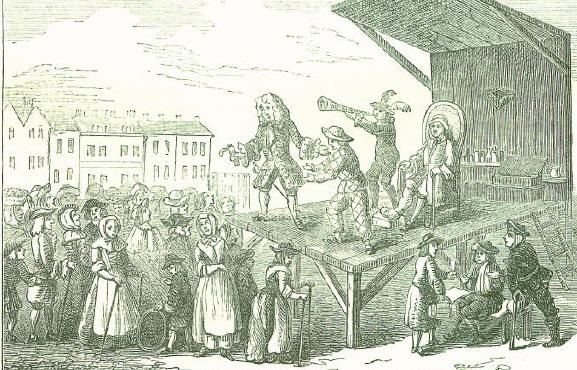
Our final synonym is mountebank, a word of Italian origin that literally translates to "mount on a bench" and refers to the raised platforms used by the hawkers (see sketch at top). It's also synonymous with saltimbanco, which means "to leap on to a bench."
I leave you today with a dialogue from SNL:
Alex Trebek: ...And finally, Sean Connery's also here let's move on to Double Jeopardy where the categories -*I googled "Cerreto" trying to find out more about its quack addiction. None of the tourist sites mention anything about charlatans; it's just your usual prattle about beautiful Tuscan-like villas and medieval churches. When you google "Cerreto quacks" all you get are hundreds of websites quoting the exact same etymology for charlatan that I used above. Thankfully, after googling "cerreto history charlatans" the Historical Archives of Italian Nephrology pulled through via the US National Center for Biotechnology Information:
Sean Connery: Not so fast Trebek.
Alex Trebek: I really thought that was going to work.
Sean Connery: Well, you were wrong, you mountebank. I pose a conundrum to ya, I riddle if you will
Alex Trebek: I don't want to hear it.
Sean Connery: What's the difference between you and a mallard with a cold? One's a sick duck and I can't remember how it ends, but your mother's a whore. [Laughs]
Cerreto is a tiny town in the Valnerine area (Umbria) famous all over the world for the phenomenon of charlatanism derived from Cerretani inhabitants. In the Middle Ages, these people started to beg for alms on hehalf of medical and religious foundations. When their occupation ended due to religious prohibition (Council of Trent) the Cerretani shifted to Charlatanism or quackery. The Charlatans exploited the absence of institutional medicine in rural areas and the credulity and superstition of many sick people. A cynical distrust of the medical profession in urban areas helped the charlatans' activity to spread. They delivered diagnostic advice and therapeutic remedies in public squares. Renal and bladder remedies were key cures from still earlier quackeries. Some historians of medicine believe that some rural or town citizens were particulalry addicted to panaceas or placebos. Charlatans from all over the world poured into the happy hunting grounds. Quackery flourished on a grand scale until education spread throughout the population and medical services were made available to the poor. Special laws to safeguard health-care, helped undermine the charlatan healing phenomenon. Popular quackery medicine neared its end in the mid twentieth century.quacksalver [OED]
montebank [OED]
saltimbanco [OED]
Labels: Dutch, French, Italian, The Daily Hump
Monday, September 18, 2006
The Daily Hump: Corsair
When did the US first fight in North Africa? Forget WWI, WWII or Ronald Reagan's 1986 raid on Libya--the Americans had fought in the region much earlier as memorialized in the opening line of the Marines' Hymn, "From the halls of Montezuma, to the shores of Tripoli." In fact, the Americans were on the shores of Tripoli *much* much earlier, in 1801, and it's all the fault of the corsairs (as is the US Navy).
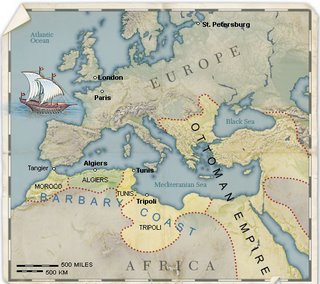 A corsair is simply a pirate, especially a pirate along North Africa's Barbary Coast. The Saracen and Turkish corsairs were actually officially sanctioned by their governments and were used as a means of disrupting Christiandom's Mediterranean trade. Corsair also came to mean the government sanctioned ships that these pirates used.
The corsairs, originally hired by the fledgling US government to protect its merchant ships, began to attack their charges. In retaliation the United States began construction of its navy and launched a series of wars against the Barbary pirates that lasted from 1801 to 1815.
The word corsair came to our language via Old Provençal and Old Italian, having its roots in the Medieval Latin cursārius which is a variation of cursus, meaning "plunder" or "a hostile excursion." In Latin cursus has a much more benign definition simply meaning "a run or voyage" (cursus is the past participle of currere, to run). Hence corsair is related closely to our English word course (as in "to run a course") and as corsairs were often involved in a chase, it's easy to see the etymological connection.
On a side note, the Italians created a false etymology for corsair, associating the word with the Corsicans with whom there was quite a bit of animosity.
corsair [OED]
corsair [Answers.com]
Barbary pirates [Wikipedia]
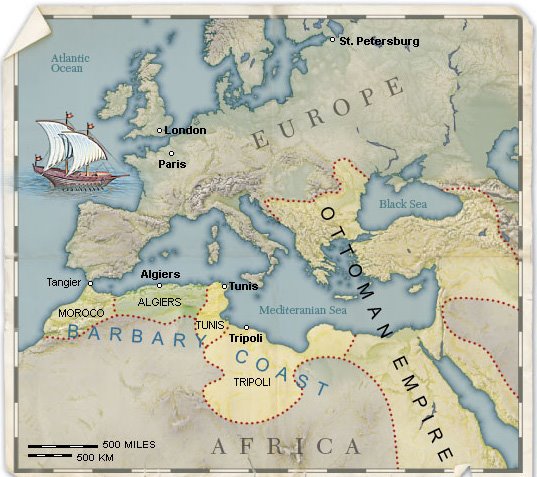 A corsair is simply a pirate, especially a pirate along North Africa's Barbary Coast. The Saracen and Turkish corsairs were actually officially sanctioned by their governments and were used as a means of disrupting Christiandom's Mediterranean trade. Corsair also came to mean the government sanctioned ships that these pirates used.
The corsairs, originally hired by the fledgling US government to protect its merchant ships, began to attack their charges. In retaliation the United States began construction of its navy and launched a series of wars against the Barbary pirates that lasted from 1801 to 1815.
The word corsair came to our language via Old Provençal and Old Italian, having its roots in the Medieval Latin cursārius which is a variation of cursus, meaning "plunder" or "a hostile excursion." In Latin cursus has a much more benign definition simply meaning "a run or voyage" (cursus is the past participle of currere, to run). Hence corsair is related closely to our English word course (as in "to run a course") and as corsairs were often involved in a chase, it's easy to see the etymological connection.
On a side note, the Italians created a false etymology for corsair, associating the word with the Corsicans with whom there was quite a bit of animosity.
corsair [OED]
corsair [Answers.com]
Barbary pirates [Wikipedia]
Labels: Italian, Medieval Latin, Old Italian, Old Provençal, The Daily Hump
