Wednesday, March 21, 2007
The Daily Hump: Goo
 I always assumed goo had some sort of onomatopoeic quality. Goo! But, in fact, it seems to be short for burgoo which is a thick stew (originally porridge) native to both New England and, oddly, Kentucky and southern Illinois. It's believe that burgoo is an alteration of ragout, also a stew, which is from the French ragoûter "to revive the taste". Goût is from the Latin gustus "taste", which gives us words such as gusto and disgust.
Gustus is from the Proto-Indo-European base *geus-. Interestingly, although this formed the root for "taste" in Greek and Latin in Germanic and Celtic words the root mostly took on the meaning "try" or "choose". Thus we find the Proto-Germanic *keusan leading to the Old Norse kjosa "to choose" and the word kyrja "chooser". Hence, in Norse mythology, the Valkyries are literally "choosers of the slain (valr, as in Valhalla)".
goo [Online Etymology Dictionary]
ragout [Online Etymology Dictionary]
Valkyrie [Online Etymology Dictionary]
burgoo [AHD]
ragout [AHD]
Labels: French, Greek, Latin, Old Norse, PIE, Proto-Germanic, The Daily Hump

Thursday, March 15, 2007
The Daily Hump: Sooth
Sooth comes from the Old English soð meaning "truth". Soð is the noun form of the adjective soþ, "true", which was originally *sonþ- and from the Proto-Germanic *santhaz (not to be confused with the Proto-Germanic sexual practice known as dirty *santhaz), a cognate with Old English synn "sin" and Latin sontis "guilty". Ultimately, we go back to the Proto-Indo-European *es-ont meaning "being, existence". This also is the root of today's s-forms of the verb "to be" such as the Latin sunt, German sind and French sont.
Sooth is also a linguistic cousin of soothe, which came from the Old English soðian "show to be true". How this came to mean "to quiet, mollify" beats me. Any ideas?
sooth [Online Etymology Dictionary]
soothe [Online Etymology Dictionary]
Ides of March [Wikipedia]
Julius Caesar [Wikipedia]
Titus Vestricius Spurinna [Wikipedia]
Labels: French, German, Latin, Old English, PIE, Proto-Germanic, The Daily Hump
Thursday, March 01, 2007
The Daily Hump: If The Brogue Fits...
 Ah, the storied brogue, that singsong lullaby of the Irish, brogue being another name for the strong dialectal accent common to Irish and Scottish speakers of English. Before we begin, let's look at one of OED's alternate definitions for brogue:
 A rude kind of shoe, generally made of untanned hide, worn by the inhabitants of the wilder parts of Ireland and the Scotch Highlands.This is important because brogue in the dialectal sense probably originated from "speech of those who call a shoe a brogue." Or, if you believe Wikipedia,
The term has been said to have been coined by an Englishman who met an Irishman whose accent was so thick that he spoke "as though he had a shoe in his mouth".Of course, English has other examples of words that were influenced by footwear: ciabatta (from Italian) and sabotage (from French) being the two most obvious. However, shoes are not always the namesake; in the case of clodhopper (clod being from Old English via Proto-Germanic and Proto-Indo-European base *gel- "to make round") the word originally referred to a plowman (literally "one who goes around fields") but then later it became the heavy shoes worn by such an unsophisticated rustic. Likewise plimsolls are so named because the band around the shoe that holds the two parts together reminded people of the mark on the hull of a ship that shows how heavy it can be loaded (the Plimsoll line--Samuel Plimsoll was a 19th c. M.P. keen on shipping reforms).
brogue [Online Etymology Dictionary]
ciabatta [OED]
sabotage [OED]
clodhopper [OED]
clod [Online Etymology Dictionary]
brogue [Wikipedia]
clodhopper [AHD]
plimsoll [Online Etymology Dictionary]
Samuel Plimsoll [Wikipedia]
Labels: French, Irish Gaelic, Italian, Old English, PIE, Proto-Germanic, The Daily Hump
Thursday, February 22, 2007
The Daily Hump: Darn!
 Darn, in the quasi-curse sense, is an American creation that was said to have originated in Puritanical New England where it was a punishable offense to say the word damn. It's thought that darn was likely influenced by 'tarnal (supposedly a favorite exclamation of Andrew Jackson), which is short for eternal, as in By the Eternal.
Darn, in the mending sense, is likely from the Middle French darner, meaning "to mend." This goes back to the Breton "piece, fragment, part," which ultimately traces back to the Proto-Indo-European root *der-, meaning "tear" (as in "rip"). And *der- also happens to be the root for our word tear, which came to modern English via Proto-Germanic then Old English.
darn [Online Etymology Dictionary]
tear (v) [Online Etymology Dictionary]
Labels: Breton, Middle French, Old English, PIE, Proto-Germanic, The Daily Hump
Tuesday, February 13, 2007
The Daily Hump: (Sea) Hag
 As the title of this post suggests my particular interest in hags is with the sea variety. Anyone who has ever watched a Popeye cartoon is familiar with the Sea Hag; she's the tall witchy woman with a vulture for a familiar who suffers an unrequited crush on the our favorite roid-raged sailor. It's kind of pathetic, really. But I experienced no such empathy as a child; I just thought the Sea Hag was creepy and awesome in the way only nautical rapscallions can be (evidence: a, b and c).
Hag is a shortened form of the Old English hægtesse meaning "witch, fury." The word can be traced further back to the Proto-Germanic *hagatusjon-. The Middle Dutch cognate, haghetisse, was also shorted to form the German Hexe, meaning "witch;" and it's via the Amish we got our English hex. Now, here's where things get crazy:
[Hag's first] element is probably cognate with [Old English] haga "enclosure" [which is related to our modern hedge]...Or second element may be connected with [Norwegian} tysja "fairy, crippled woman"...from PIE *dhewes- "to fly about, smoke, be scattered, vanish."...Haga is also the haw- in hawthorn, which is a central plant in northern European pagan religion. There may be several layers of folk-etymology here. If the hægtesse was once a powerful supernatural woman..., it may have originally carried the hawthorn sense. Later, when the pagan magic was reduced to local scatterings, it might have had the sense of "hedge-rider," or "she who straddles the hedge," because the hedge was the boundary between the "civilized" world of the village and the wild world beyond. The hægtesse would have a foot in each reality...Sea hag [TV Acres]
hag [Online Etymology Dictionary]
hex [Online Etymology Dictionary]
Häxan [IMDB.com]
The Dreams in the Witch House [Wikipedia]
Labels: German, Middle Dutch, Norwegian, Old English, Pennsylvania Dutch, PIE, Proto-Germanic, The Daily Hump
Monday, February 12, 2007
The Daily Hump: Scythe
 You may notice the humps this week are shorter; I've got a lot of work to do. Now that that's out of the way today we're going to (very gingerly) hump the scythe: whether reaping barley or souls it's the go-to tool. First things first, however; that initial sc- that we've come to know and love didn't show up until around the 15th c., likely influenced by the Latin verb scindere (to cut: think scissors). Before this time the we had the Middle English sithe and before that the Old English sigði. We can trace the word further back to the Proto-Germanic *segithoz and the Proto-Indo-European base *sek-, meaning "cut".
 The base *sek- also happens to be the root of our modern words section, a "cutting off or division," and scythe's close relative, sickle.
scythe [Online Etymology Dictionary]
scythe [OED]
sickle [Online Etymology Dictionary]
Labels: Latin, Middle English, Old English, PIE, Proto-Germanic, The Daily Hump
Thursday, February 08, 2007
The Daily Hump: Bears
 Yesterday we discovered that the Arctic is named after the Greek root for bear, arktikos. Today we're going to look at the word bear itself and why the English and Latin are so incredibly unrelated.
Our word bear comes from the Old English bera. This comes from the reconstructed Proto-Germanic *beron, meaning "the brown one" (think bruin). Apparently, a large chunk of the northern branches (the Germanic, Baltic, Celtic and Slavic branches) of our linguistic ancestors had a taboo associated with the names of wild animals being hunted and either deformed or replaced the PIE term. As Wikipedia notes examples include
...the Irish word for "bear" translated means "the good calf", in Welsh it translates as "honey-pig", in Lithuanian it means "the licker" and Russian "медведь" literally means "one who leads to honey".As my Persian teacher explained to me yesterday this substitution also occurs in many of the languages of northern Central Asia, in lands once populated by the Scythians. Given the Slavs' propinquity to Scythia it's not surprising that the Russians would also adopt this taboo as we see in the above Wikipedia quote. (Interestingly, Scythia was the first state north of the Black Sea to collapse to the Goths in the 2nd c. CE, but more on the Goths later.)
Labels: Greek, Irish Gaelic, Lithuanian, Old English, PIE, Proto-Germanic, Russian, The Daily Hump, Welsh Gaelic
Monday, February 05, 2007
The Daily Hump: Reindeer
Labels: German, Greek, Old English, Old Norse, Proto-Germanic, The Daily Hump
Thursday, February 01, 2007
The Daily Hump: Anger
But before we begin I need to get something off my chest. In elementary school I remember being told that there are three words in the English language that end in -gry. Two of them are angry and hungry; what's the third? Well, praise be unto thy Internet, as the Online Etymology Dictionary reports
...there is no third (except some extremely obscure ones). Richard Lederer calls this "one of the most outrageous and time-wasting linguistic hoaxes in our nation's history" and traces it to a New York TV quiz show from early 1975.
 It's stupid questions like that that make me angry. Anyway, we trace our anger back to Middle English. Their anger, in turn, came from Old Norse (which is not surprising since I'm sure the Vikings made a lot of people angry). In Old Norse angr referred to strife or trouble and was from the root word ang which also meant "troubled" but could also mean "strait" or "narrow." We can trace this word even further back to the Proto-Germanic *angus, meaning "narrow" or "painful" and to the Proto-Indo-European *angh- meaning "tight" or "painful."
  We have a word agnail which is originally from Middle English and refers to a corn on your foot. This is from the Old English angnægl which is nothing more than a compound: ang- + nægl. In this word ang- has the sense of painful and nægl translates to "nail;" hence, our word hangnail, a painful nail.
PS. I'm on vacation tomorrow, so no hump for you. Happy Groundhog Day!
hangnail [AHD]
agnail [AHD]
anger [Online Etymology Dictionary]
agnail [OED]
anger [OED]
Labels: Middle English, Old English, Old Norse, PIE, Proto-Germanic, The Daily Hump
Thursday, January 25, 2007
The Daily Hump: Sneeze

 The lowly sneeze, known scientifically as a sternutatory reflex,
 is a semi-autonomous, convulsive expulsion of air from the nose and mouth. This air can reach speeds of 70 m/s (250 km/h or 155 MPH). Sneezes spread disease by producing infectious droplets that are 0.5 to 5 µm in diameter, about 40,000 such droplets can be produced by a single sneeze.The word traces back to the Old English fneosan, which is from the proto-Germanic *fneusanan (which is likely of imitative origin). From this base we see similarities in Middle Dutch, Dutch (fniezen - "to sneeze"), Old Norse (fnysa - "to snort"), and Swedish (nysa - "to sneeze"). As the Online Etymology Dictionary notes
the [English] forms in sn- appear 1490s; change may be due to a misreading of fn-, or from [an Old Norse] influence. But OED suggests [the Middle English] fnese had been reduced to simple nese by early 15c., and sneeze is a "strengthened form" of this, "assisted by its phonetic appropriateness."Regardless up until around 1400 c. English had the words fnese (sneeze), fnast (breathe) and neeze, which is still used to mean sneeze in a number of Scandinavian, northern Irish English and north England regional dialects. You may find it interesting to note that fnese and fnast make up the OED's entire contingent of words beginning with fn-.
*"To sneeze at" first attested to in 1806.
Sneezing [Wikipedia]
Labels: Dutch, Middle Dutch, Middle English, Old English, Old Norse, Proto-Germanic, Swedish, The Daily Hump
Thursday, January 18, 2007
The Daily Hump: Bleach
Do ya know what I'm doin', doin' the Humpty Hump.

 Bleach isn't just the name of Nirvana's totally excellent first album (which, granted, pales is comparison to their later efforts) so-named because Kurt appreciated the chemical's effectiveness for cleaning needles. Bleach is better known as that noxious agent that keeps your brights bright and your tile floor sparkly. The word comes down to us from the Old English blǣcan, which is from the Proto-Germanic *blaikos "white," which is from the Proto-Indo-European *bhleg- "to gleam." Other related words include blanche, blank, bleak and blink; and curiously, quite unexpectedly, black.
Yes, folks, bleach and black are likely from the same root. As the Online Etymology Dictionary notes the connection between blanche, blank, bleak and blink seems to be "burning, blazing, shining, whiteness." The burning and blazing aspect is what's important because that's also the likely link between bleach and black. "That the same root yielded words for 'black' and 'white' is probably because both are colorless, and perhaps because both are associated with burning." Okay then.
Before you go some more fodder for your noggin: according to the AHD bleachers (like those ass-hurting things you used to sit on at high school pep rallies) were so named because it's a comparison of "a person's exposure to the sun when sitting on them with the exposure of linens bleaching on a clothesline." The Online Etymology Dictionary disputes this etymology however saying bleachers "were so-named because the boards were bleached by the sun." The OED doesn't weigh in on the issue so I'm going to have to go with the Online Etymology Dictionary on this one. The AHD etymology is just stoopid.
Labels: Old English, PIE, Proto-Germanic, The Daily Hump
Wednesday, January 17, 2007
The Daily Hump: Witch Hazel
 I've got a pimple living at the end of my nose and it makes me a sad WordHumper. It's one of those ones that's kind of under the skin, so it's just a sort of red splotch that hurts a lot. Anyway, I should be washing my face with witch hazel like I was back in the day, but I'm too lazy and the smell is kind of funky. Plus, this pimple got me thinking; what's so witchy about witch hazel? Is it a magical bush? Evil? Satanic perhaps?
 Actually, no. Witch hazel has absolutely nothing to do with old crones flying around on broomsticks or reciting incantations and frolicking in an orgiastic circle around a bonfire in some sylvan glen. No, the "witch" in witch hazel is from the obsolete wych, which is a shortened form of the wych elm (see photo at left) whose name in turn comes from the Old English wice. Wice is from the proto-Germanic wik- meaning "to bend" and from this root we get oodles of other modern English words including: weak, wicker and wicket. Even the words week and vicarious share a proto-Indo-European root with wik-, the PIE base *weik-, *weig- "to bend, wind" (in regards to vicarious think of bending in the sense of changing, or a substitution. For week the sense comes more from the idea of "turning" or "succession").
So, there ya have it: for better or for worse there is nothing diabolical about the powers of witch hazel.
witch hazel [Online Etymology Dictionary]
vicarious [Online Etymology Dictionary]
witch, wych, n3 [OED]
witch hazel [AHD]
Wych elm [Wikipedia]
Labels: Old English, PIE, Proto-Germanic, The Daily Hump
Friday, January 12, 2007
Hump This: Tampon
 Hump This is a (quasi-)weekly Friday feature where you, the WordHumper reader, choose which lucky word gets humped back to the stoneage (or at least to Proto-Indo-Europa). Today we're ridin' the cotton pony with CH of Brooklyn who writes:
 Talk to me about tampons. Why aren't they called vagina plugs?You'll need to thank the French that when Cap'n Bloodsnatch comes to town you're not rifling through your purse searching for a "vagina plug". But don't thank them too much because as it happens tampon actually means "plug" in Middle French. Similarly, we have a word in English tampion which is the plug or cover one uses for a muzzle of a gun or cannon to keep out the moisture.
And next time you saddle up to the bar for a pint keep this in mind: tampon can ultimately be traced back to the Proto-Germanic *tappon meaning "stopper, faucet", which happens to be the ancestor of our modern English word tap.
Hey, barkeep, I'll have a Red Stripe.
If you have a word you'd like humped please email it, along with your location, to wordhumper.
tap [Online Etymology Dictionary]
tampion [Online Etymology Dictionary]
tampion [AHD]
tampon [AHD]
Tampontification Euphemisms [Seventh Generation]
Labels: Hump This, Middle French, Proto-Germanic
Tuesday, January 02, 2007
The Daily Hump: Smitten
 Ah, to be smitten; that time in one's life when your attention is romantically focused upon a single person. But do people realize that smitten is simply the past participle of smite? You know, smite, as in God's favorite pastime in the Hebrew Bible: God smote the Egyptians, God smites the Midianites, God hearts smiting Philistines. Yes, smitten comes from a not-so-nice word at all, as smite literally means to be beaten or struck.
 Smite comes to us via Old English, Proto-Germanic and quite possibly the Proto-Indo-European base *(s)mei-, meaning (somewhat disturbingly) "to smear or rub". In the Germanic languages the early sense of smite seems to be focused on throwing. As the Online Etymology Dictionary notes, the Biblical sense of the word, as in "to slay", doesn't start showing up until around 1200 CE. Smitten, in the sense of love, is a relatively recent concoction, making its linguistic debut in 1663: "Lord Chesterfield..is..put away from Court upon the score of his lady's having smitten the Duke of Yorke" (from the Diary of Samuel Pepys, as written Jan 1, 1663--happy 344th birthday, Smitten; my apologies for being a day late but it was New Year's Day and I was hungover. You understand.)
So next time you beat, strike, throw, smear or rub your lover just remember this is all part of being smitten and, by definition, is expected.
smite [OED]
Labels: Old English, PIE, Proto-Germanic, The Daily Hump
Wednesday, December 06, 2006
The Daily Hump: Yard
Let's start with the yard in the sense of a unit of measurement. Per Wikipedia:
The yard derives its name from the word for a straight branch or rod, although the precise origin of the measure is not definitely known. Some believe it derived from the double cubit, or that it originated from cubic measure, others from its near equivalents, like the length of a stride or pace. One postulate was that the yard was derived from the girth of a person's waist, while another claim held that the measure was invented by Henry I of England as being the distance between the tip of his nose and the end of his thumb. These are believed to be more likely standardising events than inventing of the measure.Yard can likely be humped all the way back to the Proto-Indo-European root *gherdh- meaning staff or pole. In Old English the yard measured about 5 meters, a length later called a rod (rather unoriginal given the Wikipedia etymology). The yard as we know it was first attested to from 1377. And for you loyal WordHumper readers yard is likely related to the Old Teutonic *gazdaz, which gave us the Old Norse word gad. You may remember gad from our gallivant hump. It's related to our the root of our modern verb gather.
Now, how does this all connect to my backyard? Funny thing--there is no connection. It seems to be purely coincidental that one can measure their backyard with a yardstick. Let's look at the Old English roots:
Yard (in the backyard sense) --> Old English geard
Yard (in the measuring sense) --> Old English gerd
In the backyard sense yard comes from the same Germanic root that gave us garden, orchard and the people-inhabitated portion of the world in Norse mythology, Midgard. Yard also shares a Germanic root with the verb gird, meaning to surround or encircle the waist (think girdle and girth*). It's this concept of surrounding and enclosure which really captures the sense of yard's Proto-Indo-European root ghort-, which also gave us cohort, court and the Latin word for "garden" hortus, which of couse gave us horticulture (orchard actually comes from hortus + yard).
*The Wikipedia entry gives a possible etymology for yard (in the measuring sense) as "derived from the girth of a person's waist". Given that the root for girth is connected to yard in the enclosure sense, this theory may be assuming an etymological relationship between the two senses of yard which we have shown does not exist.
Yard [AHD]
Yard [Online Etymology Dictionary]
Yard [OED]
Labels: Latin, Old English, PIE, Proto-Germanic, The Daily Hump
Tuesday, November 28, 2006
The Daily Hump: Mulberries
 Most children first encounter the concept of a mulberry bush at a very early age. It's the place where monkeys chase weasels while dogs laugh in amusement until suddenly, rather inexplicably, the weasel "pops". (The cryptic nursery rhyme, which date back to 17th c England, apparently confounds many people.) The "mulberry bush" is actually not a bush at all, but rather a tree native to the warmer climates of Asia, Africa and North America. It's also economically valuable as the leaves are the sole food source for silkworms.
The word mulberry can obviously be broken in to two components. Analyzing the second element first, -berry comes from the Germanic languages, thus we find berie in Old English. This, in turn, is believe to come from the Old Teutonic *basjôn-, *bazjôn-. As the OED notes
The ulterior history is uncertain: *bazjo- has been conjecturally referred to *bazo-z [meaning "bare"] (q.v.), as if a bare or uncovered fruit, also to the root represented by [Sanskrit] bhas-, [meaning] "to eat".To understand the first element, mul-, it's best if we look at the mulberrie's genus, Morus, which comes from the Latin word for the mulberry, morum. The plural of the Latin morum is mora, and in post-classical Latin (4th c.) this form became the feminine singular. By the 12th c. mora became more became moure and then the Old French mur. Finally, mur became mul and mulberry makes its first recognizable appearance in English in Wycliffe's Bible of 1382 ("cedres as longe mulberies").
If you're curious about that mur to mul transformation, R and L are very similar phonetically (both are alveolar consonants) and it's not surprising that one would transform into the other. To give you an idea of the letters' similarities
...in Korean, there is a phoneme /r/ that is a flapped r between vowels, and is an l-sound in other phonetic contexts. These sounds are very different to an English speaker, who is attuned to hearing them because the differences are meaningful in English. However, the native Korean speaker has learned from an early age to consider the two sounds the same. Thus, Korean speakers do not differentiate the two words "ram" and "lamb", despite the fact that both R and L sounds occur in the language.Phonemes [Wikipedia]
Labels: Korean, Latin, Old English, Old French, Proto-Germanic, Sanskrit, The Daily Hump
Wednesday, November 15, 2006
The Daily Hump: Quagmire
 We hear it daily: "Kharrazi warns UK over Iraq quagmire", "Bush Vietnam trip revives Iraq quagmire", "The quagmire deepens in Afghanistan". In fact, just this morning Google News displays about 300 articles published in the past 24 hours that use the word quagmire. Outside the realm of warfare quagmire is of course a fairly well-known word referring to a swamp or bog. The word is a compound of 2 elements; quag + mire.
Let's start with the second element first, -mire. To be mired down in something is to be in a situation where it is difficult to extricate oneself. Similarly, we use the phrase bogged down, or to be swamped. Mire comes from the Old Norse mýrr which predictably means bog. The OED goes on to explain the mire is a variant of the Germanic base of mese, which is an obsolete regional word from England's southwest meaning moss. Mese is "an ablaut variant of the Germanic base" of moss, thus mire and moss are related.
 Now let's go back to t he first element, quag-. Like mire, quag can also stand on its own, meaning, according to the AHD, quagmire. The OED's definition is a bit more telling:
 A marshy or boggy spot, esp. one covered with a layer of turf which shakes or yields when walked on.That "turf which shakes" is quaking (as in an earthquake). In fact, quag and quake come from the same Old English root cwacian (incidentally, there is a synonymous and obsolete variant of quagmire, quakemire). The related Old English word *cwabba meaning "to shake or tremble" is onomatopoeic and comes from the sound of something soft and flabby being jiggled. Thus, the quag'iness of a quagmire is distantly related to the sound it makes as one walks through its muck.
Labels: Old English, Old Norse, Proto-Germanic, The Daily Hump
Tuesday, September 26, 2006
The Daily Hump: The Welsh and Their Nuts
 Yes, today we're humping the Welsh. I know, England has been humping the Welsh since Eddie I defeated Llywelyn ap Gruffudd in 1282. And, unfortunately, we're not humping Catherine Zeta Jones, nor even Anthony Hopkins; just the Welsh en masse. Let's get the ball rolling with some good ol' fashioned jokes directed at everyone's second favorite group of Celts.
Q: What do you call a sheep tied to a fence in Wales?
A: A leisure center.
Q. What do you call a Welshman with many girlfriends?
A. A Shepherd.
Q. Did you hear that Welsh people have discovered a new use for sheep?
A. Wool.
Per the Wikipedia (I'm feeling lazy today):
The English name for Wales originates from the Germanic word Walha, meaning "stranger" or "foreigner", probably derived from the name Volcae (a powerful 2nd century BC nation of Gaul). As the Celts of Gaul were Romanized, the word changed its meaning to "Romanic people", as is still apparent in the name of the Walloons of Belgium, Wallachia in Romania, as well as the "-wall" of Cornwall. The Welsh themselves called themselves Cymry, "compatriots", and named their country Cymru, which is thought to have meant "Land of the Compatriots" in Old Welsh; this has reference to their awareness that they were the original countrymen of Wales, and indeed Britain by virtue of their ancestors the Brythoniaid (Brythons), and also in order to distinguish themselves from the foreign invaders of Britain, the Saeson (English)...
 The Welsh are nuts. Well, actually, they're walnuts. Okay, that's not really true either, but walnut comes from the Old English word wealhhnutu. The first element, wealh, is the Old English equivalent to the Germanic word Walha, which, as you read above is responsible for our English word Wales and meant "foreign" (no surprise, but the second element, hnutu, is "nut"). Both wealh and Walha have the same Old Teutonic root, *wal{chi}o-z. These foreign nuts (that is, walnuts, not the Welsh) were called wealh because they were from the Roman lands of Italy and Gaul and needed to be distinguished from the native hazelnut.
 Before we conclude, I should mention there's a verb welsh, meaning to swindle a person by not paying a debt or wager. Or, in a more general sense, to welsh someone is to not fulfill an obligation. The origin of this sense is unknown.
*Requisite disclosure: I spent about 6 weeks working near Eglwyswrw during the summer of '98 and had a great time.
UPDATE: Welshnut is Dorset slang for walnut. [Probert]
Jokes about the Welsh [Celtic.info]
Wales [Wikipedia]
walnut [OED]
welsh [American Heritage Dictionary]
Labels: Old English, Proto-Germanic, The Daily Hump, Welsh Gaelic
Friday, September 22, 2006
The Daily Hump: Mötley
 Okay, okay...there really isn't an umlaut in the word motley, it's purely a heavy metal gimmick meant to give a band's logo a Teutonic quality. As Spinal Tap's David St. Hubbins noted "It's like a pair of eyes. You're looking at the umlaut, and it's looking at you."
Now that we have that out of the way, have you really ever given thought to the word motley...motley...you know, really hump the word mentally until you realize it's rather strange? It means "heterogenous" or "having a great amount of variation." In the late 14th century there was an Anglo-Norman word motlei meaning "variegated" or, in the noun form, "variegated cloth" (and was also the name of the outfit worn by a harlequin, hence motley fool). If we attempt to look further back in time the list of potential candidates for motley roots is rather...er...motley. The OED suggests three: medley, motey and mote. Let's take a gander at each.
In regards to medley the OED is specifically referring to a rare definition where it means a type of cloth made of dyed wool, which was frequently multi-colored, hence the name. This sense, in turn, is related to an obscure word, mellay, meaning hand-to-hand combat which is closely related to our very common word melee, meaning a confused violent free-for-all. Melee comes the part participle of the Old French mesler, meaning "to mix." We've seen this root before...here.
Motey is an obscure word that refers to a type of earth used as a pigment which apparently created a speckled appearance when applied. We see references to it from the mid 14th century up through the early 16th century. It's believed, but not confirmed, that the word is related to our third candidate mote.
If you're thinking of a large water-filled ditch surrounding a castle, then you're thinking of a moat, not a mote. A mote is a speck or particle, like the kind you see floating in a beam of light or that annoying speck that gets in your eye or throat, and is a cognate of the West Frisian mot meaning "peat dust." Interestingly, it's possible that mote is related to the Swedish word for dirt, which gave us our word smut. As well, it's possible mote is related to the Germanic base of what became our word moth, those pesky insects that reduce cloth to small fragments.
Ultimately, as with many words, we'll never have a definitive root for motley, just a theory; yet, it's amusing that Mötley Crüe chose a name whose roots are most likely buried in harlequin outfits, fighting and dirt.
On second thought, it's perfect.
motley [OED]
motey [OED]
mote [OED]
Labels: Anglo-Norman, Old French, Proto-Germanic, The Daily Hump, West Frisian
Thursday, August 24, 2006
Oh me so Þorny...
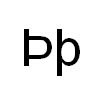 ...well, at least in modern Icelandic, Old Norse, and Old and Middle English. Thorn, or þorn (Þ, þ), traces its roots back to Proto-Germanic, where it has been reconstructed as *Thurisaz.
So, where has Þ gone in our modern English alphabet? Alas, we've replaced this ancient letter with the rather boring digraph th. Just þink about it; we could save ourselves the effort of typing one extra letter every time we spell a word that uses either a voiceless interdental fricative (like th as in the English word thick) or a voiced dental fricative (like th as in the English word the). Þe possibilities are endless.
Sometime during þe 14þ century th started to become more common in English. As its popularity waned, poor þ began to lose its shape (more specifically, it lost its ascender), first appearing similar to the Old English letter wynn (Ƿ, ƿ), þen later morphing into a Y. You can still see ghosts of our þorny linguistic past in pseudo-archaic usages such as "Ye olde...". I þink it's important to point out þat no one during this "Ye" period would ever pronounce the word Ye as yee; in this case, the Y still retained its þ'isitiy (th).
:-Þ
Labels: Icelandic, Middle English, Old English, Old Norse, Proto-Germanic
