Monday, March 26, 2007
The Daily Hump: Burgle
 I was watching the highly underrated 1966 spy flick Funeral in Berlin last night. Harry Palmer, played by Michael Caine, and Israeli secret agent Samantha Steel enter her apartment to find that it's been ransacked*. Harry's exact words are "You've been burgled."
 Burgled is a back-formation of burglar; etymologically speaking a back-formation is created when you remove all the bits and pieces (affixes) of an earlier word to derive, falsely, an "orginal" form. Burglar was from Medieval Latin via Old French. The Latin verb burgare, meaning "to break open, commit burglary" comes from the Latin burgus meaning "fortress, castle" (which is a Germanic loan-word similar akin to borough, bourgeois, etc...). While burglar appeared in English (via Middle English) as early as the 1540s burgled didn't show up until the late 19th c.
*Ransacked is from the Old Norse rannsaka, meaning "to pillage" and literally comes from "to search the house". The second element saka, "to search", is related to the Old Norse soekja, which is the root of our word seek.
burglar [Online Etymology Dictionary]
ransack [Online Etymology Dictionary]
burgle [OED]
back-formation [Wikipedia]
Funeral in Berlin [IMDB]
Labels: Latin, Medieval Latin, Old French, Old Norse, The Daily Hump

Wednesday, March 21, 2007
The Daily Hump: Goo
 I always assumed goo had some sort of onomatopoeic quality. Goo! But, in fact, it seems to be short for burgoo which is a thick stew (originally porridge) native to both New England and, oddly, Kentucky and southern Illinois. It's believe that burgoo is an alteration of ragout, also a stew, which is from the French ragoûter "to revive the taste". Goût is from the Latin gustus "taste", which gives us words such as gusto and disgust.
Gustus is from the Proto-Indo-European base *geus-. Interestingly, although this formed the root for "taste" in Greek and Latin in Germanic and Celtic words the root mostly took on the meaning "try" or "choose". Thus we find the Proto-Germanic *keusan leading to the Old Norse kjosa "to choose" and the word kyrja "chooser". Hence, in Norse mythology, the Valkyries are literally "choosers of the slain (valr, as in Valhalla)".
goo [Online Etymology Dictionary]
ragout [Online Etymology Dictionary]
Valkyrie [Online Etymology Dictionary]
burgoo [AHD]
ragout [AHD]
Labels: French, Greek, Latin, Old Norse, PIE, Proto-Germanic, The Daily Hump
Tuesday, March 13, 2007
The Daily Hump: Jaded
 I began today pondering whether jade, the gemstone, has any relation to the sensation of being jaded caused from over-indulgence. As I discovered the words are not only unrelated but one exists purely because of French gender confusion.
In the 17th c., when the gemstone was still rather unfamiliar, the feminine l'ejade became the masculine le jade via a simple error and hence our modern word jade is not ejade. L'ejade comes from the Spanish piedra de (la) ijada (stone of colic) because of the gem's supposed ability to cure this ailment. Ijada goes back to the Latin ilia meaning flanks or kidney areas (see ilium, one of the pelvic bones).
The blah kind of jade is a figurative sense coming from a noun meaning "a beaten down horse". This may be related to the Old Norse jalda, meaning "mare", which is itself from Finno-Ugric. The OED says there's no evidence to support any of this but it's as good a guess as any.
jade [Online Etymology Dictionary]
jade [OED]
Labels: Finno-Ugric, French, Latin, Old Norse, Spanish, The Daily Hump
Tuesday, February 27, 2007
The Daily Hump: Of Kilts, Tartans and Tartars*
 Kilt first makes an appearance in the English language as a type of tartaned skirt in the early 18th c. Our noun actually came from a now little-used verb form meaning "to tuck up." This word came to us via the Middle English kilten, meaning "to tuck up" (is "to tuck up" a Britishism for "to tuck in"? Anyone? Bueller?) Going back further kilt seems to be from a Scandinavian source as witnessed by the Old Norse kilting and kjalta meaning skirt or lap.
The word tartan likely comes to us via the Middle French tiretaine which referred to a "strong, coarse fabric." This can be traced back to Old French and then to the Medieval Latin tyrius meaning "cloth from Tyre." It's also possible the word was influenced by the Middle English tartaryn, also a type of cloth, which comes from Old French but is ultimately rooted in the word Tartar.
And speaking of Tartars, the tartar on your teeth is from the Greek tartaron which referred to the gunk settled to the side of casks. The Greek term is believed to be of Arabic origin unlike the proper noun Tartar which is said to be from Tata, a name the Mongols gave themselves, with some spicy influence from the Latin Tartarus, aka hell.
kilt [OED]
kilt [Online Etymology Dictionary]
tartar [OED]
Tartar [OED]
tartan [OED]
tartan [AHD]
Tartar [Online Etymology Dictionary]
*The Daily Hump is not really daily anymore--it'll now only be published on Tuesdays and Thursdays, so it really should be The Semiweekly Hump, but that name is dumb and plus I'd have to eat those rebranding costs, etc...thus, The Daily Hump it is. That being said, daily or not, there is still a new WordHumper post every weekday and thus you always have a good reason to come back now, y'hear?
Labels: Greek, Medieval Latin, Middle English, Middle French, Old French, Old Norse, The Daily Hump
Tuesday, February 06, 2007
The Daily Hump: Narwhal
 Yesterday we humped reindeer and today we're going to hump another animal with an affinity for the cold, the arctic narwhal. The narwhal is a type of whale most notable for the extremely long tusk that juts from the left jaw of the male. These tusks can grow up to 10 feet long which is pretty impressive when you consider the whale itself is no longer than 16 feet.
In Inuit legend the narwhal was created when a woman holding onto a harpoon was dragged into the sea by a beluga and became twisted upon the weapon. In Medieval folklore many Europeans equated the narwhal tusk to the unicorn horn. Vikings and other northern traders sold the tusks for large sums of gold as cups fashioned from the ivory were believed to negate the effect of any poison which they held inside.
The word narwhal comes to us from the Danish and Norwegian narhval, which itself is from the Old Norse nāhvalr. It is generally assumed that the Old Norse name is derived from nār, corpse (from its whitish color) + hvalr, whale, although this is not known for sure. Another suggestion is that the narwhal was named "the corpse whale" for its ability to lie belly up and motionless for a few minutes at a time. Or, alternatively, nā- could be short for the Old Norse nál, meaning needle, an obvious reference to the male's tusk.
Here's a fun bit of mental masturbation: If we assume the first element nā- is from nār (corpse) this is a cognate with the Old English ne, neo, which is an element associated with things that are dead. Examples in Old English include neobedd (death bed), the root of our modern word need (surprisingly enough) and orcneas (evil spirits); orcneas is the likely source of our word orc and shares a Latin root with orca, another species of whale.
narwhal [Wikipedia]
narwhal [AHD]
narwhal [Online Etymology Dictionary]
narwhal [OED]
orca [Online Etymology Dictionary]
need [OED]
orc [OED]
orc [Online Etymology Dictionary]
Labels: Danish, Latin, Norwegian, Old English, Old Norse, The Daily Hump
Monday, February 05, 2007
The Daily Hump: Reindeer
Labels: German, Greek, Old English, Old Norse, Proto-Germanic, The Daily Hump
Thursday, February 01, 2007
The Daily Hump: Anger
But before we begin I need to get something off my chest. In elementary school I remember being told that there are three words in the English language that end in -gry. Two of them are angry and hungry; what's the third? Well, praise be unto thy Internet, as the Online Etymology Dictionary reports
...there is no third (except some extremely obscure ones). Richard Lederer calls this "one of the most outrageous and time-wasting linguistic hoaxes in our nation's history" and traces it to a New York TV quiz show from early 1975.
 It's stupid questions like that that make me angry. Anyway, we trace our anger back to Middle English. Their anger, in turn, came from Old Norse (which is not surprising since I'm sure the Vikings made a lot of people angry). In Old Norse angr referred to strife or trouble and was from the root word ang which also meant "troubled" but could also mean "strait" or "narrow." We can trace this word even further back to the Proto-Germanic *angus, meaning "narrow" or "painful" and to the Proto-Indo-European *angh- meaning "tight" or "painful."
  We have a word agnail which is originally from Middle English and refers to a corn on your foot. This is from the Old English angnægl which is nothing more than a compound: ang- + nægl. In this word ang- has the sense of painful and nægl translates to "nail;" hence, our word hangnail, a painful nail.
PS. I'm on vacation tomorrow, so no hump for you. Happy Groundhog Day!
hangnail [AHD]
agnail [AHD]
anger [Online Etymology Dictionary]
agnail [OED]
anger [OED]
Labels: Middle English, Old English, Old Norse, PIE, Proto-Germanic, The Daily Hump
Thursday, January 25, 2007
The Daily Hump: Sneeze

 The lowly sneeze, known scientifically as a sternutatory reflex,
 is a semi-autonomous, convulsive expulsion of air from the nose and mouth. This air can reach speeds of 70 m/s (250 km/h or 155 MPH). Sneezes spread disease by producing infectious droplets that are 0.5 to 5 µm in diameter, about 40,000 such droplets can be produced by a single sneeze.The word traces back to the Old English fneosan, which is from the proto-Germanic *fneusanan (which is likely of imitative origin). From this base we see similarities in Middle Dutch, Dutch (fniezen - "to sneeze"), Old Norse (fnysa - "to snort"), and Swedish (nysa - "to sneeze"). As the Online Etymology Dictionary notes
the [English] forms in sn- appear 1490s; change may be due to a misreading of fn-, or from [an Old Norse] influence. But OED suggests [the Middle English] fnese had been reduced to simple nese by early 15c., and sneeze is a "strengthened form" of this, "assisted by its phonetic appropriateness."Regardless up until around 1400 c. English had the words fnese (sneeze), fnast (breathe) and neeze, which is still used to mean sneeze in a number of Scandinavian, northern Irish English and north England regional dialects. You may find it interesting to note that fnese and fnast make up the OED's entire contingent of words beginning with fn-.
*"To sneeze at" first attested to in 1806.
Sneezing [Wikipedia]
Labels: Dutch, Middle Dutch, Middle English, Old English, Old Norse, Proto-Germanic, Swedish, The Daily Hump
Wednesday, January 10, 2007
The Daily Hump: Cozy
 As warm-blooded mammals human beings seem to have a natural affinity towards snug, comfortable shelters. Perhaps this yearning for coziness is nothing more than a memory heldover from our time in the womb. The word cozy is most likely of Scandinavian origin (cf. the Norwegian kose seg, "be cozy") which is unsurprising given the cold Nordic climate.
 English also has a word gemutlich (with or without umlaut) which is from zie Germans and is generally defined as "pleasant and friendly" (possibly first used as an adjective in English by Queen Victoria). In German a gemütlich person or place is one that obeys the philosphy of Gemütlichkeit, which goes beyond the English concept of coziness in its level of abstractness:
...rather than basically just describing a place as not too large, well-heated and nicely furnished (a cosy room, a cosy flat), Gemütlichkeit connotes, much more than cosiness, the notion of belonging, social acceptance, cheerfulness, the absence of anything hectic and the spending of quality time in a place as described above...A gemütlich person...is one that takes part in this lifestyle and knows about the tensions he/she is able to cause, and thus tries to avoid these things actively.This idea of avoiding tension in one's enviroment suggests a similarity to Chinese feng shui, although I'd argue the Taoist-inspired art would likely be focused much more on passive rather than active avoidance. This being said, we do see fairly analagous ideas to Gemütlichkeit in other parts of northern Europe including the Dutch gezelligheid, the Danish hygge and the Russian уют.
From an anthropological perspective it'd be interesting to examine whether cultures from warmer climates maintain any sort of concept of cozy.
cozy [Online Etymology Dictionary]
cozy [OED]
gemütlich [OED]
Gemütlichkeit [Wikipedia]
Gezelligheid [Wikipedia]
Labels: Chinese, Danish, Dutch, German, Norwegian, Old Norse, Russian, The Daily Hump
Wednesday, January 03, 2007
The Daily Hump: Clumsy
 Surprisingly, I do not have the physical skill and grace of a ballerina or even a Gerald Ford. Lo, I am condemned to a life of uncoordination. But the unwieldiness of my being has no effect on my love of the hump, and thus today we hump, however clumsily, clumsy.
Clumsy is a fascinating little word that oft gets overlooked by your Word-of-the-Day vocabinistas. It's the adjective form of a now obsolete verb clumse, which in Middle English meant "to become stiff or numb with cold" or in transitive form "to stupify." Given the Scandinavian climate it's not surprising to discover this word is of Old Norse origin, descending from the verb klumsa, "to make motionless."
Here's where it gets cool (pun most-certainly intended): per the OED
The [Old Norse] stem klum- is in ablaut relation to klam- in [the English] clam...the radical notion being that of ‘confinement, constraint, constriction’, which, in this group, is [especially] referred to the stiffening action of cold.For you non-linguists in the crowd "ablaut relation" has nothing to do with your fat Uncle Otto from Germany; rather, it simply refers to vowel changes common in words of Indo-European origin, the classic example being sing, sang, sung. Also, it's important to point out that to "clam up", meaning to not speak, is an American construction from 1916 and is not related to the idea of confinement as described above.
clumsy [OED]
clumse [OED]
clam [Online Etymology Dictionary]
ablaut [Wikipedia]
Labels: Middle English, Old Norse, The Daily Hump
Wednesday, December 20, 2006
The Daily Hump: Hark the Herald Angels Sing...
I spent the past few weeks anxiously pouring over my beat-up copy of the OED hoping to find that one special word that best memoralizes this moment. Sweat dripped from my brow as word after word were crossed off the Hump contender list (actually, total lie, no word ever gets crossed-off the Hump contender list--you think I won't hump boob or poop deck? Just wait for what '07 brings). But finally, FINALLY, I found that one word that best captures the heart and soul of today's celebration. So, without further adoodoo, Ladies and gentlemen, I give you WordHumper's 100th post. Ladies and gentlemen, I give you reek.
Why reek you ask? Well, let's just say WordHumper kind of stinks. I mean, I love etymologies and all, but the WH eats up a good hour of my day, everyday. And since the site has been live AdSense has made me a whopping $2.46. So, on an hourly basis we're talking just over 2¢. I'm not making a career out of this anytime soon.
 Anyway, let's hump to it. Although we know reek to generally mean "to emit a noxious stench" or "to be pervaded by something unpleasant" (e.g. this site reeks of grammatical inconsistencies and blatant half-truths) it originally referred specifically to the emission of smoke. The word can be traced back to the Old Norse reykr, meaning "smoke". And where there's reykr there's Reykjavik, whose name literally translates to "smoky bay." As well, reek's root lives on in modern Dutch's ruiken meaning "to smell."
Tomorrow: Hump #101
reek [Online Etymology Dictionary]
reek [OED]
Labels: Dutch, Old Norse, The Daily Hump
Monday, December 18, 2006
The Daily Hump: From Norwegian Fjords to Portuguese Ports
 Fjords are found in Norway, Iceland, the Faroes, New Zealand, British Columbia, Alaska and Chile. Not surprisingly the word is of Old Norse origin, making its way to English via Norwegian. However, if we trace the word beyond Old Norse, past its Germanic origins, we come to the Proto-Indo-European *prtus, which comes from *por-, meaning "going, passage."
*por- is the original root of our Modern English words port (harbor, haven) and portal (opening). Port, like the wine, is a shortened form of Oporto, which is a city in northwestern Portugal from where the wine was originally shipped, and whose name comes from O Porto, "the port." The Roman name for Oporto, Portus Cale (the port of Gaia), is the source of the name Portugal itself.
fjord [Online Etymology Dictionary]
port [Online Etymology Dictionary]
Portugal [Online Etymology Dictionary]
Labels: Latin, Old Norse, PIE, Portuguese, The Daily Hump
Wednesday, December 13, 2006
The Daily Hump: All Things Gawk
The OED offers two possible etymologies for the verb gawk. Either a) it's from the noun gawk, meaning "An awkward, loutish person; an oaf" or b) it's an alteration of the obsolete verb gaw which meant "to stare" and comes via the Old Norse gā, meaning "to heed".
The adjective form, gawky (meaning "awkward, ungainly") is where the story gets fun. Apparently, the word gawk can mean "left" (in the directional sense) and there was once a dialectal term in north England "gawk-handed". The Online Etymology Dictionary theorizes that this sense is the root of gawky, which may be "...a contraction of gaulick, a derogatory slang that could have originated during some period of strained Anglo-[French] relations." The OED, however, offers no evidence to suggest that gawk, in the sense of "left", has anything to do with the oafish gawk. That being said, humanity has a general prejudice against the left best exemplified by our word sinister, coming from the Latin word for "left." Perhaps the awkward qualities of a gawk continue this prejudice towards all things left-handed.
gawk [OED]
Labels: Old Norse, The Daily Hump
Wednesday, November 15, 2006
The Daily Hump: Quagmire
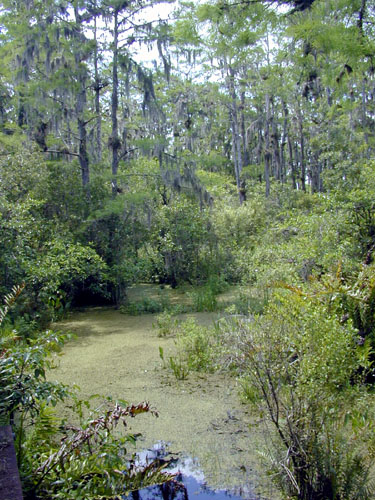 We hear it daily: "Kharrazi warns UK over Iraq quagmire", "Bush Vietnam trip revives Iraq quagmire", "The quagmire deepens in Afghanistan". In fact, just this morning Google News displays about 300 articles published in the past 24 hours that use the word quagmire. Outside the realm of warfare quagmire is of course a fairly well-known word referring to a swamp or bog. The word is a compound of 2 elements; quag + mire.
Let's start with the second element first, -mire. To be mired down in something is to be in a situation where it is difficult to extricate oneself. Similarly, we use the phrase bogged down, or to be swamped. Mire comes from the Old Norse mýrr which predictably means bog. The OED goes on to explain the mire is a variant of the Germanic base of mese, which is an obsolete regional word from England's southwest meaning moss. Mese is "an ablaut variant of the Germanic base" of moss, thus mire and moss are related.
 Now let's go back to t he first element, quag-. Like mire, quag can also stand on its own, meaning, according to the AHD, quagmire. The OED's definition is a bit more telling:
 A marshy or boggy spot, esp. one covered with a layer of turf which shakes or yields when walked on.That "turf which shakes" is quaking (as in an earthquake). In fact, quag and quake come from the same Old English root cwacian (incidentally, there is a synonymous and obsolete variant of quagmire, quakemire). The related Old English word *cwabba meaning "to shake or tremble" is onomatopoeic and comes from the sound of something soft and flabby being jiggled. Thus, the quag'iness of a quagmire is distantly related to the sound it makes as one walks through its muck.
Labels: Old English, Old Norse, Proto-Germanic, The Daily Hump
Monday, October 30, 2006
The Daily Hump: Berserker
 But enough lamenting--berserker is from the Old Norse berserkr which the AHD defines as a "wild warrior or champion". The word likely comes from the compound bear-sark, sark being a fairly archaic word meaning "shirt" (side note: per the OED, sark still means "shirt" in modern Scandinavian languages). This descriptive name refers to the bear hides that the warriors would wear as they marauded around the North Atlantic from the 9th through 11th centuries.
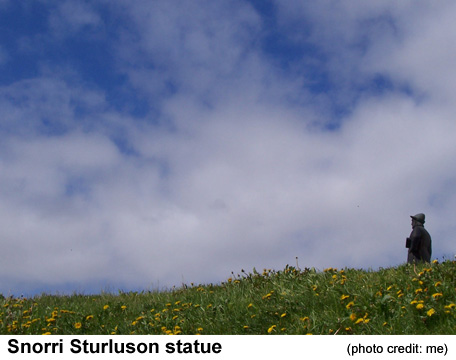
Most of what we know about berserkers comes from the sagas, specifically Egils saga, most likely written in the 13th c by Snorri Sturluson. I've been to Borg, home of Egils saga's protagonist, Egills Skallagrímsson, but alas, found no berserkers.
See also apeshit.
Labels: Old Norse, The Daily Hump
Friday, October 27, 2006
TRJ: Smorgasbord
I have a TRJ for you, "smorgasboard"...saw it on the Weather Channel this morning and I thought I'd mention it.
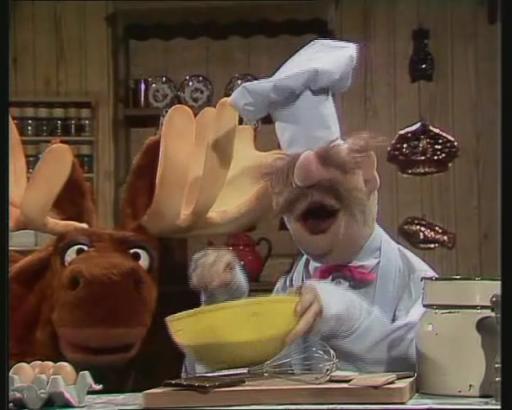 An excellent choice, Caroline...er...CH from Brooklyn. Smorgasbord, smörgåsbord in Swedish (I wish English would leave in umlaut and ring diacritics. They make words much more interesting to look at.), describes a sort of buffet; or, more generically, a varied collection of anything. Smörgås on its own is a slice of bread with butter. The word smör comes to us from Old Norse and means butter; it's a cognate of our English noun smear. Gås is a Swedish dialectal word meaning "lump of butter" and if from the Old Norse gās, goose. Gās gave English its word for a young goose, gosling. Bord, also from Old Norse, is a table and is a cognate of our word board. Der.
Okay, I know your next question--why do the Swedes use the same word for goose and lump of butter? I did some research and found a few theories, all listed on the American Dialectal Society mailing list, circa July 2001.
...the etymology of the word is not 100% certain,or
but apparently it was first used to describe the butter clumps that (as geese) float on the butter milk when one churns butter.
The origin of gås is indeed goose, but smörgås is to be interpreted as goose fat used as a spread ("smear") for bread. Today, of course, the spread is likely not to be goose fat but dairy-based...or
I was always under the impression that the word smörgås was meant to mean "butter goose," in which the open-faced sandwich looks like a goose because the toppings are piled so high. So I'm speculating that it has less to do with goose fat than with a goose shape.The goose-fat theory seems the most credible to me; afterall the Swedes eat some nasty stuff. Seriously, have you ever been to a country that has as many foods available in tube-form? Gross.
If you have a word you'd like humped because you're either too lazy or inept to do it yourself please email it, along with your location, to wordhumper. And in case you missed the TRJ from two weeks ago check out Hallucinations. See you Monday!
Thursday, October 19, 2006
The Daily Hump: Akimbo
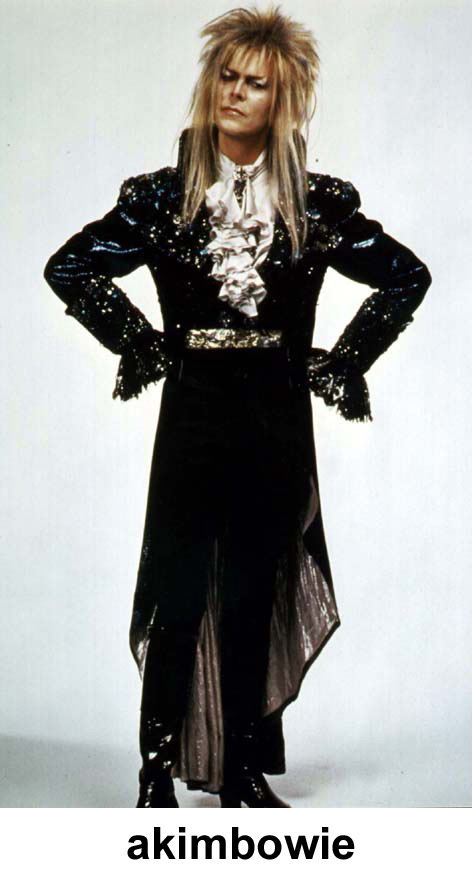 Akimbo surprises me. Given its -bo ending I ignorantly assumed it had African roots (think Mande languages of the upper Niger River valley or our English word mumbo jumbo). In fact, the word can be traced back to Middle English, first appearing in the early 15th c. text The Tale of Beryn ("The hoost..set his hond in kenebowe"). We know in is our modern in. The -bowe corresponds to our modern English bow, as in something that is bent, a knot with two loops or the weapon used to launch arrows. It's the kene portion which stumps the experts. Because of this single element historical linguists have a great deal of difficulty tracing the word's etymology pre-1400.
The OED is kind enough to suggest two possibilities. The first theory focuses around the Middle English phrase a cambok which meant "in the manner of a crooked stick". Thus, analagously, a cam bow would be "in the manner of a crooked bow". The second theory suggests that akimbo is related to the Old Norse keng-boginn which literally means "bent staple-wise, or in a horse-shoe curve". The OED deems neither of these theories wholly satisfactory:
The difficulty as to a-cambok, a cam bow, is that no forms of the word [akimbo] show cam-, from which the earliest are the most remote. The Icel. keng-boginn comes nearer the form, but there is no evidence that it had the special sense of a-kimbo, and none that the latter ever had the general sense of ‘crooked.’ It also postulates an early Eng. series of forms like *keng-bown or *keng-bowed, *keng-bow, *akengbow, quite unknown and unaccounted for.
Labels: Mande, Middle English, Old Norse, The Daily Hump
Thursday, August 24, 2006
Oh me so Þorny...
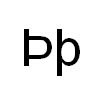 ...well, at least in modern Icelandic, Old Norse, and Old and Middle English. Thorn, or þorn (Þ, þ), traces its roots back to Proto-Germanic, where it has been reconstructed as *Thurisaz.
So, where has Þ gone in our modern English alphabet? Alas, we've replaced this ancient letter with the rather boring digraph th. Just þink about it; we could save ourselves the effort of typing one extra letter every time we spell a word that uses either a voiceless interdental fricative (like th as in the English word thick) or a voiced dental fricative (like th as in the English word the). Þe possibilities are endless.
Sometime during þe 14þ century th started to become more common in English. As its popularity waned, poor þ began to lose its shape (more specifically, it lost its ascender), first appearing similar to the Old English letter wynn (Ƿ, ƿ), þen later morphing into a Y. You can still see ghosts of our þorny linguistic past in pseudo-archaic usages such as "Ye olde...". I þink it's important to point out þat no one during this "Ye" period would ever pronounce the word Ye as yee; in this case, the Y still retained its þ'isitiy (th).
:-Þ
Labels: Icelandic, Middle English, Old English, Old Norse, Proto-Germanic
Monday, August 21, 2006
Bull
 Along the lines of Caroline's recent post, I suggest the Web 2.0 Bullshit Generator. It'll help you reinvent semantic platforms.
And speaking of bullshit, shit has a rather interesting etymology:
Scholars trace the word back to Old Norse origin (skīta), and it is virtually certain that it was used in some form by preliterate Germanic tribes at the time of the Roman Empire. It was originally adopted into Old English as scitte, eventually morphing into Middle English schītte. The word may be further traced to Proto-Germanic *skit-, and ultimately to Proto-Indo-European *skheid-, "split, divide, separate" (cf. Lithuanian šūdas ["shit"]). Conceptually, it refers to that part of the body (the excrement), which is "divided" from the rest of the body. It is related to the verb "to shed" (as in, "to shed one's skin"), "to shoot", and other words in common English usage.Perhaps coincidentally, bull also traces from Old Norse. Thus begs the question, did the Vikings invent bullshit? Think about that next time you're taking a divide.
Shit [Wikipedia]
Labels: Middle English, Old English, Old Norse, PIE, Proto-Germanic
