
Wednesday, March 21, 2007
The Daily Hump: Goo
 I always assumed goo had some sort of onomatopoeic quality. Goo! But, in fact, it seems to be short for burgoo which is a thick stew (originally porridge) native to both New England and, oddly, Kentucky and southern Illinois. It's believe that burgoo is an alteration of ragout, also a stew, which is from the French ragoûter "to revive the taste". Goût is from the Latin gustus "taste", which gives us words such as gusto and disgust.
Gustus is from the Proto-Indo-European base *geus-. Interestingly, although this formed the root for "taste" in Greek and Latin in Germanic and Celtic words the root mostly took on the meaning "try" or "choose". Thus we find the Proto-Germanic *keusan leading to the Old Norse kjosa "to choose" and the word kyrja "chooser". Hence, in Norse mythology, the Valkyries are literally "choosers of the slain (valr, as in Valhalla)".
goo [Online Etymology Dictionary]
ragout [Online Etymology Dictionary]
Valkyrie [Online Etymology Dictionary]
burgoo [AHD]
ragout [AHD]
Labels: French, Greek, Latin, Old Norse, PIE, Proto-Germanic, The Daily Hump

Thursday, March 15, 2007
The Daily Hump: Sooth
The ides of March, a date that will live in infamy (at least for members of the gens Julia). For it's on this day that Gaius Julius Caesar, from the Caesarian section of Rome, was slain by a gaggle of senators which included among them supposed bff Brutus. Of course, Caesar got a pretty good heads up from one Titus Vestricius Spurinna whose name may not be well known but job title surely is: soothsayer. Alas, Titus's warnings were not heeded and the world took receipt of one very dead emperor 2,051 years ago today.
Sooth comes from the Old English soð meaning "truth". Soð is the noun form of the adjective soþ, "true", which was originally *sonþ- and from the Proto-Germanic *santhaz (not to be confused with the Proto-Germanic sexual practice known as dirty *santhaz), a cognate with Old English synn "sin" and Latin sontis "guilty". Ultimately, we go back to the Proto-Indo-European *es-ont meaning "being, existence". This also is the root of today's s-forms of the verb "to be" such as the Latin sunt, German sind and French sont.
Sooth is also a linguistic cousin of soothe, which came from the Old English soðian "show to be true". How this came to mean "to quiet, mollify" beats me. Any ideas?
sooth [Online Etymology Dictionary]
soothe [Online Etymology Dictionary]
Ides of March [Wikipedia]
Julius Caesar [Wikipedia]
Titus Vestricius Spurinna [Wikipedia]
Sooth comes from the Old English soð meaning "truth". Soð is the noun form of the adjective soþ, "true", which was originally *sonþ- and from the Proto-Germanic *santhaz (not to be confused with the Proto-Germanic sexual practice known as dirty *santhaz), a cognate with Old English synn "sin" and Latin sontis "guilty". Ultimately, we go back to the Proto-Indo-European *es-ont meaning "being, existence". This also is the root of today's s-forms of the verb "to be" such as the Latin sunt, German sind and French sont.
Sooth is also a linguistic cousin of soothe, which came from the Old English soðian "show to be true". How this came to mean "to quiet, mollify" beats me. Any ideas?
sooth [Online Etymology Dictionary]
soothe [Online Etymology Dictionary]
Ides of March [Wikipedia]
Julius Caesar [Wikipedia]
Titus Vestricius Spurinna [Wikipedia]
Labels: French, German, Latin, Old English, PIE, Proto-Germanic, The Daily Hump
Tuesday, March 13, 2007
The Daily Hump: Jaded
 I began today pondering whether jade, the gemstone, has any relation to the sensation of being jaded caused from over-indulgence. As I discovered the words are not only unrelated but one exists purely because of French gender confusion.
In the 17th c., when the gemstone was still rather unfamiliar, the feminine l'ejade became the masculine le jade via a simple error and hence our modern word jade is not ejade. L'ejade comes from the Spanish piedra de (la) ijada (stone of colic) because of the gem's supposed ability to cure this ailment. Ijada goes back to the Latin ilia meaning flanks or kidney areas (see ilium, one of the pelvic bones).
The blah kind of jade is a figurative sense coming from a noun meaning "a beaten down horse". This may be related to the Old Norse jalda, meaning "mare", which is itself from Finno-Ugric. The OED says there's no evidence to support any of this but it's as good a guess as any.
jade [Online Etymology Dictionary]
jade [OED]
Labels: Finno-Ugric, French, Latin, Old Norse, Spanish, The Daily Hump
Thursday, March 01, 2007
The Daily Hump: If The Brogue Fits...
 Ah, the storied brogue, that singsong lullaby of the Irish, brogue being another name for the strong dialectal accent common to Irish and Scottish speakers of English. Before we begin, let's look at one of OED's alternate definitions for brogue:
 A rude kind of shoe, generally made of untanned hide, worn by the inhabitants of the wilder parts of Ireland and the Scotch Highlands.This is important because brogue in the dialectal sense probably originated from "speech of those who call a shoe a brogue." Or, if you believe Wikipedia,
The term has been said to have been coined by an Englishman who met an Irishman whose accent was so thick that he spoke "as though he had a shoe in his mouth".Of course, English has other examples of words that were influenced by footwear: ciabatta (from Italian) and sabotage (from French) being the two most obvious. However, shoes are not always the namesake; in the case of clodhopper (clod being from Old English via Proto-Germanic and Proto-Indo-European base *gel- "to make round") the word originally referred to a plowman (literally "one who goes around fields") but then later it became the heavy shoes worn by such an unsophisticated rustic. Likewise plimsolls are so named because the band around the shoe that holds the two parts together reminded people of the mark on the hull of a ship that shows how heavy it can be loaded (the Plimsoll line--Samuel Plimsoll was a 19th c. M.P. keen on shipping reforms).
brogue [Online Etymology Dictionary]
ciabatta [OED]
sabotage [OED]
clodhopper [OED]
clod [Online Etymology Dictionary]
brogue [Wikipedia]
clodhopper [AHD]
plimsoll [Online Etymology Dictionary]
Samuel Plimsoll [Wikipedia]
Labels: French, Irish Gaelic, Italian, Old English, PIE, Proto-Germanic, The Daily Hump
Tuesday, January 23, 2007
The Daily Hump: Humping Quasimodo
Homer: (running into the church) Sanctuary! Sanctuary!
Reverend Lovejoy: Why did I teach him that word?
 Now that it's lunch I have some time to take my daily hump. If you checked in earlier you may have noticed this morning's post is titled Humpback Flashback. Naturally, humpback got me thinking of Quasimodo, best known as the lovable cripple from the 1996 animated film The Hunchback of Notre Dame (Go Fighting Irish!) (and, no, there's no difference between humpbacks, hunchbacks and crookbacks says WordNet). For those of you like me who have better things to do [i.e. anything] than slug through Victor Hugo Boss's 1831 tome or Disney's piss-poor hatchet job it's interesting to observe
 Quasimodo's name is a pun. Frollo finds him on the cathedrals doorsteps on Quasimodo Sunday, and names him after the holiday, inadvertedly calling him "half-formed."Quasimodo Sunday is the first Sunday after Easter, recently designated in 2000 as Divine Mercy Sunday by Pope John Paul II. As Wikipedia notes
The name Quasimodo came from the Latin text of the traditional Introit (opening blessing) for this day, which begins "Quasi modo geniti infantes..." ("As newborn babes...", from the First Epistle of Peter 2:2). Literally, quasi modo means "in the manner of [i.e. newborn babes]".Quasi modo Wordhumper hump.
Quasimodo [Wikipedia]
Quasimodo Sunday [Wikipedia]
The Hunchback of Notre Dame (1996) [IMDB]
The Hunchback of Notre Dame (1939) [IMDB]
The Hunchback of Notre-Dame [Amazon]
Labels: French, Latin, The Daily Hump
Friday, December 01, 2006
Hump This: Pimp My Etymology
Hump This is a (quasi-)weekly Friday feature where you, the WordHumper reader, choose which lucky word gets humped back to the stoneage (or at least to Proto-Indo-Europa). Today's word comes from RM in California who asks:
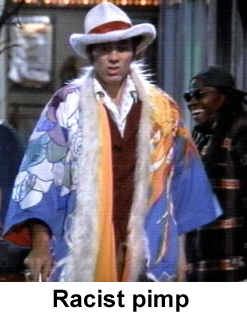 1) It's been suggested that pimp has a connection with the German Pimpf meaning "small boy" but the German word appears much later than the English pimp (c. 1600) and thus any causal relationship seems unlikely. Plus, there are apparently a number of semantic differences.
2) The second suggestion, which is what I would have guessed, is that pimp is short for pimpernel, scarlet-colored or otherwise. But again, the OED claims there are semantic irregularities.
3) There are a number of possible French roots including pimpant (seductive in appearance), pimper (to adorn) and pimpernol, which is a small eel (and is surprisingly not etymologically related to pimpernel at all). The OED dismisses any connections to these words as merely coincidental.
However, the Online Etymology Dictionary, citing a mysterious source "Weekley", offers this li'l nugget of linguistic gold:
If you have a word you'd like humped please email it, along with your location, to wordhumper.
Where does the word "pimp" come from?The American Heritage Dictionary sometimes disappoints me. Effort counts for something in life and sometimes the AHD just doesn't try very hard. Case in point, its entry for the word pimp: "Origin Unknown". Now, the OED also says pimp's origin is unknown however it lists a myriad of possibilities then strikes them down one-by-one. I appreciate this. Let's take a look at what the OED has to say:
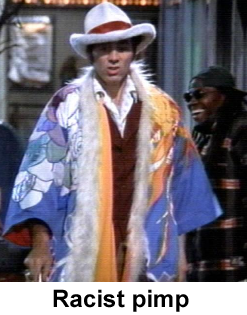 1) It's been suggested that pimp has a connection with the German Pimpf meaning "small boy" but the German word appears much later than the English pimp (c. 1600) and thus any causal relationship seems unlikely. Plus, there are apparently a number of semantic differences.
2) The second suggestion, which is what I would have guessed, is that pimp is short for pimpernel, scarlet-colored or otherwise. But again, the OED claims there are semantic irregularities.
3) There are a number of possible French roots including pimpant (seductive in appearance), pimper (to adorn) and pimpernol, which is a small eel (and is surprisingly not etymologically related to pimpernel at all). The OED dismisses any connections to these words as merely coincidental.
However, the Online Etymology Dictionary, citing a mysterious source "Weekley", offers this li'l nugget of linguistic gold:
Weekley suggests [Middle French] pimpreneau, defined in Cotgrave [?] (1611) as "a knave, rascall, varlet, scoundrell."So, there you go. Now where's my money, bitch?
If you have a word you'd like humped please email it, along with your location, to wordhumper.
Wednesday, November 22, 2006
The Daily Hump: A Humorous Perversion
 Today's hump is neither humorous nor perverse. You've been had. This morning we're looking at gallivant, which the OED describes as a "humorous perversion" (ah!) of gallant (noting that gallivant is generally used in its present participle form gallivanting). Gallant isn't just a ugly old-folks car. Back in the early 19th c., around the same time gallivant first appeared in print (1823), gallant was being used to mean "to gad about idly". Interestingly the OED defines gallivant as "To gad about in a showy fashion, esp. with persons of the other sex." What's with gad?
Gad (in verb form) is of obscure origin. Although it's possible the word comes from the same root as the noun form (i.e. gadfly, where the sense of gad refers to a goad used for prodding cattle), the OED notes that its usage quotes don't support this thesis. Rather, they theorize that gad is "a back-formation" of gadling, which during the 16th c. meant a wayfarer or vagabond. The original sense of gadling, as it was used in Beowulf ("His gædelinges guðgewædu"), meant "companion" or "fellow" and it comes from the Old English root gæd meaning "fellowship". Incidentally, this is the same root which gives us our modern verb to gather.
The verb gallant is from the adjective form and is of French origin. The OED notes
The early senses of the adj. in Fr. are: ‘dashing, spirited, bold’ (obsolete in Fr., but the source of the prevailing sense in mod.Eng.); ‘gay in appearance, handsome, gaily attired’; and ‘fitted for the pleasures of society, attractive in manners, courteous, polished’. The last of these gave rise in mod.Fr. to the specialized senses ‘politely attentive to women’, and ‘amorous, amatory’, which were adopted into Eng. in the 17th c., and are usually distinguished by the accentuation ga'llant.The Old French root, galant, is from the past participle form of the Old French verb galer, meaning "to make merry". Via a Spanish lineage this is where Modern English gets its word gala.
WordHumper returns on Monday. Gobble gobble.
Labels: French, Old English, Old French, Spanish, The Daily Hump
Tuesday, November 21, 2006
The Daily Hump: Corduroy
 Corduroy is from the French corde du roi, "the king's cord." If it were only that easy. Depending on which source you want to believe corde du roi may be a great example of a false etymology.
 The word corduroy has never been used in French; they refer to the fabric as velours côtelé. The AHD reports that corduroy comes from cord + duroy, duroy being an obsolete term referring to a course woolen fabric. However, the OED disputes this:
Duroy occurs with serge and drugget as a coarse woollen fabric manufactured in Somersetshire in the 18th c....it has no apparent connexion with corduroy.Alas, the OED doesn't offer much of an alternative theory feebly noting that Corderoy is an English surname. Interestingly, the OED states that although the etymology of duroy is uncertain it could be from du roi, "of the king". Thus, if we accept AHD's contention that the etymology of corduroy is cord + duroy, then the supposedly false etymology, "the king's cord", may actually be correct!
Labels: French, The Daily Hump
Wednesday, October 18, 2006
The Daily Hump: Choppin' Broccoli
 Broccoli has been a favorite vegetable of mine for years now. Whether steamed, raw or stir-fried it's one of the simple pleasures in life. My love stems from a number of factors including broccoli's taste, the auditory satisfaction I receive when crunching into a raw floret, and even broccoli's general aesthetic qualities--the deep green and bonzai-like complexity.
Despite its obvious Italian roots, the first mention of broccoli is in a mid-16th c. French text. It's possible Romans were cultivating the plant as far back as the 1st c. CE (a vegetable similar to broccoli is described by Pliny the Elder) but, at least in the New World, the vegetable was considered fairly exotic until commercial cultivation began in California in 1922.
In Italian the word broccoli is a plural form of broccolo, which is the flowering sprout of a turnip. The root brocco means shoot or stalk and is a direct descendant of the vulgar Latin *brocca meaning spike. In addition to broccoli, *brocca gives us such modern English words as broach (via the Latin broccus, projecting), brooch and brocade.
broccoli [OED]
broccoli [Wikipedia]
Labels: French, Italian, Latin, The Daily Hump
Tuesday, September 26, 2006
The Daily Hump: Charlatans
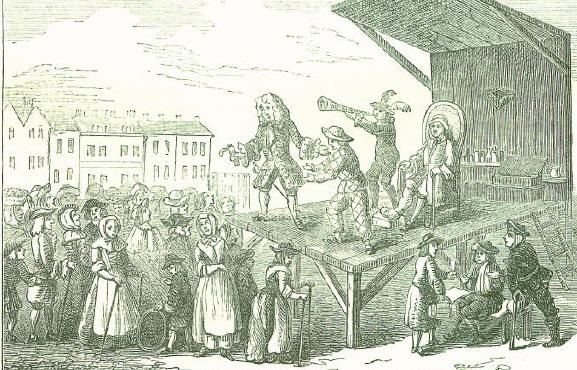 Charlatans are frauds who often make elaborate claims of skill or knowledge in order to con their unassuming victims. The word has numerous synonyms and today we're going to examine a few.
 First, let's look at the word charlatan itself. It's a word that came to English in the early 17th century via the French, who borrowed it from the Italian ciarlatano, which is a hybrid of ciarlare, "to prattle" and cerrentano, an inhabitiant of Cerreto. According to the American Heritage Dictionary Cerreto was a city once famous for its quacks.*
 And speaking of quacks, in the above definition it's actually an abbreviation for quacksalver. Not to be confused with quicksilver (which is a future hump), quacksalver comes to us from 16th century Dutch where it was thought to mean "one who quacks about ointments." It has also been suggested that the quack- portion meant "to work in a bungling fashion", but that doesn't lend itself to as much humormous imagery.
Our final synonym is mountebank, a word of Italian origin that literally translates to "mount on a bench" and refers to the raised platforms used by the hawkers (see sketch at top). It's also synonymous with saltimbanco, which means "to leap on to a bench."
I leave you today with a dialogue from SNL:
Alex Trebek: ...And finally, Sean Connery's also here let's move on to Double Jeopardy where the categories -*I googled "Cerreto" trying to find out more about its quack addiction. None of the tourist sites mention anything about charlatans; it's just your usual prattle about beautiful Tuscan-like villas and medieval churches. When you google "Cerreto quacks" all you get are hundreds of websites quoting the exact same etymology for charlatan that I used above. Thankfully, after googling "cerreto history charlatans" the Historical Archives of Italian Nephrology pulled through via the US National Center for Biotechnology Information:
Sean Connery: Not so fast Trebek.
Alex Trebek: I really thought that was going to work.
Sean Connery: Well, you were wrong, you mountebank. I pose a conundrum to ya, I riddle if you will
Alex Trebek: I don't want to hear it.
Sean Connery: What's the difference between you and a mallard with a cold? One's a sick duck and I can't remember how it ends, but your mother's a whore. [Laughs]
Cerreto is a tiny town in the Valnerine area (Umbria) famous all over the world for the phenomenon of charlatanism derived from Cerretani inhabitants. In the Middle Ages, these people started to beg for alms on hehalf of medical and religious foundations. When their occupation ended due to religious prohibition (Council of Trent) the Cerretani shifted to Charlatanism or quackery. The Charlatans exploited the absence of institutional medicine in rural areas and the credulity and superstition of many sick people. A cynical distrust of the medical profession in urban areas helped the charlatans' activity to spread. They delivered diagnostic advice and therapeutic remedies in public squares. Renal and bladder remedies were key cures from still earlier quackeries. Some historians of medicine believe that some rural or town citizens were particulalry addicted to panaceas or placebos. Charlatans from all over the world poured into the happy hunting grounds. Quackery flourished on a grand scale until education spread throughout the population and medical services were made available to the poor. Special laws to safeguard health-care, helped undermine the charlatan healing phenomenon. Popular quackery medicine neared its end in the mid twentieth century.quacksalver [OED]
montebank [OED]
saltimbanco [OED]
Labels: Dutch, French, Italian, The Daily Hump
Wednesday, September 06, 2006
The Daily Hump: Curmudgeon
 Most, if not all, WordHumper readers know the definition of curmudgeon. It's used fairly often in everyday conversation to mean an ill-tempered miser, a niggard. I first came across the word in 1992 as it was the title of a track on the b-side of Nirvana's Lithium single. I remember thinking it was a strange word then, but the etymology is what truly makes curmudgeon peculiar.
I really cannot explain the theory of curmudgeon's etymology better than the OED, so I'll just quote them on this one.
The occurrence in Holland's Livy, 1600, of CORNMUDGIN (q.v.) has led to a suggestion that this was the original form, with the meaning ‘concealer or hoarder of corn’, mudgin being associated with ME. much-en, mich-en to pilfer, steal, or muchier, Norman form of OF. mucier, musser to conceal, hide away. But examination of the evidence shows that curmudgeon was in use a quarter of a century before Holland's date, and that cornmudgin is apparently merely a nonce-word of Holland's, a play upon corn and curmudgeon. The suggestion that the first syllable is cur, the dog, is perhaps worthy of note; but that of Dr. Johnson's ‘unknown correspondent’, c{oe}ur méchant for F. méchant c{oe}ur, ‘evil or malicious heart’, is noticeable only as an ingenious specimen of pre-scientific ‘etymology’, and as having been retailed by Ash in the form, ‘from the French c{oe}ur unknown, and mechant a correspondent’!Personally, I always assumed the etymology had something to do with the Latin cur meaning 'why'. And there's an East Anglian word murgeon that originally had the meaning of dirt (but now tends to mean manure). I have no idea how curmudgeon would come to mean miser from 'why dirt', but I'm sure we'll come across stranger less obvious etymologies as we continue our wordhump odyssey. Anyway, we should probably just ignore my theory. On a sidenote, I think the idea of a cornmudgin is hilarious and I intend on adopting that word into my everyday vocabulary.
curmudgeon [OED]
cornmudgin [OED]
murgeon [OED]
Labels: Anglo-Norman, East Anglian, French, Middle English, Old French, The Daily Hump
Thursday, August 31, 2006
The Daily Hump: Jew's Harp
I'm a Jew, but I don't own a harp. I suppose if I did, it'd be a Jew's harp. But in actuality there is a specific type of musical instrument called the Jew's harp--it was earlier known as a Jews' trump--and yet it is neither a harp nor a trumpet and why it is associated with the Jews has been a source of mystery for centuries.
 The Jew's harp consists of a lyre-shaped metal frame that is held between the teeth. A soft twanging sound is created by plucking a steel tongue that projects from the frame. The instrument is found in cultures throughout the world yet only in English has it managed to become associated with Jews. Some theories suggest that the Jew's harp got its name because it was made popular by my favorite extinct group of converts, the Khazars. Others suggest Jew is simply a corruption of jaw. And yet another theory posits that Jew is a corruption of the French jeu (toy).
Funnily enough, the dictionary of dictionaries, the OED, calls the jeu theory "baseless and inept." Oh snap! The OED theorizes that because the Jew association only exists in English perhaps Jews were involved in the manufacturing and selling of the instruments in England. Another OED theory is that because the Bible continually mentions harps and trumpets, the word Jew was added to the name as a marketing ploy (Jews are Biblical and they endorse this harp--Christian Joe like the Bible, thus Christian Joe wants this Jew's harp). This idea seems a bit of a stretch because although it correctly assumes that a Biblical association would be viewed positively, it's ignoring the blatantly obvious fact that a Jewish association would most likely be viewed negatively. Afterall, the English are the same people that in 1290 expelled Jews from their country for 350 years (thanks, Edward I--ass).
Nope, I actually think the jeu theory is most likely the correct one. Webster's cites the etymological root at the Dutch Jeugdtromp (youth's trumpet). If we apply Occam's razor, these linguistic corruptions seem much more likely than the OED suggestions. I have to admit, I'm a bit disappointed with the OED on this one.
Jews' Tromp [OED]
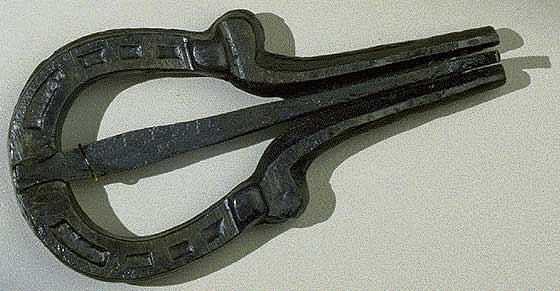 The Jew's harp consists of a lyre-shaped metal frame that is held between the teeth. A soft twanging sound is created by plucking a steel tongue that projects from the frame. The instrument is found in cultures throughout the world yet only in English has it managed to become associated with Jews. Some theories suggest that the Jew's harp got its name because it was made popular by my favorite extinct group of converts, the Khazars. Others suggest Jew is simply a corruption of jaw. And yet another theory posits that Jew is a corruption of the French jeu (toy).
Funnily enough, the dictionary of dictionaries, the OED, calls the jeu theory "baseless and inept." Oh snap! The OED theorizes that because the Jew association only exists in English perhaps Jews were involved in the manufacturing and selling of the instruments in England. Another OED theory is that because the Bible continually mentions harps and trumpets, the word Jew was added to the name as a marketing ploy (Jews are Biblical and they endorse this harp--Christian Joe like the Bible, thus Christian Joe wants this Jew's harp). This idea seems a bit of a stretch because although it correctly assumes that a Biblical association would be viewed positively, it's ignoring the blatantly obvious fact that a Jewish association would most likely be viewed negatively. Afterall, the English are the same people that in 1290 expelled Jews from their country for 350 years (thanks, Edward I--ass).
Nope, I actually think the jeu theory is most likely the correct one. Webster's cites the etymological root at the Dutch Jeugdtromp (youth's trumpet). If we apply Occam's razor, these linguistic corruptions seem much more likely than the OED suggestions. I have to admit, I'm a bit disappointed with the OED on this one.
Jews' Tromp [OED]
Labels: Dutch, French, Khazar, The Daily Hump
Monday, August 28, 2006
The Daily Hump: Picayune and a Lack of Confidence, Man
If you're like me the only time you can remember ever hearing the word picayune was in reference to The Bloom Picayune or The Times-Picayune of New Orleans. This being the case, you may think I've decided to word hump picayune in memory of the first anniversary of Katrina (or the 17th anniversary of the demise of Bloom County). You'd be wrong.
It's a bit of a convoluted story how picayune became today's word. On Friday my friend John over at the ever-excellent DealBreaker.com suggested I research the etymology of confidence man which ended up revealing a spate of errors across the Internet.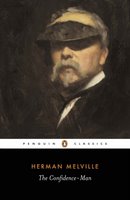 Many sources trace the etymology of confidence man back to Herman Melville's 1857 novel The Confidence-Man. Wrong. According to Wikipedia the inspriation for Melville's use of the term was the 1849 trial of William Thompson. Thompson would convince his mark to lend him his timepiece (or sometimes money) promising it'd be returned the following day; of course in all these cases Thompson would never be seen again. Up until this past Friday Wikipedia claimed that the first publication to coin the term was The New York Herald on July 8, 1849. Many websites do the same. In fact, the small New Orleans Picayune seems to have beaten the New York Herald by about 2 weeks, publishing this quote on June 21, 1849, "Well, then, continues the `confidence man', just lend me your watch till to-morrow." I edited the Wiki entry accordingly.
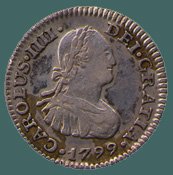 Ok, so, the search for the etymology of confidence man led me to The New Orleans Picayune which made me curious about the etymology of picayune. Make sense? The picayune is an obsolete term that was once common in southern United States, especially Louisiana where it was a Spanish half-real (by real, I mean a silver coin formerly used in Spain and Latin America: see photo). In later use the picayune was a 5-cent piece or other coin of little value. This definition was soon adapted to mean anything trivial, unimportant or in the case of people, worthless and contemptible. Thus one could describe William Thompson as rather picayune (it can be used alternately as a noun or adjective).
According to the OED, the term goes as far back as to 1643 where a Lyonnais source used it to describe foreign coinage. Around the 1740s a plural form (picaillons) began to circulate in France as a slang term for money or cash.
William Thompson [Wikipedia]
It's a bit of a convoluted story how picayune became today's word. On Friday my friend John over at the ever-excellent DealBreaker.com suggested I research the etymology of confidence man which ended up revealing a spate of errors across the Internet.
Many sources trace the etymology of confidence man back to Herman Melville's 1857 novel The Confidence-Man. Wrong. According to Wikipedia the inspriation for Melville's use of the term was the 1849 trial of William Thompson. Thompson would convince his mark to lend him his timepiece (or sometimes money) promising it'd be returned the following day; of course in all these cases Thompson would never be seen again. Up until this past Friday Wikipedia claimed that the first publication to coin the term was The New York Herald on July 8, 1849. Many websites do the same. In fact, the small New Orleans Picayune seems to have beaten the New York Herald by about 2 weeks, publishing this quote on June 21, 1849, "Well, then, continues the `confidence man', just lend me your watch till to-morrow." I edited the Wiki entry accordingly.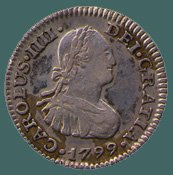 Ok, so, the search for the etymology of confidence man led me to The New Orleans Picayune which made me curious about the etymology of picayune. Make sense? The picayune is an obsolete term that was once common in southern United States, especially Louisiana where it was a Spanish half-real (by real, I mean a silver coin formerly used in Spain and Latin America: see photo). In later use the picayune was a 5-cent piece or other coin of little value. This definition was soon adapted to mean anything trivial, unimportant or in the case of people, worthless and contemptible. Thus one could describe William Thompson as rather picayune (it can be used alternately as a noun or adjective).
According to the OED, the term goes as far back as to 1643 where a Lyonnais source used it to describe foreign coinage. Around the 1740s a plural form (picaillons) began to circulate in France as a slang term for money or cash.
William Thompson [Wikipedia]
Labels: Carney, French, The Daily Hump
