
Thursday, January 18, 2007
WordHumper EXCLUSIVE!!!
 WordHumper is first to report that DealBreaker.com's esteemed editor John Carney is out of the hospital!
MUST SOURCE WORDHUMPER. MUST SOURCE WORDHUMPER.

Monday, January 15, 2007
WordHumper EXCLUSIVE!!!
WordHumper is first to report that DealBreaker.com's esteemed editor John Carney broke a freakin' leg thanks to some asshole hit and run driver. Here's wishin' John a fast and speedy recovery!MUST SOURCE WORDHUMPER. MUST SOURCE WORDHUMPER.
Update: "EXCLUSIVE" is a joke, people! Cool your jets...
Thursday, November 30, 2006
Sound Moving Beyond Language
Ben uses sound to not just communicate but also to see. Think dolphins and bats.
DealBreaker's John Carney has suggested that given the theory that the earliest languages were click-based, perhaps it is possible that our vocal cords developed out of a need to not just communicate but also to see in the dark. If this were true then Ben's ability to echolocate may not be a new adaptation but rather the reawakening of a long-dormant trait.
DealBreaker's John Carney has suggested that given the theory that the earliest languages were click-based, perhaps it is possible that our vocal cords developed out of a need to not just communicate but also to see in the dark. If this were true then Ben's ability to echolocate may not be a new adaptation but rather the reawakening of a long-dormant trait.
Labels: Carney
Monday, August 28, 2006
The Daily Hump: Picayune and a Lack of Confidence, Man
If you're like me the only time you can remember ever hearing the word picayune was in reference to The Bloom Picayune or The Times-Picayune of New Orleans. This being the case, you may think I've decided to word hump picayune in memory of the first anniversary of Katrina (or the 17th anniversary of the demise of Bloom County). You'd be wrong.
It's a bit of a convoluted story how picayune became today's word. On Friday my friend John over at the ever-excellent DealBreaker.com suggested I research the etymology of confidence man which ended up revealing a spate of errors across the Internet. Many sources trace the etymology of confidence man back to Herman Melville's 1857 novel The Confidence-Man. Wrong. According to Wikipedia the inspriation for Melville's use of the term was the 1849 trial of William Thompson. Thompson would convince his mark to lend him his timepiece (or sometimes money) promising it'd be returned the following day; of course in all these cases Thompson would never be seen again. Up until this past Friday Wikipedia claimed that the first publication to coin the term was The New York Herald on July 8, 1849. Many websites do the same. In fact, the small New Orleans Picayune seems to have beaten the New York Herald by about 2 weeks, publishing this quote on June 21, 1849, "Well, then, continues the `confidence man', just lend me your watch till to-morrow." I edited the Wiki entry accordingly.
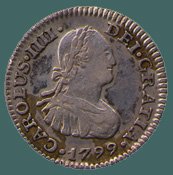 Ok, so, the search for the etymology of confidence man led me to The New Orleans Picayune which made me curious about the etymology of picayune. Make sense? The picayune is an obsolete term that was once common in southern United States, especially Louisiana where it was a Spanish half-real (by real, I mean a silver coin formerly used in Spain and Latin America: see photo). In later use the picayune was a 5-cent piece or other coin of little value. This definition was soon adapted to mean anything trivial, unimportant or in the case of people, worthless and contemptible. Thus one could describe William Thompson as rather picayune (it can be used alternately as a noun or adjective).
According to the OED, the term goes as far back as to 1643 where a Lyonnais source used it to describe foreign coinage. Around the 1740s a plural form (picaillons) began to circulate in France as a slang term for money or cash.
William Thompson [Wikipedia]
It's a bit of a convoluted story how picayune became today's word. On Friday my friend John over at the ever-excellent DealBreaker.com suggested I research the etymology of confidence man which ended up revealing a spate of errors across the Internet.
Many sources trace the etymology of confidence man back to Herman Melville's 1857 novel The Confidence-Man. Wrong. According to Wikipedia the inspriation for Melville's use of the term was the 1849 trial of William Thompson. Thompson would convince his mark to lend him his timepiece (or sometimes money) promising it'd be returned the following day; of course in all these cases Thompson would never be seen again. Up until this past Friday Wikipedia claimed that the first publication to coin the term was The New York Herald on July 8, 1849. Many websites do the same. In fact, the small New Orleans Picayune seems to have beaten the New York Herald by about 2 weeks, publishing this quote on June 21, 1849, "Well, then, continues the `confidence man', just lend me your watch till to-morrow." I edited the Wiki entry accordingly.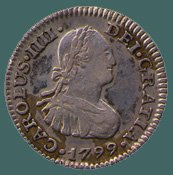 Ok, so, the search for the etymology of confidence man led me to The New Orleans Picayune which made me curious about the etymology of picayune. Make sense? The picayune is an obsolete term that was once common in southern United States, especially Louisiana where it was a Spanish half-real (by real, I mean a silver coin formerly used in Spain and Latin America: see photo). In later use the picayune was a 5-cent piece or other coin of little value. This definition was soon adapted to mean anything trivial, unimportant or in the case of people, worthless and contemptible. Thus one could describe William Thompson as rather picayune (it can be used alternately as a noun or adjective).
According to the OED, the term goes as far back as to 1643 where a Lyonnais source used it to describe foreign coinage. Around the 1740s a plural form (picaillons) began to circulate in France as a slang term for money or cash.
William Thompson [Wikipedia]
Labels: Carney, French, The Daily Hump
Tuesday, August 22, 2006
Crack is addicting--wait, no, addictive...kaboom!
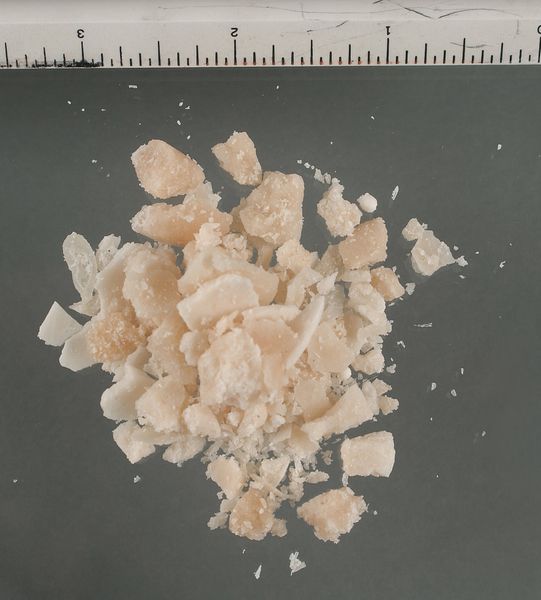 While reporting on the crack-like properties of Blackberries, my friend John, one of the good folks over at the stellar DealBreaker.com, used the word addicting. A reader commented that "'Addicting' is not even a word."
The addicting/addictive debate is as old as the cosmos*. John called the reader's contention "absurd" and he's right; addicting is the participal adjective of addict, while addictive is simply the adjective. This is according to the OmotherfuckingED. Game, set and match.
Wayne, over on Dionidium, does a nice job of summing up the usage differences between the two words.
Addicting vs Addictive [Dionidium]
Crackberry: You Really Might Be Addicted [DealBreaker]
*That is, if the cosmos were created in 1939, OED's earliest reference to the words.
Labels: Carney
