Thursday, March 08, 2007
The Daily Hump: Z
 I was talking to my gf the other day about British versus American spellings, particularly with regards to the American's much more abundant use of the letter Z. Rather quickly, the subject turned away from spelling to the pronunciation of the letter itself: zee versus zed. It seems natural to me that we'd call Z zee, afterall we call B bee, D dee, G jee, K kay, etc...basically you don't need more than two consonants to spell any letters in our alphabet minus the wily W. But much to my surprise we Americans are all alone because the British (including everyone, excluding the Americans, who were once under the empire's yoke) and the French are all zedophiles.
 Z was not native to Old English. English inherited the letter from the Anglo-Normans and Z ultimately harkens back to the Greek zeta, which itself goes back to the Hebrew zayin. It's easy to understand the relationship between zed and zeta and it wasn't until the end of the 17th c. that people started hearing zee. However, as Randomhouse's Maven notes, it could be that we Americans have one man to thank for our pronunciation
...Noah Webster--lexicographer, spelling reformer, and advocate for a unique, distinctive American English--must have exerted considerable influence. The pronunciation of Z in his great two-volume American Dictionary of the English Language (1828) was unequivocal: "Z . . . It is pronounced zee."Interestingly, other dialectal names for the letter exist beyond zee and zed: izzard, ezod, uzzard (all from the mid-18th c. and likely derived from the French et zède) and zod.
zed [Online Etymology Dictionary]
Z [Online Etymology Dictionary]
Z [Wikipedia]
Labels: Anglo-Norman, Greek, Hebrew, The Daily Hump

Thursday, March 01, 2007
Hump This: Squirrel
 Hump This is a (quasi-)weekly Friday feature where you, the WordHumper reader, choose which lucky word gets humped back to the stoneage (or at least to Proto-Indo-Europa). Today's request comes from RM in California who writes:
 Dear Wordhumper,RM, thanks for the question--our word squirrel comes to us via the Anglo-Norman esquirel circa 1327. Is it a coincidence that the word appears a mere twenty years before the black death ravaged Europe and just one decade before the launch of the Hundred Years' War? I don't think so. That being said, the squirrel made it into Old French (escurel) via the Latin sciurus, which came from the Greek skiouros, literally meaning "shadow-tailed." The notion is squirrels have large bushy tails which allow them to easily shade themselves. Fascinating.
Like so many in my close knit family, I have an affinity for rodents and in particular, squirrels. Once, I saw a show on some cable channel I no longer get that said the word 'squirrel' comes from a greek word meaning something along the lines of, 'covers head with his tail for shade'. I could be totally wrong because this was awhile ago. So, where does the word 'squirrel' come from?
 If you have a word you'd like humped please email it along with your city or state to wordhumper@gmail.com. To paraphrase Q-Tip of A Tribe Called Quest, the ladies sweat my Wordhump style like the squirrels sweat the nuts.
squirrel [Online Etymology Dictionary]
Labels: Anglo-Norman, Greek, Hump This, Latin, Old French
Friday, October 20, 2006
The Daily Hump: Mushrooms and Toadstools
 There's so much to say about mushrooms and toadstools from a historical and cultural perspective that I wouldn't know where to begin nor is WordHumper the forum to explore the intricacies of my favorite fungi. The best I can do is suggest you read Elio Schaecter's excellent In The Company of Mushrooms*. As for me, I'll be limiting this discourse to purely an etymological examination.
Mushroom comes to us from the Medieval Latin musariō, musariōn- via Old French, Anglo-Norman then finally Middle English. Per the Online Etymology Dictionary:
Barnhart says [mushroom is] "of uncertain origin." Klein calls it "a word of pre-Latin origin, used in the North of France;" OED says it usually is held to be a derivative of Fr. mousse "moss," and Weekley agrees, saying it is properly "applied to variety which grows in moss."Don't worry, I don't know who Banhart, Klein or Weekley are either.
Toadstool is one of my favorite words in the English language. The OED and many other dictionaries explain the word as "fanciful"; a compound of toad + stool that was first coined in Middle English. Toads were regarded as extremely poisonous and toadstools generally only refer to inedible or poisonous mushrooms. In my readings I also happened upon an alternate etmology which suggests that toadstool had nothing to do with toads but rather the German tod, death. As Wikipedia states:

The term [toadstool] dates from the fourteenth century and is a fanciful [there is that word again!] name combining toad, which were associated with poison, and stool, which is an archaic term for the head of a mushroom. Another explanation comes from the German translation of tod-stuhl, literally, "death-chair," referring to the shape of the fruiting body and also to the slow, agonizing death from mushroom poisoning for those who eat it.Regardless of which etymology is correct, toadstools are named for their toxicity. Given the association of toads with poison I investigated whether the English toad could be related to the German tod; alas, the OED claims that although toad can be traced as far back as to the Old English tādige it has no cognates in other languages and is thus considered of unknown origin.**
In conclusion, next time you're shrooming with the hippies, smelling a stinky phallus, hanging out with the hobbits, Smurfs, mycologists, or Brothers Mario, or just eating a slice of pizza stop and think about what a lousy and boring world we'd live in without the ubiquitous mushroom.***
*Completely unrelated, I also suggest you read Spy: The Funny Years.
 **It should be noted that Princess Toadstool is the best character available in Super Mario Bros 2 (photo: SMB1). Obviously, I'm not the only person who wondered why Mario would be romantically involved with someone whose last name is based upon a fungus responsible for "slow, agonizing death"; in late 1996 Nintendo changed her name to Peach. So gay.
***I'll be out of the country for a few days so the next hump will be on Wednesday.
Labels: Anglo-Norman, German, Medieval Latin, Middle English, Old English, Old French, The Daily Hump
Wednesday, October 04, 2006
The Daily Hump: All The Mews That's Fit To Print
 For you Brits in the audience, you've undoubtedly stumbled across mews while shuffling around the larger cities, especially London. Even Manhattanites have likely walked down Washington Mews (pictured) just north of Washington Sq Park and home to many an NYU language department. As one would expect "mew" in these cases has less to do with feline cries and more to do with the type of thoroughfare--but what exactly is a mew?
Per the American Heritage Dictionary a mews is (or one can say "are"...either the singular or plural verb is correct):
1. A group of buildings originally containing private stables, often converted into residential apartments.
2. A small street, alley, or courtyard on which such buildings stand.
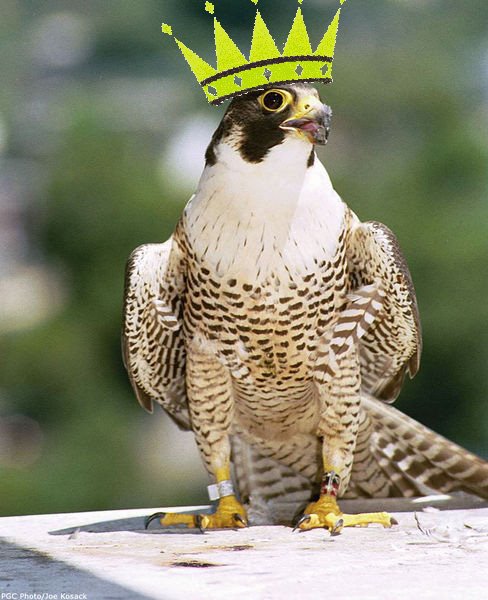 Fair enough. The most famous of mews is likely the Royal Mews near Buckingham Palace where the Queen's coaches are kept. Originally, the Royal Mews were at Charing Cross built on the site of an even older mews, the one for the royal hawks. During the middle ages a mew was a cage for birds, especially hawks, when they were moulting. The Royal Mews came into existence shortly after the falconry fad was first exported from France to England post-Norman conquest of 1066. Falcon happens to be a French loanword, as is mew (French being the language of the court for both the Norman and early Plantagenet kings), which came from the verb muer, the act of shedding feathers. Muer is from the Latin mūtāre (to change), which is of course responsible for our modern English mutate and mutant.
mews [OED]
mew [OED]
falconry [Wikipedia]
Labels: Anglo-Norman, Latin, The Daily Hump
Friday, September 29, 2006
TRJ: Cuckoo for Cuckold Puffs
Alternate title: One Flew Over the Cuckold's Nest
Today's special in the history of WordHumper because we're inaugurating "Total Request Jive" or "TRJ" for short. This will be a weekly Friday feature where you the WordHumper reader decide which lucky word gets humped back to the stoneage (or at least to Proto-Indo-Europa). And today's word comes to us from CH in Brooklyn who IMs:
CH: i want you to hump "cuckold"
CH: i bet it's dirty
 I accept your challenge, CH! Cuckold goes back to the Old French word for the cuckoo bird. Because it's Friday and I'm lazy and the research has already been done let's go right to the blockquote from American Heritage.
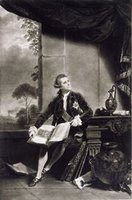 It should be noted that although cuckold does have a rather negative connotation not all men who suffered this fate were necessarily unhappy. In fact a wittol is a man who doesn't mind that his wife is servicing the neighborhood. This comes from the Middle English wetewold, which is composed of the verb weten (to know), and (coke)wold, which, as we saw above means cuckold. The most famous of wittols is likely Sir William Hamilton (left) whose wife Emma became the lover of Horatio Nelson.
On a side note, the Middle English weten is also responsible for our Modern English word wit. And in case you're wondering how cuckoo came to mean a foolish or crazy person, I'm sorry to say sources are vague at best. The OED simply notes that a person is called cuckoo in reference to the "bird's monotonous call."
wittol [American Heritage]
wit [American Heritage]
wittol [OED]
cuckold [OED]
cuckoo [OED]
cuckold [Wikipedia]
cuckoo [Wikipedia]
William Hamilton [Wikipedia]
Today's special in the history of WordHumper because we're inaugurating "Total Request Jive" or "TRJ" for short. This will be a weekly Friday feature where you the WordHumper reader decide which lucky word gets humped back to the stoneage (or at least to Proto-Indo-Europa). And today's word comes to us from CH in Brooklyn who IMs:
CH: i want you to hump "cuckold"
CH: i bet it's dirty
 I accept your challenge, CH! Cuckold goes back to the Old French word for the cuckoo bird. Because it's Friday and I'm lazy and the research has already been done let's go right to the blockquote from American Heritage.
 The female of some Old World cuckoos lays its eggs in the nests of other birds, leaving them to be cared for by the resident nesters. This parasitic tendency has given the female bird a figurative reputation for unfaithfulness as well. Hence in Old French we find the word cucuault, composed of cocu, “cuckoo, cuckold,” and the pejorative suffix –ald and used to designate a husband whose wife has wandered afield like the female cuckoo. An earlier assumed form of the Old French word was borrowed into Middle English by way of Anglo-Norman. Middle English cokewold, the ancestor of Modern English cuckold, is first recorded in a work written around 1250.The OED adds that in German cuckold
...applied to the adulterer as well as the husband of the adulteress, and Littré cites an assertion of the same double use in French; in English, where cuckold has never been the name of the bird, we do not find it applied to the adulterer.You may have heard that cuckolds are sometimes "wearing the horns"--if you're into egregious acts of humiliation you'll be happy to learn that this refers to an apocryphal tradition that claims in some European villages when a wife gives birth to a child recognizably not his own a parade is held "...in which the hapless husband is forced to wear antlers on his head as a symbol of his wife’s infidelity". Ouch.
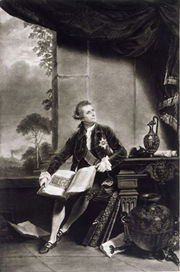 It should be noted that although cuckold does have a rather negative connotation not all men who suffered this fate were necessarily unhappy. In fact a wittol is a man who doesn't mind that his wife is servicing the neighborhood. This comes from the Middle English wetewold, which is composed of the verb weten (to know), and (coke)wold, which, as we saw above means cuckold. The most famous of wittols is likely Sir William Hamilton (left) whose wife Emma became the lover of Horatio Nelson.
On a side note, the Middle English weten is also responsible for our Modern English word wit. And in case you're wondering how cuckoo came to mean a foolish or crazy person, I'm sorry to say sources are vague at best. The OED simply notes that a person is called cuckoo in reference to the "bird's monotonous call."
wittol [American Heritage]
wit [American Heritage]
wittol [OED]
cuckold [OED]
cuckoo [OED]
cuckold [Wikipedia]
cuckoo [Wikipedia]
William Hamilton [Wikipedia]
Labels: Anglo-Norman, Middle English, Old French, TRJ
Friday, September 22, 2006
The Daily Hump: Mötley
 Okay, okay...there really isn't an umlaut in the word motley, it's purely a heavy metal gimmick meant to give a band's logo a Teutonic quality. As Spinal Tap's David St. Hubbins noted "It's like a pair of eyes. You're looking at the umlaut, and it's looking at you."
Now that we have that out of the way, have you really ever given thought to the word motley...motley...you know, really hump the word mentally until you realize it's rather strange? It means "heterogenous" or "having a great amount of variation." In the late 14th century there was an Anglo-Norman word motlei meaning "variegated" or, in the noun form, "variegated cloth" (and was also the name of the outfit worn by a harlequin, hence motley fool). If we attempt to look further back in time the list of potential candidates for motley roots is rather...er...motley. The OED suggests three: medley, motey and mote. Let's take a gander at each.
In regards to medley the OED is specifically referring to a rare definition where it means a type of cloth made of dyed wool, which was frequently multi-colored, hence the name. This sense, in turn, is related to an obscure word, mellay, meaning hand-to-hand combat which is closely related to our very common word melee, meaning a confused violent free-for-all. Melee comes the part participle of the Old French mesler, meaning "to mix." We've seen this root before...here.
Motey is an obscure word that refers to a type of earth used as a pigment which apparently created a speckled appearance when applied. We see references to it from the mid 14th century up through the early 16th century. It's believed, but not confirmed, that the word is related to our third candidate mote.
If you're thinking of a large water-filled ditch surrounding a castle, then you're thinking of a moat, not a mote. A mote is a speck or particle, like the kind you see floating in a beam of light or that annoying speck that gets in your eye or throat, and is a cognate of the West Frisian mot meaning "peat dust." Interestingly, it's possible that mote is related to the Swedish word for dirt, which gave us our word smut. As well, it's possible mote is related to the Germanic base of what became our word moth, those pesky insects that reduce cloth to small fragments.
Ultimately, as with many words, we'll never have a definitive root for motley, just a theory; yet, it's amusing that Mötley Crüe chose a name whose roots are most likely buried in harlequin outfits, fighting and dirt.
On second thought, it's perfect.
motley [OED]
motey [OED]
mote [OED]
Labels: Anglo-Norman, Old French, Proto-Germanic, The Daily Hump, West Frisian
Wednesday, September 06, 2006
The Daily Hump: Curmudgeon
 Most, if not all, WordHumper readers know the definition of curmudgeon. It's used fairly often in everyday conversation to mean an ill-tempered miser, a niggard. I first came across the word in 1992 as it was the title of a track on the b-side of Nirvana's Lithium single. I remember thinking it was a strange word then, but the etymology is what truly makes curmudgeon peculiar.
I really cannot explain the theory of curmudgeon's etymology better than the OED, so I'll just quote them on this one.
The occurrence in Holland's Livy, 1600, of CORNMUDGIN (q.v.) has led to a suggestion that this was the original form, with the meaning ‘concealer or hoarder of corn’, mudgin being associated with ME. much-en, mich-en to pilfer, steal, or muchier, Norman form of OF. mucier, musser to conceal, hide away. But examination of the evidence shows that curmudgeon was in use a quarter of a century before Holland's date, and that cornmudgin is apparently merely a nonce-word of Holland's, a play upon corn and curmudgeon. The suggestion that the first syllable is cur, the dog, is perhaps worthy of note; but that of Dr. Johnson's ‘unknown correspondent’, c{oe}ur méchant for F. méchant c{oe}ur, ‘evil or malicious heart’, is noticeable only as an ingenious specimen of pre-scientific ‘etymology’, and as having been retailed by Ash in the form, ‘from the French c{oe}ur unknown, and mechant a correspondent’!Personally, I always assumed the etymology had something to do with the Latin cur meaning 'why'. And there's an East Anglian word murgeon that originally had the meaning of dirt (but now tends to mean manure). I have no idea how curmudgeon would come to mean miser from 'why dirt', but I'm sure we'll come across stranger less obvious etymologies as we continue our wordhump odyssey. Anyway, we should probably just ignore my theory. On a sidenote, I think the idea of a cornmudgin is hilarious and I intend on adopting that word into my everyday vocabulary.
curmudgeon [OED]
cornmudgin [OED]
murgeon [OED]
Labels: Anglo-Norman, East Anglian, French, Middle English, Old French, The Daily Hump


