Sunday, May 11, 2008
Masters in Robin Hoodology
 The Robin Hood Studies Pathway
"This new and exciting multi-disciplinary pathway provides an opportunity for in-depth exploration of the origins and development of one of England’s most enduring legendary figures."
The Robin Hood Studies Pathway [The University of Nottingham]
Labels: Middle English, robin hood, univesity of nottingham

Tuesday, February 27, 2007
The Daily Hump: Of Kilts, Tartans and Tartars*
 Kilt first makes an appearance in the English language as a type of tartaned skirt in the early 18th c. Our noun actually came from a now little-used verb form meaning "to tuck up." This word came to us via the Middle English kilten, meaning "to tuck up" (is "to tuck up" a Britishism for "to tuck in"? Anyone? Bueller?) Going back further kilt seems to be from a Scandinavian source as witnessed by the Old Norse kilting and kjalta meaning skirt or lap.
The word tartan likely comes to us via the Middle French tiretaine which referred to a "strong, coarse fabric." This can be traced back to Old French and then to the Medieval Latin tyrius meaning "cloth from Tyre." It's also possible the word was influenced by the Middle English tartaryn, also a type of cloth, which comes from Old French but is ultimately rooted in the word Tartar.
And speaking of Tartars, the tartar on your teeth is from the Greek tartaron which referred to the gunk settled to the side of casks. The Greek term is believed to be of Arabic origin unlike the proper noun Tartar which is said to be from Tata, a name the Mongols gave themselves, with some spicy influence from the Latin Tartarus, aka hell.
kilt [OED]
kilt [Online Etymology Dictionary]
tartar [OED]
Tartar [OED]
tartan [OED]
tartan [AHD]
Tartar [Online Etymology Dictionary]
*The Daily Hump is not really daily anymore--it'll now only be published on Tuesdays and Thursdays, so it really should be The Semiweekly Hump, but that name is dumb and plus I'd have to eat those rebranding costs, etc...thus, The Daily Hump it is. That being said, daily or not, there is still a new WordHumper post every weekday and thus you always have a good reason to come back now, y'hear?
Labels: Greek, Medieval Latin, Middle English, Middle French, Old French, Old Norse, The Daily Hump
Monday, February 12, 2007
The Daily Hump: Scythe
 You may notice the humps this week are shorter; I've got a lot of work to do. Now that that's out of the way today we're going to (very gingerly) hump the scythe: whether reaping barley or souls it's the go-to tool. First things first, however; that initial sc- that we've come to know and love didn't show up until around the 15th c., likely influenced by the Latin verb scindere (to cut: think scissors). Before this time the we had the Middle English sithe and before that the Old English sigði. We can trace the word further back to the Proto-Germanic *segithoz and the Proto-Indo-European base *sek-, meaning "cut".
 The base *sek- also happens to be the root of our modern words section, a "cutting off or division," and scythe's close relative, sickle.
scythe [Online Etymology Dictionary]
scythe [OED]
sickle [Online Etymology Dictionary]
Labels: Latin, Middle English, Old English, PIE, Proto-Germanic, The Daily Hump
Wednesday, February 07, 2007
The Daily Hump: Arctic
I've travelled beyond the Arctic Circle; it's an incredible place and I highly recommend it. Unfortunately, I didn't see any polar bears and that's a real etymological disappointment. See, Arctic comes from Latin arcticus, which comes from the Greek arktikos, meaning "of the bear." Bears? Yes. The Greeks were referring to the constellation Ursa Major which sits in the north. The Greek arktikos recalls the Proto-Indo-European root *rtko, which we also come upon in the Welsh word for bear, arth; this is a probable source for the name Arthur.
 Interestingly, in Middle English the word was not Arctic, but rather Artic. This is because in Medieval Latin that first c sound ceased to be pronounced so the Old French, the source of the Middle English, dropped the letter completely. The c was restored in 1601 after the word was refashioned to adhere to the original Latin spelling.
Not surprisingly Antarctic comes from anti + Arctic; that is, "the opposite of the Arctic." And no, despite my graphic there are no polar bears in the southern hemisphere...I was simply trying to draw a connection between the word Arctic and bears. Nevermind. My genius is wasted on you.
arctic [AHD]
Arctic [Online Etymology Dictionary]
Antarctic [Online Etymology Dictionary]
Arctic [OED]
Arthur [Behind the Name]
Ursa Major [Wikipedia]
Labels: Greek, Latin, Medieval Latin, Middle English, Old French, PIE, The Daily Hump, Welsh Gaelic
Thursday, February 01, 2007
The Daily Hump: Anger
But before we begin I need to get something off my chest. In elementary school I remember being told that there are three words in the English language that end in -gry. Two of them are angry and hungry; what's the third? Well, praise be unto thy Internet, as the Online Etymology Dictionary reports
...there is no third (except some extremely obscure ones). Richard Lederer calls this "one of the most outrageous and time-wasting linguistic hoaxes in our nation's history" and traces it to a New York TV quiz show from early 1975.
 It's stupid questions like that that make me angry. Anyway, we trace our anger back to Middle English. Their anger, in turn, came from Old Norse (which is not surprising since I'm sure the Vikings made a lot of people angry). In Old Norse angr referred to strife or trouble and was from the root word ang which also meant "troubled" but could also mean "strait" or "narrow." We can trace this word even further back to the Proto-Germanic *angus, meaning "narrow" or "painful" and to the Proto-Indo-European *angh- meaning "tight" or "painful."
  We have a word agnail which is originally from Middle English and refers to a corn on your foot. This is from the Old English angnægl which is nothing more than a compound: ang- + nægl. In this word ang- has the sense of painful and nægl translates to "nail;" hence, our word hangnail, a painful nail.
PS. I'm on vacation tomorrow, so no hump for you. Happy Groundhog Day!
hangnail [AHD]
agnail [AHD]
anger [Online Etymology Dictionary]
agnail [OED]
anger [OED]
Labels: Middle English, Old English, Old Norse, PIE, Proto-Germanic, The Daily Hump
Tuesday, January 30, 2007
The Daily Hump: Sibyl Disobedience
My name is Humpty, pronounced with a Umpty.
Yo ladies, oh how I like to hump thee.
 A Sibyl (note the capital S) is a member of a group of women who the Greeks and Romans regarded as having powers of divination and prophecy. In common noun form the word has come to mean a witch or, as used in the quote below from Network, a fortune-teller. Our word sibyl comes to us from the Greek Sibulla by way of Latin (Sibylla), Old French and Middle English (sibile). The word's origin is not fully understood but it is thought to come from the Doric Siobolla and from Attic Theoboule, meaning "divine wish."
Diana: Did you know there are a number of psychics working as licensed brokers on Wall Street? Some of them counsel their clients by use of Tarot cards. They're all pretty successful, even in a bear market and selling short. I met one of them a couple of weeks ago and thought of doing a show around her -- The Wayward Witch of Wall Street, something like that...Her name, aptly enough, is Sibyl. Sybil the Soothsayer.sibyl [AHD]
sibyl [Online Etymology Dictionary]
Sibyl [OED]
Cybill Shepherd [IMDB]
Labels: Attic, Doric, Greek, Latin, Middle English, Old French, The Daily Hump
Thursday, January 25, 2007
The Daily Hump: Sneeze

 The lowly sneeze, known scientifically as a sternutatory reflex,
 is a semi-autonomous, convulsive expulsion of air from the nose and mouth. This air can reach speeds of 70 m/s (250 km/h or 155 MPH). Sneezes spread disease by producing infectious droplets that are 0.5 to 5 µm in diameter, about 40,000 such droplets can be produced by a single sneeze.The word traces back to the Old English fneosan, which is from the proto-Germanic *fneusanan (which is likely of imitative origin). From this base we see similarities in Middle Dutch, Dutch (fniezen - "to sneeze"), Old Norse (fnysa - "to snort"), and Swedish (nysa - "to sneeze"). As the Online Etymology Dictionary notes
the [English] forms in sn- appear 1490s; change may be due to a misreading of fn-, or from [an Old Norse] influence. But OED suggests [the Middle English] fnese had been reduced to simple nese by early 15c., and sneeze is a "strengthened form" of this, "assisted by its phonetic appropriateness."Regardless up until around 1400 c. English had the words fnese (sneeze), fnast (breathe) and neeze, which is still used to mean sneeze in a number of Scandinavian, northern Irish English and north England regional dialects. You may find it interesting to note that fnese and fnast make up the OED's entire contingent of words beginning with fn-.
*"To sneeze at" first attested to in 1806.
Sneezing [Wikipedia]
Labels: Dutch, Middle Dutch, Middle English, Old English, Old Norse, Proto-Germanic, Swedish, The Daily Hump
Wednesday, January 03, 2007
The Daily Hump: Clumsy
 Surprisingly, I do not have the physical skill and grace of a ballerina or even a Gerald Ford. Lo, I am condemned to a life of uncoordination. But the unwieldiness of my being has no effect on my love of the hump, and thus today we hump, however clumsily, clumsy.
Clumsy is a fascinating little word that oft gets overlooked by your Word-of-the-Day vocabinistas. It's the adjective form of a now obsolete verb clumse, which in Middle English meant "to become stiff or numb with cold" or in transitive form "to stupify." Given the Scandinavian climate it's not surprising to discover this word is of Old Norse origin, descending from the verb klumsa, "to make motionless."
Here's where it gets cool (pun most-certainly intended): per the OED
The [Old Norse] stem klum- is in ablaut relation to klam- in [the English] clam...the radical notion being that of ‘confinement, constraint, constriction’, which, in this group, is [especially] referred to the stiffening action of cold.For you non-linguists in the crowd "ablaut relation" has nothing to do with your fat Uncle Otto from Germany; rather, it simply refers to vowel changes common in words of Indo-European origin, the classic example being sing, sang, sung. Also, it's important to point out that to "clam up", meaning to not speak, is an American construction from 1916 and is not related to the idea of confinement as described above.
clumsy [OED]
clumse [OED]
clam [Online Etymology Dictionary]
ablaut [Wikipedia]
Labels: Middle English, Old Norse, The Daily Hump
Monday, November 27, 2006
The Daily Hump: Daffodil
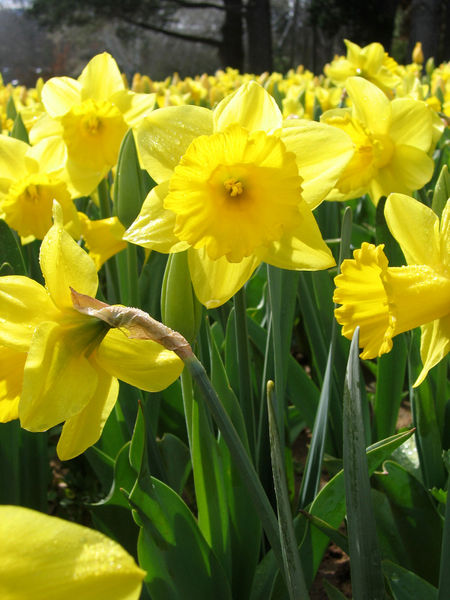 The common daffodil, also known as a narcissus (which has an interesting etymology of its own), is a hardy bulb that flowers mainly in the spring. In Middle English the flower was known as affodil, coming from the Latin asphodelus, meaning "asphodel", which is basically another name for daffodils and some other plants in the lily family.* The flower first made its appearance (as affodill) in the English language around 1420.
The mystery is, of course, how we got from the Middle English affodil to the Modern English daffodil. Where did that d come from? The OED has a number of theories:
It has been variously suggested as due to childish or playful distortion, as in Ted for Edward, tante for aunt; to union of the article th' (cf. COTGR., Affrodille, Th'Affodill, and north. Eng. t'affadil); to final d of and, in (e.g.) ‘fennell an-d affodil’; to union of the Dutch or Flemish article, as de affodil = the affodil; and to Fr. prep. d' as in fleur d'aphrodille...*Asphodel is also the flower that blooms along the plains of Hades. It was a favorite food of the dead and it takes little imagination to imagine toga-wearing zombies grazing on the asphodel pastures of the Elysium fields:
down the dank(Odyssey 24.5-9, translation by Robert Fagles)
moldering paths and past the Ocean's streams they went
and past the White Rock and the Sun's Western Gates and past
the Land of Dreams, and soon they reached the fields of asphodel
where the dead, the burnt-out wraiths of mortals make their home
Labels: Dutch, Flemish, Latin, Middle English, The Daily Hump
Thursday, November 16, 2006
The Daily Hump: Dandelion
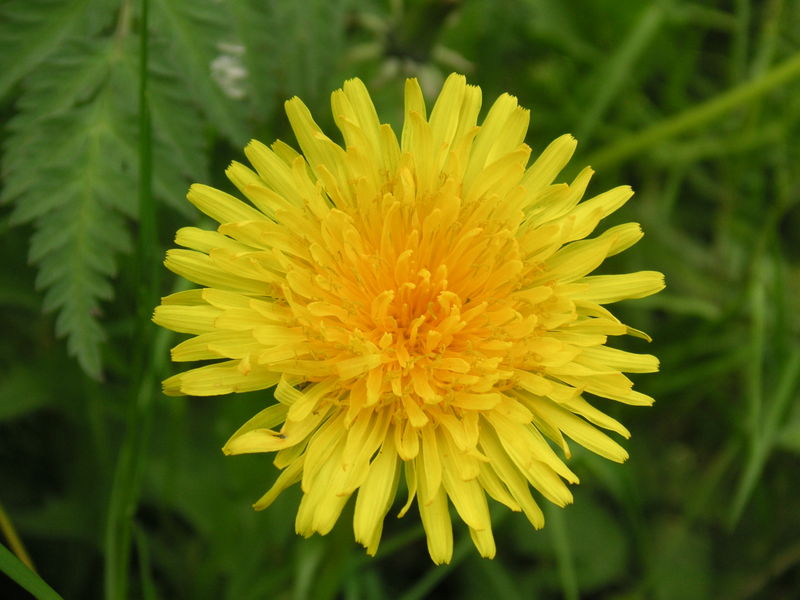 I owned an album when I was very young, "Dandelions Never Roar"; even to a 3-year-old the title's pun was plainly obvious. But it wasn't until 25 years later that I wondered whether this common flower really had a feline namesake or whether the similarities in name were purely coincidental.
I'm now able to report that this is not a coincidence. Speakers of Middle English called the dandelion dent-de-lioun. From here it's pretty easy to see the Old French (dent-de-lion) influence and translate the root; "tooth of lion". This description of course refers to the flower's sharply indented leaves. As the AHD reports,
The English spelling reflects the pronunciation of the Old French word at the time it was borrowed into English. The t in dentdelion probably disappeared early in Old French, having been absorbed into the related sound of the d. The earliest recorded instance of the word occurs in an herbal written in 1373, but we find an instance of dandelion used in a proper name (Willelmus Dawndelyon) in a document dated 1363.
 It's interesting to note that in Modern French the name for the flower has absolutely nothing to do with lions or teeth; the word is pissenlit, which amusingly translates to "urinate in bed". As Wikipedia states this likely refers to the flower's well-known diuretic properties. The dandelion's herbal properties are also what gives it its genus, Taraxacum. Botanical.com says that
 Taraxacum...is derived from the Greek taraxos (disorder), and akos (remedy), on account of the curative action of the plant. A possible alternative derivation of Taraxacum is suggested in The Treasury of Botany:In any event, next time you travel to Paris, drink too much wine and piss your sheets, just claim it was the dandelion.The generic name is possibly derived from the Greek taraxo ("I have excited" or "caused") and achos (pain), in allusion to the medicinal effects of the plant.
Labels: Middle English, Old French, The Daily Hump
Tuesday, October 31, 2006
The Daily Hump: The Bogeyman
From ghoulies and ghosties and long-leggety beastiesThe Cornish language, today only spoken by about 3,500 people, is of the Brythonic group of Celtic languages along with Welsh and Breton. It is generally believed that from this group we find the etymology of our modern day bogeyman. Specifically, bogey may be a cognate of the Welsh bwgwl, meaning "terror, terrifying". As Michael Quinion observes
And things that go bump in the night, Good Lord, deliver us!
The Welsh root word bwg gave rise to the long-obsolete word bug for a hobgoblin, which now survives only in bugbear, a dreadful bearlike apparition that ate naughty children, a more terrifying idea than the modern weakened sense of something merely vexatious or annoying. Another closely related word is bugaboo. Possibly also related is the barghest, a goblin which appeared in the form of a large, black dog and which portended doom...This obsolete form, bug, is related to the Middle English bugge, a frightening specter, which is ultimately the source of the modern bogey, also sometimes spelled bogy. Bogey is a quasi-proper name that often refers to the devil. The OED noted that in an 1887 survey older people remembered hearing the word in this form as far back as 1825 although written evidence only goes back as far as 1836-1840.
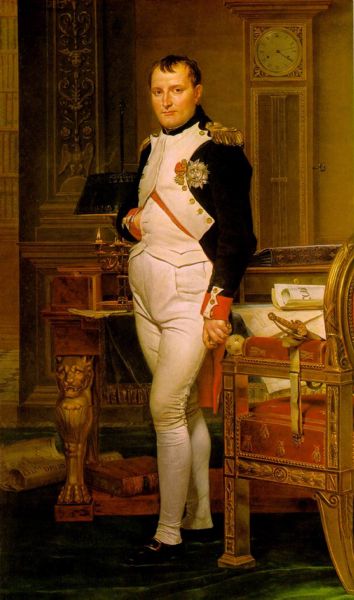 Wikipedia lays out a few alternate theories of the Bogeyman's etymology including:
...a reference to Napoleon Bonaparte, who was nicknamed "Boney" by the British. Boney was certainly used as a threat to British children of the time, and it is claimed that Boney became Boneyman, which became Bogeyman.In addition to haunting the bedrooms of children, the bogeyman made his presence known on many a golf course where bogey originally meant "the number of strokes a good player may be reckoned to need for the course or for a hole" (since the 1940s bogey has meant a score of one stroke over par for a hole). The OED quotes the following annecdote:
It may also have been derived from the Bugis people of Indonesia, feared pirates who preyed on shipping in the Straits of Malacca. According to this latter theory, European sailors who encountered them took their tales back to the Old World, telling stories of the "bugismen" to scare their children into behaving.
Still other sources trace the etymology through "boggy man" back to the bog men found from time to time preserved out in the peat bogs. According to this story, the fear was that the bog men would come walking off the moors like zombies.
One popular song at least has left its permanent effect on the game of golf. That song is ‘The Bogey Man’. In 1890 Dr. Thos. Browne, R.N., the hon. secretary of the Great Yarmouth Club, was playing against a Major Wellman, the match being against the ‘ground score’, which was the name given to the scratch value of each hole. The system of playing against the ‘ground score’ was new to Major Wellman, and he exclaimed, thinking of the song of the moment, that his mysterious and well-nigh invincible opponent was a regular ‘bogey-man’. The name ‘caught on’ at Great Yarmouth, and to-day ‘Bogey’ is one of the most feared opponents on all the courses that acknowledge him (1908 M.A.P. 25 July 78/1).And in case you were curious (I was) boogies (also known as boogers, rhinolith or dried snot) first appeared in American slang dictionaries in the 1890s, suggesting its use in common parlance much much earlier. Alas, whether they have anything to do with the bogeyman is anyone's guess.
Stay tuned for later in the week when I hump hobgoblins, jack-o'-lanterns and bugaboos.
Labels: Breton, Cornish, Middle English, The Daily Hump, Welsh Gaelic
Thursday, October 26, 2006
The Daily Hump: Genitive Herpes
 Now that that's out of the way, today I thought we'd do something a bit different and not hump a word but rather the morpheme 's. Have you ever sat around and wondered why we use a 's to denote possession? You probably haven't, but that's where you and I differ. I've studied a few other languages including Latin, Old Norse and French and none of these use a 's. As far as my admittedly limited knowledge demonstrates, the 's is a purely English phenomenon and I'm determined to figure out why (or at least where it came from).
If you've studied Latin, or most other languages where meaning is not dependent on word order, you've probably studied cases, and more specifically the genitive case. In simplistic terms the genitive case is the series of manipulations you make to a word to show that it possesses something. For instance, puella in Latin means "the girl", yet puellae servus would mean "the girl's slave". This -ae ending is the genitive suffix (feminine singular in this instance). As you see in this example the genitive -ae directly translates to our modern English 's. Thus, one could argue that the 's is the English genitive ending. One could argue this, but one would be considered wrong.
Sure, once upon a time you'd be considered correct. Back then linguists called the 's a saxon genitive. This name harkens back to English's Germanic roots; however, the more savvy modern linguist has come to realize that the 's is not representative of a genitive case at all, but rather it has become a (prepare to giggle) clitic. Think of a clitic as the remora of linguistics, a functional parasitic word that cannot live on its own and must be combined with a host. A good example would be the l' in the French l'eau (the water). Anyway, here's a classic example of why the 's is considered clitic and not representative of a genitive case: "The king of Sparta's wife was called Helen." If 's was a genetive ending then Helen would be the wife of Sparta, however, obviously Helen is the wife of the king, thus the 's is not showing possession directly, but is instead functioning a bit more abstractly.
Regardless of our modern constructions of possession, the 's started off as a genitive ending. In Old English the genitive ending was -es, so the apostrophe in our 's once upon a time substituted for the missing e, much like how apostrophes signify missing letters in everyday contractions such as didn't and we'll (but not gn'fn'r because I can't figure our what letters the apostrophes are substituting).
Why the apostrophe came into use when showing possession is up for debate. In Christina Cavella and Robin A. Kernodle's paper How the Past Affects the Future: The Story of the Apostrophe, they point out that some experts believe the apostrophe
is "a mere printer’s gimmick, doubtless born of the mistaken notion that the genitive ending was a contraction of his". An invention of mortals, the apostrophe has indeed been subject to human error. The –es genitive ending,Despite all this, in Modern English remnants of the genitive case live on in some of our pronouns: whose, my/mine, his/hers/its, our/ours, their/theirs.often spelled and pronounced –ies or –ys in early Middle English, was confused as early as the thirteenth century with his, the possessive of he, so that Shakespeare could later write ‘the count his gally’, and even expressions like ‘my sister her watch’ appeared (qtd. in Hook, 1999, pp. 44-45).The unstressed pronunciation of the genitive –es seemed to have caused many speakers to believe they were saying his. This usage presumably caused pronunciation problems and gender confusion with a noun such as woman or girl, or a plural noun like winners, but nevertheless was quite common (Hook, 1975, p.160). The apostrophe became a sort of "compromise" to indicate either the missing –e in the genitive ending –es, or the hi of the mistaken possessive indicator his (Hook, 1999, p. 45).
Genitive Case [Wikipedia]
Labels: Latin, Middle English, Old English, The Daily Hump
Friday, October 20, 2006
The Daily Hump: Mushrooms and Toadstools
 There's so much to say about mushrooms and toadstools from a historical and cultural perspective that I wouldn't know where to begin nor is WordHumper the forum to explore the intricacies of my favorite fungi. The best I can do is suggest you read Elio Schaecter's excellent In The Company of Mushrooms*. As for me, I'll be limiting this discourse to purely an etymological examination.
Mushroom comes to us from the Medieval Latin musariō, musariōn- via Old French, Anglo-Norman then finally Middle English. Per the Online Etymology Dictionary:
Barnhart says [mushroom is] "of uncertain origin." Klein calls it "a word of pre-Latin origin, used in the North of France;" OED says it usually is held to be a derivative of Fr. mousse "moss," and Weekley agrees, saying it is properly "applied to variety which grows in moss."Don't worry, I don't know who Banhart, Klein or Weekley are either.
Toadstool is one of my favorite words in the English language. The OED and many other dictionaries explain the word as "fanciful"; a compound of toad + stool that was first coined in Middle English. Toads were regarded as extremely poisonous and toadstools generally only refer to inedible or poisonous mushrooms. In my readings I also happened upon an alternate etmology which suggests that toadstool had nothing to do with toads but rather the German tod, death. As Wikipedia states:

The term [toadstool] dates from the fourteenth century and is a fanciful [there is that word again!] name combining toad, which were associated with poison, and stool, which is an archaic term for the head of a mushroom. Another explanation comes from the German translation of tod-stuhl, literally, "death-chair," referring to the shape of the fruiting body and also to the slow, agonizing death from mushroom poisoning for those who eat it.Regardless of which etymology is correct, toadstools are named for their toxicity. Given the association of toads with poison I investigated whether the English toad could be related to the German tod; alas, the OED claims that although toad can be traced as far back as to the Old English tādige it has no cognates in other languages and is thus considered of unknown origin.**
In conclusion, next time you're shrooming with the hippies, smelling a stinky phallus, hanging out with the hobbits, Smurfs, mycologists, or Brothers Mario, or just eating a slice of pizza stop and think about what a lousy and boring world we'd live in without the ubiquitous mushroom.***
*Completely unrelated, I also suggest you read Spy: The Funny Years.
 **It should be noted that Princess Toadstool is the best character available in Super Mario Bros 2 (photo: SMB1). Obviously, I'm not the only person who wondered why Mario would be romantically involved with someone whose last name is based upon a fungus responsible for "slow, agonizing death"; in late 1996 Nintendo changed her name to Peach. So gay.
***I'll be out of the country for a few days so the next hump will be on Wednesday.
Labels: Anglo-Norman, German, Medieval Latin, Middle English, Old English, Old French, The Daily Hump
Thursday, October 19, 2006
The Daily Hump: Akimbo
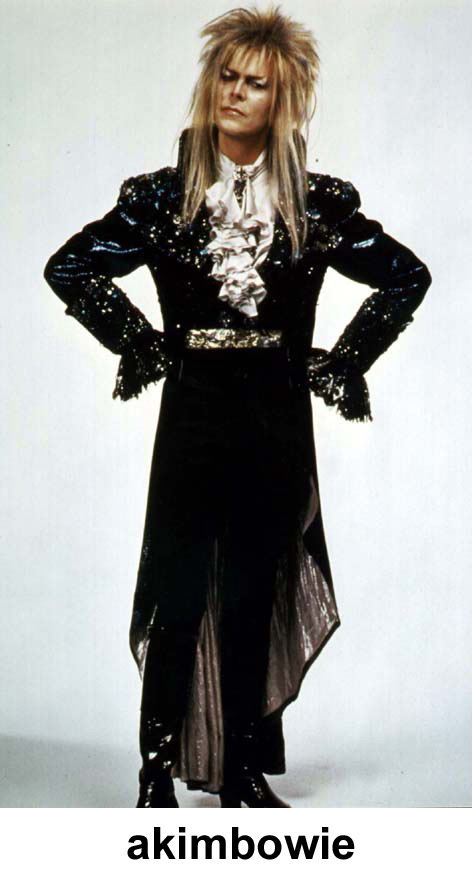 Akimbo surprises me. Given its -bo ending I ignorantly assumed it had African roots (think Mande languages of the upper Niger River valley or our English word mumbo jumbo). In fact, the word can be traced back to Middle English, first appearing in the early 15th c. text The Tale of Beryn ("The hoost..set his hond in kenebowe"). We know in is our modern in. The -bowe corresponds to our modern English bow, as in something that is bent, a knot with two loops or the weapon used to launch arrows. It's the kene portion which stumps the experts. Because of this single element historical linguists have a great deal of difficulty tracing the word's etymology pre-1400.
The OED is kind enough to suggest two possibilities. The first theory focuses around the Middle English phrase a cambok which meant "in the manner of a crooked stick". Thus, analagously, a cam bow would be "in the manner of a crooked bow". The second theory suggests that akimbo is related to the Old Norse keng-boginn which literally means "bent staple-wise, or in a horse-shoe curve". The OED deems neither of these theories wholly satisfactory:
The difficulty as to a-cambok, a cam bow, is that no forms of the word [akimbo] show cam-, from which the earliest are the most remote. The Icel. keng-boginn comes nearer the form, but there is no evidence that it had the special sense of a-kimbo, and none that the latter ever had the general sense of ‘crooked.’ It also postulates an early Eng. series of forms like *keng-bown or *keng-bowed, *keng-bow, *akengbow, quite unknown and unaccounted for.
Labels: Mande, Middle English, Old Norse, The Daily Hump
Tuesday, October 10, 2006
The Daily Hump: I've got wood...
 ...wainscotting, that is. For those of you who aren't involved in home decorating wainscotting is either the panel (usually wood) that's applied to walls of rooms or it's the lower part of a wall when its finish is different than the upper portion. Although now mainly decorative, its original purpose was to cover the lower part of walls which were often subjected to rising dampness. In more general terms wainscot is a high quality type of oak imported from either Russia, Germany or the Netherlands.
 Marge Simpson: This house has such beautiful wainscotting.Marge is right. Per the American Heritage Dictionary wainscot is a Middle English word from the Middle Dutch waghenscot. It's likely that waghen- is related to the Dutch wagen or our word wagon as wainscot may have referred to the quality of wood used in carriage construction. The suffix -scot simply means "partition".
Mrs. Quimby: Marge, I didn't know you were into wainscotting.
Marge: I read an article about it at the tire store. Did you know it's not named after someone named Wayne Scott?
Woah...hold your horses there, American Heritage. The OED isn't too quick to define -scot as partition. In fact, it doesn't at all--simply saying the ending has an "uncertain meaning". Even the the waghen- portion is up for debate with a 16th century source saying the word is from the Flemish waeghe, wave, referring to the undulations in the grain of the wood. Some modern scholars suspect the prefix comes from the Middle Dutch weeg, wall. The OED stands by its contention that wain- really is from wagon- although it admits the original meaning of the compound word is a mystery.
It's interesting to note that there is a word wain that appears in Middle English and up through dialectal Modern English meaning a large open vehicle, such as a wagon. Both wain and wagon can be traced back to the Indogermanic root *wegh- or *wogh- meaning "to carry". This root also gives us modern words of common usage such as weigh and way.
For you Hamptons folks, you've likely blinked and missed the hamlet of Wainscott (note: two t's--population 628) while heading out to your Amagansett house. In researching the etymology I uncovered this from Newsday.com:
Four years after East Hampton Town was founded in 1648, the first mention of the rich soil of Wainscott occurs in official records, citing an order that "a cartway shall be laid out to Wainscott where it may be most convenient.''
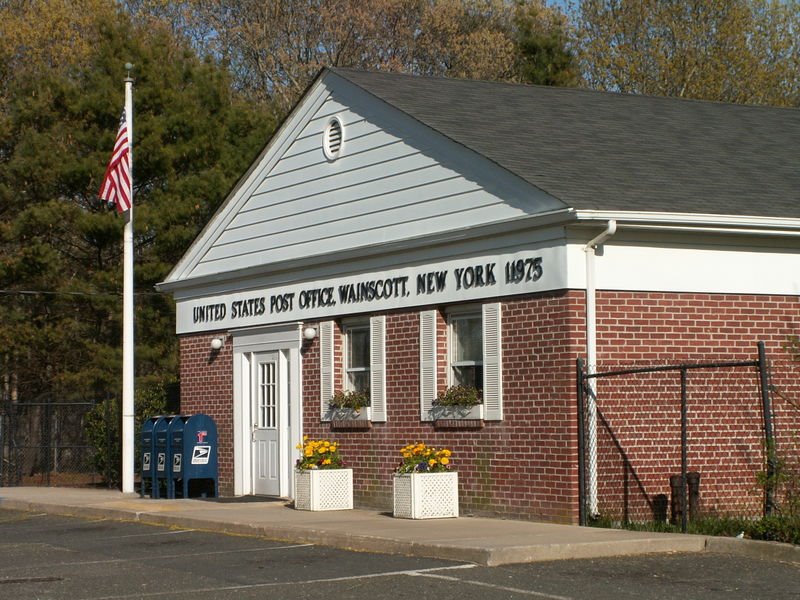 Wainscott post office: note lack of wainscotting
Given the OED's definition of wain is it possible that Wainscott received its name because of this "cartway"? That'd be cool, but no. Per Wikipedia the hamlet was named after a village north of Maidstone, England.
Labels: Middle Dutch, Middle English, PIE, The Daily Hump
Friday, September 29, 2006
TRJ: Cuckoo for Cuckold Puffs
Today's special in the history of WordHumper because we're inaugurating "Total Request Jive" or "TRJ" for short. This will be a weekly Friday feature where you the WordHumper reader decide which lucky word gets humped back to the stoneage (or at least to Proto-Indo-Europa). And today's word comes to us from CH in Brooklyn who IMs:
CH: i want you to hump "cuckold"
CH: i bet it's dirty
 I accept your challenge, CH! Cuckold goes back to the Old French word for the cuckoo bird. Because it's Friday and I'm lazy and the research has already been done let's go right to the blockquote from American Heritage.
 The female of some Old World cuckoos lays its eggs in the nests of other birds, leaving them to be cared for by the resident nesters. This parasitic tendency has given the female bird a figurative reputation for unfaithfulness as well. Hence in Old French we find the word cucuault, composed of cocu, “cuckoo, cuckold,” and the pejorative suffix –ald and used to designate a husband whose wife has wandered afield like the female cuckoo. An earlier assumed form of the Old French word was borrowed into Middle English by way of Anglo-Norman. Middle English cokewold, the ancestor of Modern English cuckold, is first recorded in a work written around 1250.The OED adds that in German cuckold
...applied to the adulterer as well as the husband of the adulteress, and Littré cites an assertion of the same double use in French; in English, where cuckold has never been the name of the bird, we do not find it applied to the adulterer.You may have heard that cuckolds are sometimes "wearing the horns"--if you're into egregious acts of humiliation you'll be happy to learn that this refers to an apocryphal tradition that claims in some European villages when a wife gives birth to a child recognizably not his own a parade is held "...in which the hapless husband is forced to wear antlers on his head as a symbol of his wife’s infidelity". Ouch.
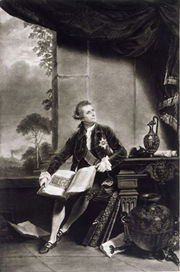 It should be noted that although cuckold does have a rather negative connotation not all men who suffered this fate were necessarily unhappy. In fact a wittol is a man who doesn't mind that his wife is servicing the neighborhood. This comes from the Middle English wetewold, which is composed of the verb weten (to know), and (coke)wold, which, as we saw above means cuckold. The most famous of wittols is likely Sir William Hamilton (left) whose wife Emma became the lover of Horatio Nelson.
On a side note, the Middle English weten is also responsible for our Modern English word wit. And in case you're wondering how cuckoo came to mean a foolish or crazy person, I'm sorry to say sources are vague at best. The OED simply notes that a person is called cuckoo in reference to the "bird's monotonous call."
wittol [American Heritage]
wit [American Heritage]
wittol [OED]
cuckold [OED]
cuckoo [OED]
cuckold [Wikipedia]
cuckoo [Wikipedia]
William Hamilton [Wikipedia]
Labels: Anglo-Norman, Middle English, Old French, TRJ
Thursday, September 28, 2006
The Daily Hump: Rigmarole
Rigmarole, a common enough word meaning a confused, rambling, petty discourse or a succession of lame tasks, is apparently an alteration of Ragman Roll. Ah, yes, the famous Ragman Roll...wait, what the hell is a Ragman Roll? It's time for some hot and heavy blockquote action beginning with our friends at Wikipedia:
And per the OED the Ragman Roll appointed "justices [of King Edward I] to hear and determine complaints of injuries done within 25 years previous" (a list of complaints could certainly be considered a rigmarole in our modern sense of the word). The American Heritage and Merriam Webster dictionaries say that Ragman Roll is from the Middle English Ragmane Rolle, which was a scroll used in Ragman, a game of chance. Per the OED Ragman wasRagman Rolls the name given to the collection of instruments by which the nobility and gentry of Scotland were compelled to subscribe allegiance to King Edward I of England between the Conference of Norham in May 1291 and the final award in favor of Baliol in November 1292 and again in 1296.
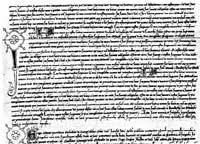
a. A game of chance, app. played with a written roll having strings attached to the various items contained in it, one of which the player selected or ‘drew’ at random. In one form the game was a mere amusement, the items in the roll being verses descriptive of personal character.Who was King Ragman? It's possible he was a King Ragemon le Bon, no relation to Simon, who had a number of verses written about him around the year 1290. Michael Quinion over at World Wide Words points out that some believe the name of the game Ragman came "from rag in the sense of tatters, used as a name for a devil (as in ragamuffin, originally a demon)." The Ragemon le Bon theory seems much more likely given that it can't be mere coincidence that King Eddie I issued his so-called Ragman Roll at the Conference of Norham just one year after the Ragemon verses were written.
b. King Ragman, feigned to be the author of the roll used in playing the game.
In conclusion, here's the timeline as I see it:
Circa 1290: Versus are written about King Ragemon le Bon, which spawns a game, Ragman
May 1291: Conference of Norham - King Edward I issues his Ragman Roll, so named because for whatever reason it reminded people of the game Ragman
Sometime later: Ragman Roll comes to mean a rambling discourse
Mid 18th c: Per the OED, the word rig-my-role starts appearing meaning a rambling discourse
Late 18th c: Rigmarole appears with modern spelling
*Pure poppycock, actually--monkey kung fu *always* distracts us.
Labels: Middle English, Middle French, The Daily Hump
Monday, September 25, 2006
The Daily Hump: What's next, Gormagons?
First, let's begin with the Gormagon, which was recently featured as Michael Quinion's "Weird Word". A Gormagon can be one of two things; it's
A monster with six eyes, three mouths, four arms, eight legs, five on one side and three on the other, three arses, two tarses [penises], and a cunt upon its backFunny enough, a Gormagon can also refer to a member of an 18th century society that imitated the Freemasons. The etymology is pretty much unknown with the OED claiming it's a nonsenical word that has "pseudo-Chinese" roots ("1725 Two Letters in Grand Mystery of Freemasons (ed. 2) 13 The Venerable Order of Gormogons having been brought into England by a Chinese Mandarin.")
 I wonder whether the word is related to Gorgon, the three snake-haired sisters of which Medusa is the most well-known. Gorgon is from a Greek word meaning "terrible" and the Gormagon certainly seems terrible. In case you're wondering Gorgonzola cheese is named after a village near Milan and has no connection to Gorgons from what I can tell; however, I might be wrong.
Next up, next. If we trace the history of the English language back through time we eventually hit a point where it does not exist as a distinguishable language of its own. We know Middle English came before Modern English and Old English came even earlier, but what language gave birth to Old English? The answer is Old Frisian, a language spoken on the European North Sea coast from the 8th to 16th centuries. The people who settled in England from the 4th century onward came from these shores and brought with them their vocabulary, including the word next.
Next started off as the superlative form of nigh or near. Around the late 14th century, the word nighest came in to existence, followed by nearest in the 15th century. Around the same time that next fell out of fashion in the superlative sense the OED notes "The notion of greatest proximity tends to be merged into that of adjacency, either within a sequence or series or simply as regards physical location." Henceforth, next began its next life meaning "immediately following."
Gormagon [OED]
Gorgon [OED]
next [OED]
Old Frisian [Wikipedia]
Labels: Chinese, Greek, Middle English, Old English, Old Frisian, The Daily Hump
Friday, September 15, 2006
The Daily Hump: Mating Season
 We all know what a stalemate is. In chess this is a result when the person whose turn it is has no allowable moves and their king is not in check. More figuratively, a stalemate refers to any situation which ends in a draw. Likewise, when a stalemate occurs in chess the game is drawn. Before we delve into the etymology, I think it's interesting to note that a stalemate did not always result in no winner. Per the OED,
In England from the 17th c. to the beginning of the 19th c. the player who received stalemate won the game. Various other rules have been in vogue at different times; sometimes the player giving stalemate won, either wholly or to the extent of half the stake; sometimes the last few moves had to be played over again until a mate resulted; sometimes the piece causing the obstruction was removed.Up until the 18th c. the situation we now call a stalemate was simply known as a stale. For whatever reason the word mate was later appended as a suffix. It's generally believed that the word stale harkens back to the Old French estaler (to come to a standstill). Mate is simply a shortened form of checkmate, and a stalemate could not logically involve a checkmate, thus the word stalemate is a misnomer. On a side note, estaler was adopted into Middle English and spawned our modern verb stall.
Our modern word checkmate comes from the Middle English checkmat which was from the Old French eschec mat which goes back even further to the Arabic šāh māt, literally "the king is dead." The Arabic šāh, meaning "king", was borrowed from the Persian shāh--a title that was used by the monarchs of Iran, most recently by the leader deposed in the 1979 Iranian Revolution.
The plural form of checkmate's Old French ancestor, eschec mat is esches. In Middle English esches was shortened to simply ches, which is where, of course, we find our word for the game itself, chess.
Thus, linguistically speaking, chess is truly the game of kings.
stalemate [OED]
checkmate [OED]
Labels: Arabic, Middle English, Old French, Persian, The Daily Hump
Friday, September 08, 2006
The Daily Hump: Hobnob
 It wasn't until Shakespeare came along that we see the first compounded use of hob and nob meaning something beyond the literal "to have and have not." In Twelfth Night Viola states "His incensement..is so implacable, that satisfaction can be none, but by pangs of death and sepulcher: Hob, nob, is his word: giu't or take't." Pleasantly for the modern etymologist Shakespeare contextually defines the 1601 meaning of "hob, nob" as "to give or take."
 Around the middle of the 18th century the verb hobnob begins popping up rather frequently to mean "to drink together." In a literal sense, it still retained the meaning of giving and taking; specifically what was being given and taken was the wine of two drinkers as their glasses clinked together during a toast. We all know that drinking breeds chumminess and today the word simply means "to associate familiarly."
Of course, that's not the whole story. Back in Shakespeare's time, before the give and take aspect of hobnob was associated with wine, an adverbial definition appeared--hit or miss. Hit or miss shares an obvious linguistic symmetry with give and take and have and have not. This meaning endured well into the 20th century, although today this definition has been rendered virtually obsolete by hobnob's more popular verb form.
Hobnob [OED]
Labels: Middle English, Shakespeare, The Daily Hump
