Monday, February 26, 2007
TWiEL: Wymysorys
You're familiar with the quasi-weekly Hump This and of course you know The Daily Hump, that weekday feature that's been more regular than a sixty-five year old full of prune juice. Well, this week I'm happy to introduce two new features: Mondays' This Week in Endangered Languages (TWiEL) and Wednesdays' I Live for Dead Tongues (ILfDT).
Endangered languages make me sad. Like endangered animals they're just steps away from disappearing from this earth forever. As Wikipedia notes
TWiEL will be relying a lot on Wikipedia's List of endangered languages so I'll be using their definition for determining whether a language is endangered: it must have less than 1,000 speakers and be in rapid decline. I maintain this column as an appreciation for the shrinking universe which these languages describe. Today we're going to start with the waning Wymysorys.
Wymysorys
Language family: Indo-European, Germanic, West Germanic, High German
Writing system: Latin alphabet
Where you'll hear it: Wilamowice, Poland
 The origins: "Wymysorys appears to derive from 12th century Middle High German, with a strong influence from Low German, Dutch, Frisian, Polish and Old English. The inhabitants of Wilamowice are thought to be descendants of Dutch, German and Scottish settlers who arrived in Poland in the 13th century. However, the inhabitants of Wilamowice always refused any connections with Germany and proclaimed their Dutch origins."
Famous speakers: poet Florian Biesik
The beginning of the end: "After World War II, local communist authorities forbade the use of the language. Despite the fact that the ban was lifted after 1956, Wymysorys has been gradually replaced by Polish, especially amongst the younger generations."
And today: 70 speakers
Example:
Endangered languages make me sad. Like endangered animals they're just steps away from disappearing from this earth forever. As Wikipedia notes
While there are somewhere around six or seven thousand languages on Earth today, about half of them have fewer than about 3,000 speakers. Experts predict that even in a good scenario, about half of today's languages will go extinct within the next fifty to one hundred years.Sure, unlike extinct animals, we can occassionally resurrect an extinct language but it hasn't happened to often (Wikipedia shows only 13 examples). Some people even argue that language extinction is good
...fewer languages means better and clearer communications among the majority of speakers. The economic cost of maintaining myriad separate languages, and their translator caretakers, is enormous.Humbug. Languages are invaluable; they are unique and hold within their grammar, lexicon and oral traditions thousands of clues about the identities of the speakers and how they live. To delete a language is to permanently destroy windows into these cultures. This line of thinking condones abuse of the minority by the majority and is nothing more than a form of cultural whitewashing.
TWiEL will be relying a lot on Wikipedia's List of endangered languages so I'll be using their definition for determining whether a language is endangered: it must have less than 1,000 speakers and be in rapid decline. I maintain this column as an appreciation for the shrinking universe which these languages describe. Today we're going to start with the waning Wymysorys.
Wymysorys
Language family: Indo-European, Germanic, West Germanic, High German
Writing system: Latin alphabet
Where you'll hear it: Wilamowice, Poland
 The origins: "Wymysorys appears to derive from 12th century Middle High German, with a strong influence from Low German, Dutch, Frisian, Polish and Old English. The inhabitants of Wilamowice are thought to be descendants of Dutch, German and Scottish settlers who arrived in Poland in the 13th century. However, the inhabitants of Wilamowice always refused any connections with Germany and proclaimed their Dutch origins."
Famous speakers: poet Florian Biesik
The beginning of the end: "After World War II, local communist authorities forbade the use of the language. Despite the fact that the ban was lifted after 1956, Wymysorys has been gradually replaced by Polish, especially amongst the younger generations."
And today: 70 speakers
Example:
Śłöf duy buwła fest!
Skumma frmdy gest,
Skumma muma ana fettyn,
Z' brennia nysła ana epułn,
Śłöf duy Jasiu fest!
Sleep, my boy, soundly!
Foreign guests are coming,
Aunts and uncles are coming,
Bringing nuts and apples,
Sleep Johnny sound
Labels: Dutch, Germanic, High German, Indo-European, Low German, Middle High German, Old English, Old Frisian, Polish, TWiEL, West Germanic, Wymysorys

Monday, September 25, 2006
The Daily Hump: What's next, Gormagons?
Today you get two words for the price of one hump.
First, let's begin with the Gormagon, which was recently featured as Michael Quinion's "Weird Word". A Gormagon can be one of two things; it's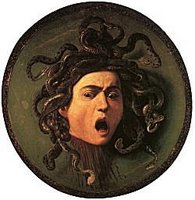 I wonder whether the word is related to Gorgon, the three snake-haired sisters of which Medusa is the most well-known. Gorgon is from a Greek word meaning "terrible" and the Gormagon certainly seems terrible. In case you're wondering Gorgonzola cheese is named after a village near Milan and has no connection to Gorgons from what I can tell; however, I might be wrong.
Next up, next. If we trace the history of the English language back through time we eventually hit a point where it does not exist as a distinguishable language of its own. We know Middle English came before Modern English and Old English came even earlier, but what language gave birth to Old English? The answer is Old Frisian, a language spoken on the European North Sea coast from the 8th to 16th centuries. The people who settled in England from the 4th century onward came from these shores and brought with them their vocabulary, including the word next.
Next started off as the superlative form of nigh or near. Around the late 14th century, the word nighest came in to existence, followed by nearest in the 15th century. Around the same time that next fell out of fashion in the superlative sense the OED notes "The notion of greatest proximity tends to be merged into that of adjacency, either within a sequence or series or simply as regards physical location." Henceforth, next began its next life meaning "immediately following."
Gormagon [OED]
Gorgon [OED]
next [OED]
Old Frisian [Wikipedia]
First, let's begin with the Gormagon, which was recently featured as Michael Quinion's "Weird Word". A Gormagon can be one of two things; it's
A monster with six eyes, three mouths, four arms, eight legs, five on one side and three on the other, three arses, two tarses [penises], and a cunt upon its backFunny enough, a Gormagon can also refer to a member of an 18th century society that imitated the Freemasons. The etymology is pretty much unknown with the OED claiming it's a nonsenical word that has "pseudo-Chinese" roots ("1725 Two Letters in Grand Mystery of Freemasons (ed. 2) 13 The Venerable Order of Gormogons having been brought into England by a Chinese Mandarin.")
 I wonder whether the word is related to Gorgon, the three snake-haired sisters of which Medusa is the most well-known. Gorgon is from a Greek word meaning "terrible" and the Gormagon certainly seems terrible. In case you're wondering Gorgonzola cheese is named after a village near Milan and has no connection to Gorgons from what I can tell; however, I might be wrong.
Next up, next. If we trace the history of the English language back through time we eventually hit a point where it does not exist as a distinguishable language of its own. We know Middle English came before Modern English and Old English came even earlier, but what language gave birth to Old English? The answer is Old Frisian, a language spoken on the European North Sea coast from the 8th to 16th centuries. The people who settled in England from the 4th century onward came from these shores and brought with them their vocabulary, including the word next.
Next started off as the superlative form of nigh or near. Around the late 14th century, the word nighest came in to existence, followed by nearest in the 15th century. Around the same time that next fell out of fashion in the superlative sense the OED notes "The notion of greatest proximity tends to be merged into that of adjacency, either within a sequence or series or simply as regards physical location." Henceforth, next began its next life meaning "immediately following."
Gormagon [OED]
Gorgon [OED]
next [OED]
Old Frisian [Wikipedia]
Labels: Chinese, Greek, Middle English, Old English, Old Frisian, The Daily Hump
