Thursday, March 01, 2007
Hump This: Squirrel
 Hump This is a (quasi-)weekly Friday feature where you, the WordHumper reader, choose which lucky word gets humped back to the stoneage (or at least to Proto-Indo-Europa). Today's request comes from RM in California who writes:
 Dear Wordhumper,RM, thanks for the question--our word squirrel comes to us via the Anglo-Norman esquirel circa 1327. Is it a coincidence that the word appears a mere twenty years before the black death ravaged Europe and just one decade before the launch of the Hundred Years' War? I don't think so. That being said, the squirrel made it into Old French (escurel) via the Latin sciurus, which came from the Greek skiouros, literally meaning "shadow-tailed." The notion is squirrels have large bushy tails which allow them to easily shade themselves. Fascinating.
Like so many in my close knit family, I have an affinity for rodents and in particular, squirrels. Once, I saw a show on some cable channel I no longer get that said the word 'squirrel' comes from a greek word meaning something along the lines of, 'covers head with his tail for shade'. I could be totally wrong because this was awhile ago. So, where does the word 'squirrel' come from?
 If you have a word you'd like humped please email it along with your city or state to wordhumper@gmail.com. To paraphrase Q-Tip of A Tribe Called Quest, the ladies sweat my Wordhump style like the squirrels sweat the nuts.
squirrel [Online Etymology Dictionary]
Labels: Anglo-Norman, Greek, Hump This, Latin, Old French

Friday, January 26, 2007
Hump This: Maelstrom
 Hump This is a (quasi-)weekly Friday feature where you, the WordHumper reader, choose which lucky word gets humped back to the stoneage (or at least to Proto-Indo-Europa). Today's request comes from AM in Brooklyn, Norway who writes:
 I'm a Viking princess and am leading a fleet of longships on an RPP* raid of an idyllic Christian village of peasant farmers. However, my friend Thorvald the Berserker warned me of some nasty maelstrom action off the coast of Norway. What's up with maelstrom? Sounds Dutch.AM, how right you are! Maelstrom, which has become a generic term for a large whirlpool or turbulent situation, started off life as a proper noun on Dutch maps of the 17th (or possibly 16th) century and referred to a massive whirlpool in the Arctic Ocean off the Lofoten Islands of Norway**. The first definitive use of maelstrom is from a 1673 book written by a pastor living in the Faroes, but despite what those tricky Faroese would have you believe the word is of Dutch origin, literally meaning "grinding-stream." The first element mael, comes from the Dutch verb malen, meaning "to grind" and is the root of our modern English word meal.
 Have fun storming the village!
If you have a word you'd like humped please email it, along with your location, to wordhumper.
*RPP: Rape, pillage, plunder - a favorite Viking pasttime
**The Lofotens also happen to be home of the village of Å, which is my favorite name for a town anywhere in the world.
maelstrom [OED]
Friday, January 12, 2007
Hump This: Tampon
 Hump This is a (quasi-)weekly Friday feature where you, the WordHumper reader, choose which lucky word gets humped back to the stoneage (or at least to Proto-Indo-Europa). Today we're ridin' the cotton pony with CH of Brooklyn who writes:
 Talk to me about tampons. Why aren't they called vagina plugs?You'll need to thank the French that when Cap'n Bloodsnatch comes to town you're not rifling through your purse searching for a "vagina plug". But don't thank them too much because as it happens tampon actually means "plug" in Middle French. Similarly, we have a word in English tampion which is the plug or cover one uses for a muzzle of a gun or cannon to keep out the moisture.
And next time you saddle up to the bar for a pint keep this in mind: tampon can ultimately be traced back to the Proto-Germanic *tappon meaning "stopper, faucet", which happens to be the ancestor of our modern English word tap.
Hey, barkeep, I'll have a Red Stripe.
If you have a word you'd like humped please email it, along with your location, to wordhumper.
tap [Online Etymology Dictionary]
tampion [Online Etymology Dictionary]
tampion [AHD]
tampon [AHD]
Tampontification Euphemisms [Seventh Generation]
Labels: Hump This, Middle French, Proto-Germanic
Friday, January 05, 2007
Hump This: Sham
First, a big shoutout (one word? two words? hyphenated?) to Katy Oliver's mom who is an avowed WordHumping fan. Mrs. O, I'd love to send you a copy of my book All I Really Need to Know About Humping I Learned in Kindergarten but I haven't written it yet.
Second, a big dis to tickets.com. I was on your site at 8:55 this morning waiting for 9AM when the Arcade Fire tickets were to go on sale. I refreshed my browser tirelessly figuring I could score just 2 tickets to one of the 5 shows the AF were playing. Ten minutes later all the shows were sold out. You can't tell me that all these NYU brats/hipsters were up at 9AM buying tickets. I don't buy it. Thus, I dis you.
Now on to the humpage--
 Hump This is a (quasi-)weekly Friday feature where you, the WordHumper reader, choose which lucky word gets humped back to the stoneage (or at least to Proto-Indo-Europa). Today's word comes from AM in Brooklyn who asks:
Sham, which first appears as slang (in both noun and verb forms) around 1677, quickly came into frequent use. The word is of curious origin. Both the AHD and the Online Etymology Dictionary suggest sham is a northern dialectal form of shame. The OED disputes this idea, however, noting that although this theory is plausible "the alleged origin does not seem to account satisfactorily for the sense in the early examples."
If you have a word you'd like humped please email it, along with your location, to wordhumper.
UPDATE: I guess I won't be getting AF tix anytime soon. (Thanks for the link, A)
Second, a big dis to tickets.com. I was on your site at 8:55 this morning waiting for 9AM when the Arcade Fire tickets were to go on sale. I refreshed my browser tirelessly figuring I could score just 2 tickets to one of the 5 shows the AF were playing. Ten minutes later all the shows were sold out. You can't tell me that all these NYU brats/hipsters were up at 9AM buying tickets. I don't buy it. Thus, I dis you.
Now on to the humpage--
 Hump This is a (quasi-)weekly Friday feature where you, the WordHumper reader, choose which lucky word gets humped back to the stoneage (or at least to Proto-Indo-Europa). Today's word comes from AM in Brooklyn who asks:
 What's up with sham? Bed shams, pillow shams, and Sham the thoroughbred who placed second to Secretariat in the 1973 Kentucky Derby. That horse was a sham! I lost big money!Calm down, Esse! The AHD gives one definition of sham as "A decorative cover made to simulate an article of household linen and used over or in place of it." This sense of "simulation" is what connects say pillow sham to the sham which defines a state of deceitfulness and fakery.
Sham, which first appears as slang (in both noun and verb forms) around 1677, quickly came into frequent use. The word is of curious origin. Both the AHD and the Online Etymology Dictionary suggest sham is a northern dialectal form of shame. The OED disputes this idea, however, noting that although this theory is plausible "the alleged origin does not seem to account satisfactorily for the sense in the early examples."
If you have a word you'd like humped please email it, along with your location, to wordhumper.
UPDATE: I guess I won't be getting AF tix anytime soon. (Thanks for the link, A)
Labels: Hump This
Friday, December 22, 2006
Hump This: Pussyfoot
 Hump This is a (quasi-)weekly Friday feature where you, the WordHumper reader, choose which lucky word gets humped back to the stoneage (or at least to Proto-Indo-Europa). Today's word comes from BL in New York who writes:
 I would like for you to look into the origins of the word "pussyfoot." And please don't half-ass it.Personally, I have a feeling BL knows EXACTLY where this word comes from being that it obviously means to move stealthily like a cat, but she (or he...I don't give away the identities of WH readers) gets off on using words that, shall we say, have multiple shades of meaning.
I noticed that per the OED the first recorded use of pussyfoot is from 1893 in reference to "Men who were beginning to walk pussy-footed and shy at shadows." Men who "shy at shadows" strike me as being pussies (in our modern cowardly sense of the word). This is interesting because again, per the OED, it seems that the word pussy, in both the anatomical and effeminate senses, had a small usage boom in the latter half of the 19th c., which ties in nicely to the coinage of pussyfoot. Thus, it seems possible that the advent of pussyfooting may not have been solely dependent on feline gait, but rather the word contains a hint of pure, unadulturated pussiness.
If you have a word you'd like humped please email it, along with your location, to wordhumper.
Labels: Hump This
Friday, December 15, 2006
Hump This: Fanatics
Hump This is a (quasi-)weekly Friday feature where you, the WordHumper reader, choose which lucky word gets humped back to the stoneage (or at least to Proto-Indo-Europa). Today's word comes from MK in New York who writes:
Fan is originally of American origin, late 19th c., and was used in reference to baseball. It's obviously an abbreviated form of fanatic although it's possible it was influenced by an early 19th c. term Fancy, which the Online Etymology Dictionary describes as "a collective term for followers of a certain hobby or sport (especially boxing)." Fancy or not, it's immediately apparent that since its humble baseball beginnings fan was never meant to achieve the connotative gravitas of fanatic.
Interestingly, fanatic's Latin root fanum is also related to the Latin festus which gives us our words feast and festival.
If you have a word you'd like humped please email it, along with your location, to wordhumper.
Fan and Fanatic [Online Etymology Dictionary]
Fanatic [AHD]
Fanatic [OED]
Fan [OED]
You are a word humping fanatic. You should hump that at some point, since fan and fanatic come from the same root but one means crazy (sometimes celebrity killing) person.You're right, MK. I am both a word humping fan and fanatic. Fanatic made its English language debut in the first half of the 16th c. to mean an insane person. It comes from the Latin fanum, meaning temple, and is a reference to the sometimes over-the-top orgiastic rites practiced in pagan Rome. Its sense of extreme zealousness first appeared in the mid-17th c.
Fan is originally of American origin, late 19th c., and was used in reference to baseball. It's obviously an abbreviated form of fanatic although it's possible it was influenced by an early 19th c. term Fancy, which the Online Etymology Dictionary describes as "a collective term for followers of a certain hobby or sport (especially boxing)." Fancy or not, it's immediately apparent that since its humble baseball beginnings fan was never meant to achieve the connotative gravitas of fanatic.
Interestingly, fanatic's Latin root fanum is also related to the Latin festus which gives us our words feast and festival.
If you have a word you'd like humped please email it, along with your location, to wordhumper.
Fan and Fanatic [Online Etymology Dictionary]
Fanatic [AHD]
Fanatic [OED]
Fan [OED]
Friday, December 08, 2006
Hump This: Governor/Gubernatorial
Hump This is a (quasi-)weekly Friday feature where you, the WordHumper reader, choose which lucky word gets humped back to the stoneage (or at least to Proto-Indo-Europa). Today's word comes from RM in California who asks:  In order to understand the differences in spelling let's start by looking at govern.
Govern enters the English language at the end of the 13th c. via Old French. The French, in turn, had gotten the word from the Latin gubernare, which originally had the meaning "to steer (a ship)". The Latin word comes from the Greek kybernan, also meaning "to steer or pilot", and which, incidentally happens to be the root of our word cybernetics. Now you understand why cyborgs run the government.
Gubernatorial is a chiefly American word that first appeared in 1734 in reference to "The [New Jersey] Governor in his gubernatorial Capacity". Apparently the colonial Americans assumed the Latin verb gubernare must have had an associated adjective construction, gubernatorius, despite lacking evidence of this form.
So, gubernatorial was contrived directly from the Latin versus governor which found its form via the normal transformations common to centuries of usage.
If you have a word you'd like humped please email it, along with your location, to wordhumper.
Gubernatorial [OED]
Govern [OED]
Gubernatorial [Online Etymology Dictionary]
I would like you to explore governor/gubernatorial. I see how the words are related.. sort of. B's and V's are related and vowels have drifted but why? What happened?
 In order to understand the differences in spelling let's start by looking at govern.
Govern enters the English language at the end of the 13th c. via Old French. The French, in turn, had gotten the word from the Latin gubernare, which originally had the meaning "to steer (a ship)". The Latin word comes from the Greek kybernan, also meaning "to steer or pilot", and which, incidentally happens to be the root of our word cybernetics. Now you understand why cyborgs run the government.
Gubernatorial is a chiefly American word that first appeared in 1734 in reference to "The [New Jersey] Governor in his gubernatorial Capacity". Apparently the colonial Americans assumed the Latin verb gubernare must have had an associated adjective construction, gubernatorius, despite lacking evidence of this form.
So, gubernatorial was contrived directly from the Latin versus governor which found its form via the normal transformations common to centuries of usage.
If you have a word you'd like humped please email it, along with your location, to wordhumper.
Gubernatorial [OED]
Govern [OED]
Gubernatorial [Online Etymology Dictionary]
Labels: Greek, Hump This, Latin, Old French
Friday, December 01, 2006
Hump This: Pimp My Etymology
Hump This is a (quasi-)weekly Friday feature where you, the WordHumper reader, choose which lucky word gets humped back to the stoneage (or at least to Proto-Indo-Europa). Today's word comes from RM in California who asks:
 1) It's been suggested that pimp has a connection with the German Pimpf meaning "small boy" but the German word appears much later than the English pimp (c. 1600) and thus any causal relationship seems unlikely. Plus, there are apparently a number of semantic differences.
2) The second suggestion, which is what I would have guessed, is that pimp is short for pimpernel, scarlet-colored or otherwise. But again, the OED claims there are semantic irregularities.
3) There are a number of possible French roots including pimpant (seductive in appearance), pimper (to adorn) and pimpernol, which is a small eel (and is surprisingly not etymologically related to pimpernel at all). The OED dismisses any connections to these words as merely coincidental.
However, the Online Etymology Dictionary, citing a mysterious source "Weekley", offers this li'l nugget of linguistic gold:
If you have a word you'd like humped please email it, along with your location, to wordhumper.
Where does the word "pimp" come from?The American Heritage Dictionary sometimes disappoints me. Effort counts for something in life and sometimes the AHD just doesn't try very hard. Case in point, its entry for the word pimp: "Origin Unknown". Now, the OED also says pimp's origin is unknown however it lists a myriad of possibilities then strikes them down one-by-one. I appreciate this. Let's take a look at what the OED has to say:
 1) It's been suggested that pimp has a connection with the German Pimpf meaning "small boy" but the German word appears much later than the English pimp (c. 1600) and thus any causal relationship seems unlikely. Plus, there are apparently a number of semantic differences.
2) The second suggestion, which is what I would have guessed, is that pimp is short for pimpernel, scarlet-colored or otherwise. But again, the OED claims there are semantic irregularities.
3) There are a number of possible French roots including pimpant (seductive in appearance), pimper (to adorn) and pimpernol, which is a small eel (and is surprisingly not etymologically related to pimpernel at all). The OED dismisses any connections to these words as merely coincidental.
However, the Online Etymology Dictionary, citing a mysterious source "Weekley", offers this li'l nugget of linguistic gold:
Weekley suggests [Middle French] pimpreneau, defined in Cotgrave [?] (1611) as "a knave, rascall, varlet, scoundrell."So, there you go. Now where's my money, bitch?
If you have a word you'd like humped please email it, along with your location, to wordhumper.
Friday, November 17, 2006
Hump This: Cat

Hump This is a (quasi-)weekly Friday feature where you, the WordHumper reader, choose which lucky word gets humped back to the stoneage (or at least to Proto-Indo-Europa). Today's word comes from RM in California who asks:
You already humped goat but what about cat? I think it must come from [the French] chat but where'd THAT come from? Not Latin, clearly.It's a simple enough word and probably one of the first words most people learn to spell. The OED reports cat is traced as far back as records go for all modern European languages suggesting "extensive communication". Alas, it is because cat can be found in virtually all these languages over the past 2,000 years (the first recorded appearance of the word in Europe is the Latin catta, 1st c. CE) that it becomes practically impossible to pinpoint the word's origin.
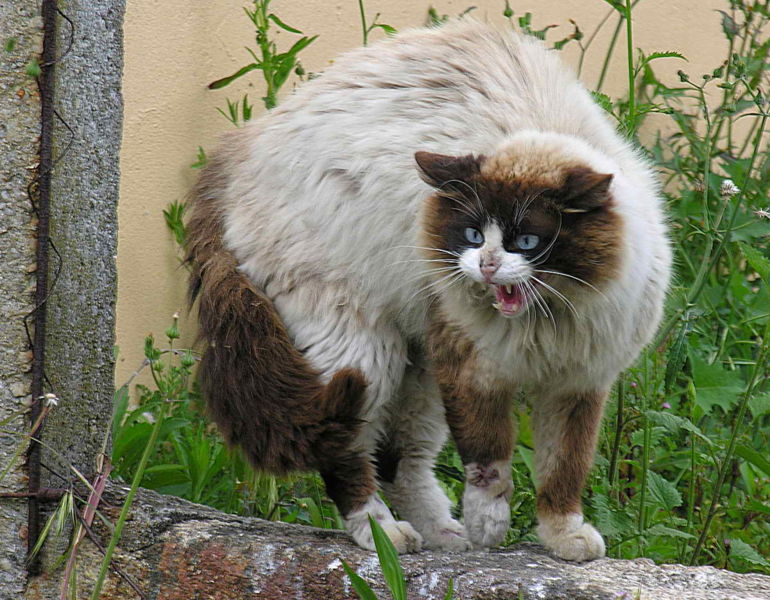 That being said, cats have been kept by humans since ancient Egyptian times and most likely our modern word cat comes from this region (cf. Nubian kadis, Berber kadiska, both meaning "cat").
If you have a word you'd like humped please email it, along with your location, to wordhumper.
cat [Online Etymology Dictionay]
Tuesday, August 22, 2006
Hump This: Heckle
 Heckle: heck·le
Inflected forms: heck·led, heck·ling, heck·les
1. To try to embarrass and annoy (someone speaking or performing in public) by questions, gibes, or objections; badger.
2. To comb (flax or hemp) with a hatchel.
[Source:The American Heritage® Dictionary of the English Language: Fourth Edition. 2000.]
To comb flax or hemp with a hatchel? Who knew! I though heckling was just amusing one's self at another's expense. Now I like it even more.
Labels: Guest Hump, Hump This
