Tuesday, February 27, 2007
The Daily Hump: Of Kilts, Tartans and Tartars*
 Kilt first makes an appearance in the English language as a type of tartaned skirt in the early 18th c. Our noun actually came from a now little-used verb form meaning "to tuck up." This word came to us via the Middle English kilten, meaning "to tuck up" (is "to tuck up" a Britishism for "to tuck in"? Anyone? Bueller?) Going back further kilt seems to be from a Scandinavian source as witnessed by the Old Norse kilting and kjalta meaning skirt or lap.
The word tartan likely comes to us via the Middle French tiretaine which referred to a "strong, coarse fabric." This can be traced back to Old French and then to the Medieval Latin tyrius meaning "cloth from Tyre." It's also possible the word was influenced by the Middle English tartaryn, also a type of cloth, which comes from Old French but is ultimately rooted in the word Tartar.
And speaking of Tartars, the tartar on your teeth is from the Greek tartaron which referred to the gunk settled to the side of casks. The Greek term is believed to be of Arabic origin unlike the proper noun Tartar which is said to be from Tata, a name the Mongols gave themselves, with some spicy influence from the Latin Tartarus, aka hell.
kilt [OED]
kilt [Online Etymology Dictionary]
tartar [OED]
Tartar [OED]
tartan [OED]
tartan [AHD]
Tartar [Online Etymology Dictionary]
*The Daily Hump is not really daily anymore--it'll now only be published on Tuesdays and Thursdays, so it really should be The Semiweekly Hump, but that name is dumb and plus I'd have to eat those rebranding costs, etc...thus, The Daily Hump it is. That being said, daily or not, there is still a new WordHumper post every weekday and thus you always have a good reason to come back now, y'hear?
Labels: Greek, Medieval Latin, Middle English, Middle French, Old French, Old Norse, The Daily Hump

Thursday, February 22, 2007
The Daily Hump: Darn!
Today I was wondering; does the lame exclamation darn have anything to do with mending socks? Answer: no.
 Darn, in the quasi-curse sense, is an American creation that was said to have originated in Puritanical New England where it was a punishable offense to say the word damn. It's thought that darn was likely influenced by 'tarnal (supposedly a favorite exclamation of Andrew Jackson), which is short for eternal, as in By the Eternal.
Darn, in the mending sense, is likely from the Middle French darner, meaning "to mend." This goes back to the Breton "piece, fragment, part," which ultimately traces back to the Proto-Indo-European root *der-, meaning "tear" (as in "rip"). And *der- also happens to be the root for our word tear, which came to modern English via Proto-Germanic then Old English.
darn [Online Etymology Dictionary]
tear (v) [Online Etymology Dictionary]
 Darn, in the quasi-curse sense, is an American creation that was said to have originated in Puritanical New England where it was a punishable offense to say the word damn. It's thought that darn was likely influenced by 'tarnal (supposedly a favorite exclamation of Andrew Jackson), which is short for eternal, as in By the Eternal.
Darn, in the mending sense, is likely from the Middle French darner, meaning "to mend." This goes back to the Breton "piece, fragment, part," which ultimately traces back to the Proto-Indo-European root *der-, meaning "tear" (as in "rip"). And *der- also happens to be the root for our word tear, which came to modern English via Proto-Germanic then Old English.
darn [Online Etymology Dictionary]
tear (v) [Online Etymology Dictionary]
Labels: Breton, Middle French, Old English, PIE, Proto-Germanic, The Daily Hump
Friday, January 12, 2007
Hump This: Tampon
 Hump This is a (quasi-)weekly Friday feature where you, the WordHumper reader, choose which lucky word gets humped back to the stoneage (or at least to Proto-Indo-Europa). Today we're ridin' the cotton pony with CH of Brooklyn who writes:
 Talk to me about tampons. Why aren't they called vagina plugs?You'll need to thank the French that when Cap'n Bloodsnatch comes to town you're not rifling through your purse searching for a "vagina plug". But don't thank them too much because as it happens tampon actually means "plug" in Middle French. Similarly, we have a word in English tampion which is the plug or cover one uses for a muzzle of a gun or cannon to keep out the moisture.
And next time you saddle up to the bar for a pint keep this in mind: tampon can ultimately be traced back to the Proto-Germanic *tappon meaning "stopper, faucet", which happens to be the ancestor of our modern English word tap.
Hey, barkeep, I'll have a Red Stripe.
If you have a word you'd like humped please email it, along with your location, to wordhumper.
tap [Online Etymology Dictionary]
tampion [Online Etymology Dictionary]
tampion [AHD]
tampon [AHD]
Tampontification Euphemisms [Seventh Generation]
Labels: Hump This, Middle French, Proto-Germanic
Thursday, September 28, 2006
The Daily Hump: Rigmarole
There's always a frenetic energy at WordHumper HQ--a potent glee as we dive into the inner-workings of a new word each weekday morning. But sometimes, every once in a while, we stumble upon a word with such a meandering history that mere mention of its etymology turns even the most peaceful of lexicographers in to a raging pugilist. On days such as these an excitement so palpable hangs in the air that even monkey kung fu cannot distract us from the tasks at hand.*
Rigmarole, a common enough word meaning a confused, rambling, petty discourse or a succession of lame tasks, is apparently an alteration of Ragman Roll. Ah, yes, the famous Ragman Roll...wait, what the hell is a Ragman Roll? It's time for some hot and heavy blockquote action beginning with our friends at Wikipedia:
In conclusion, here's the timeline as I see it:
Circa 1290: Versus are written about King Ragemon le Bon, which spawns a game, Ragman
May 1291: Conference of Norham - King Edward I issues his Ragman Roll, so named because for whatever reason it reminded people of the game Ragman
Sometime later: Ragman Roll comes to mean a rambling discourse
Mid 18th c: Per the OED, the word rig-my-role starts appearing meaning a rambling discourse
Late 18th c: Rigmarole appears with modern spelling
*Pure poppycock, actually--monkey kung fu *always* distracts us.
Rigmarole, a common enough word meaning a confused, rambling, petty discourse or a succession of lame tasks, is apparently an alteration of Ragman Roll. Ah, yes, the famous Ragman Roll...wait, what the hell is a Ragman Roll? It's time for some hot and heavy blockquote action beginning with our friends at Wikipedia:
And per the OED the Ragman Roll appointed "justices [of King Edward I] to hear and determine complaints of injuries done within 25 years previous" (a list of complaints could certainly be considered a rigmarole in our modern sense of the word). The American Heritage and Merriam Webster dictionaries say that Ragman Roll is from the Middle English Ragmane Rolle, which was a scroll used in Ragman, a game of chance. Per the OED Ragman wasRagman Rolls the name given to the collection of instruments by which the nobility and gentry of Scotland were compelled to subscribe allegiance to King Edward I of England between the Conference of Norham in May 1291 and the final award in favor of Baliol in November 1292 and again in 1296.
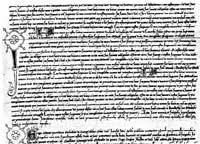
a. A game of chance, app. played with a written roll having strings attached to the various items contained in it, one of which the player selected or ‘drew’ at random. In one form the game was a mere amusement, the items in the roll being verses descriptive of personal character.Who was King Ragman? It's possible he was a King Ragemon le Bon, no relation to Simon, who had a number of verses written about him around the year 1290. Michael Quinion over at World Wide Words points out that some believe the name of the game Ragman came "from rag in the sense of tatters, used as a name for a devil (as in ragamuffin, originally a demon)." The Ragemon le Bon theory seems much more likely given that it can't be mere coincidence that King Eddie I issued his so-called Ragman Roll at the Conference of Norham just one year after the Ragemon verses were written.
b. King Ragman, feigned to be the author of the roll used in playing the game.
In conclusion, here's the timeline as I see it:
Circa 1290: Versus are written about King Ragemon le Bon, which spawns a game, Ragman
May 1291: Conference of Norham - King Edward I issues his Ragman Roll, so named because for whatever reason it reminded people of the game Ragman
Sometime later: Ragman Roll comes to mean a rambling discourse
Mid 18th c: Per the OED, the word rig-my-role starts appearing meaning a rambling discourse
Late 18th c: Rigmarole appears with modern spelling
*Pure poppycock, actually--monkey kung fu *always* distracts us.
Labels: Middle English, Middle French, The Daily Hump
